


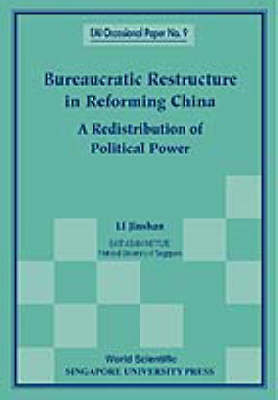
Bureaucratic Restructure In Reforming China: A Redistribution Of Political Power
Seiten
1998
World Scientific Publishing Co Pte Ltd (Verlag)
978-981-02-3706-6 (ISBN)
World Scientific Publishing Co Pte Ltd (Verlag)
978-981-02-3706-6 (ISBN)
- Titel z.Zt. nicht lieferbar
- Portofrei ab CHF 40
- Auch auf Rechnung
- Artikel merken
Since the introduction of the Dengist reform in the late 1970s, the state bureaucracy in China has experienced four major restructurings, each entailed the redistribution of political power. This text covers the four restructurings whilst exploring this field from the 1970s through to 1998.
Since the introduction of the Dengist reform in the late 1970s, the state bureaucracy in China has experienced four major restructurings, each of which entailed the redistribution of political power. According to the purpose and scale of reorganization, the restructuring of the State Council can be divided into two stages. At the first stage, covering the period 1982 to 1997, Deng Xiaoping and his Executives, Zhao Ziyang and Li Peng, restructured part of the government administration in order to integrate market forces into the central-planning system. The integration was not smooth because of the struggles between reformers and conservatives, so the restructuring met with a backlash. After the Ninth National People's Congress in March 1998, the restructuring has entered its second stage, characterized by a radical retrenchment of government organizations and employees both at the central and local levels. In carrying this out, Zhu Rongji intends to relinquish government links with enterprises, thus pushing the “socialist market economy” further ahead.
Since the introduction of the Dengist reform in the late 1970s, the state bureaucracy in China has experienced four major restructurings, each of which entailed the redistribution of political power. According to the purpose and scale of reorganization, the restructuring of the State Council can be divided into two stages. At the first stage, covering the period 1982 to 1997, Deng Xiaoping and his Executives, Zhao Ziyang and Li Peng, restructured part of the government administration in order to integrate market forces into the central-planning system. The integration was not smooth because of the struggles between reformers and conservatives, so the restructuring met with a backlash. After the Ninth National People's Congress in March 1998, the restructuring has entered its second stage, characterized by a radical retrenchment of government organizations and employees both at the central and local levels. In carrying this out, Zhu Rongji intends to relinquish government links with enterprises, thus pushing the “socialist market economy” further ahead.
Introduction - reforming a socialist planning-style bureacracy. Approaches to the Chinese administration; reorganisation for Socialist market economy; reorganization for a market economy.
| Reihe/Serie | East Asian Institute Contemporary China Series ; 9 |
|---|---|
| Verlagsort | Singapore |
| Sprache | englisch |
| Themenwelt | Sozialwissenschaften ► Politik / Verwaltung ► Politische Systeme |
| Sozialwissenschaften ► Politik / Verwaltung ► Staat / Verwaltung | |
| ISBN-10 | 981-02-3706-5 / 9810237065 |
| ISBN-13 | 978-981-02-3706-6 / 9789810237066 |
| Zustand | Neuware |
| Informationen gemäß Produktsicherheitsverordnung (GPSR) | |
| Haben Sie eine Frage zum Produkt? |
Mehr entdecken
aus dem Bereich


aus dem Bereich
Das politische System der USA und die Zukunft der Demokratie
Buch | Hardcover (2025)
C.H.Beck (Verlag)
CHF 39,20
Russland, Europa, Amerika
Buch | Softcover (2025)
C.H.Beck (Verlag)
CHF 25,20


