


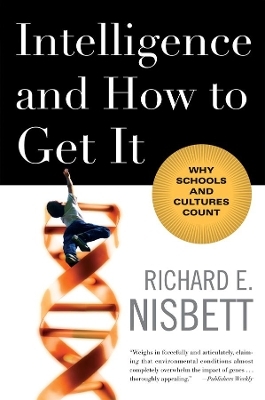
Intelligence and How to Get It
Why Schools and Cultures Count
Seiten
2010
WW Norton & Co (Verlag)
978-0-393-33769-3 (ISBN)
WW Norton & Co (Verlag)
978-0-393-33769-3 (ISBN)
- Lieferbar (Termin unbekannt)
- Portofrei ab CHF 40
- Auch auf Rechnung
- Artikel merken
“[Nisbett] weighs in forcefully and articulately . . . [using] a thoroughly appealing style to engage . . . throughout.”—Publishers Weekly
Who are smarter, Asians or Westerners? Are there genetic explanations for group differences in test scores? From the damning research of The Bell Curve to the more recent controversy surrounding geneticist James Watson’s statements, one factor has been consistently left out of the equation: culture. In the tradition of Stephen Jay Gould’s The Mismeasure of Man, world-class social psychologist Richard E. Nisbett takes on the idea of intelligence as biologically determined and impervious to culture with vast implications for the role of education as it relates to social and economic development. Intelligence and How to Get It asserts that intellect is not primarily genetic but is principally determined by societal influences.
Who are smarter, Asians or Westerners? Are there genetic explanations for group differences in test scores? From the damning research of The Bell Curve to the more recent controversy surrounding geneticist James Watson’s statements, one factor has been consistently left out of the equation: culture. In the tradition of Stephen Jay Gould’s The Mismeasure of Man, world-class social psychologist Richard E. Nisbett takes on the idea of intelligence as biologically determined and impervious to culture with vast implications for the role of education as it relates to social and economic development. Intelligence and How to Get It asserts that intellect is not primarily genetic but is principally determined by societal influences.
Richard E. Nisbett is Theodore M. Newcomb Distinguished University Professor of Psychology at the University of Michigan and Research Professor at Michigan’s Institute for Social Research. He has taught courses in social psychology, cultural psychology, cognitive psychology, and evolutionary psychology. His research focuses on how people from different cultures think, perceive, feel, and act in different ways. He is the recipient of the Distinguished Scientific Contribution Award of the American Psychological Association and the William James Fellow Award of the American Psychological Society and is a member of the National Academy of Sciences and the American Academy of Arts and Sciences.
| Erscheint lt. Verlag | 19.3.2010 |
|---|---|
| Verlagsort | New York |
| Sprache | englisch |
| Maße | 140 x 211 mm |
| Gewicht | 328 g |
| Themenwelt | Geisteswissenschaften ► Psychologie ► Allgemeine Psychologie |
| Sozialwissenschaften | |
| ISBN-10 | 0-393-33769-3 / 0393337693 |
| ISBN-13 | 978-0-393-33769-3 / 9780393337693 |
| Zustand | Neuware |
| Informationen gemäß Produktsicherheitsverordnung (GPSR) | |
| Haben Sie eine Frage zum Produkt? |
Mehr entdecken
aus dem Bereich

aus dem Bereich
Paket bestehend aus »Das Patienten-Manual« und »Das Trainer-Manual«
Buch | Softcover (2025)
Schattauer (Verlag)
CHF 125,95
Lernen, Emotion, Motivation, Gedächtnis
Buch | Softcover (2025)
Beltz (Verlag)
CHF 39,20


