


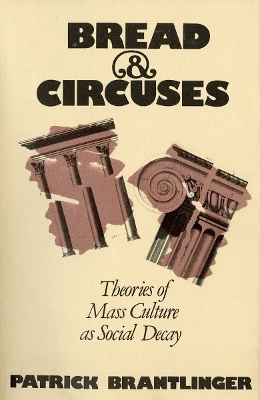
Bread and Circuses
Theories of Mass Culture As Social Decay
Seiten
2016
Cornell University Press (Verlag)
978-0-8014-9338-6 (ISBN)
Cornell University Press (Verlag)
978-0-8014-9338-6 (ISBN)
Lively and well written, Bread and Circuses analyzes theories that have treated mass culture as either a symptom or a cause of social decadence. Discussing many of the most influential and representative theories of mass culture, it ranges widely from Greek and Roman origins, through Marx, Nietzsche, Freud, Ortega y Gasset, T. S. Eliot, and the...
Lively and well written, Bread and Circuses analyzes theories that have treated mass culture as either a symptom or a cause of social decadence. Discussing many of the most influential and representative theories of mass culture, it ranges widely from Greek and Roman origins, through Marx, Nietzsche, Freud, Ortega y Gasset, T. S. Eliot, and the theorists of the Frankfurt Institute, down to Marshall McLuhan and Daniel Bell, Brantlinger considers the many versions of negative classicism and shows how the belief in the historical inevitability of social decay—a belief today perpetuated by the mass media themselves—has become the dominant view of mass culture in our time. While not defending mass culture in its present form, Brantlinger argues that the view of culture implicit in negative classicism obscures the question of how the media can best be used to help achieve freedom and enlightenment on a truly democratic basis.
Lively and well written, Bread and Circuses analyzes theories that have treated mass culture as either a symptom or a cause of social decadence. Discussing many of the most influential and representative theories of mass culture, it ranges widely from Greek and Roman origins, through Marx, Nietzsche, Freud, Ortega y Gasset, T. S. Eliot, and the theorists of the Frankfurt Institute, down to Marshall McLuhan and Daniel Bell, Brantlinger considers the many versions of negative classicism and shows how the belief in the historical inevitability of social decay—a belief today perpetuated by the mass media themselves—has become the dominant view of mass culture in our time. While not defending mass culture in its present form, Brantlinger argues that the view of culture implicit in negative classicism obscures the question of how the media can best be used to help achieve freedom and enlightenment on a truly democratic basis.
Patrick Brantlinger is James Rudy Professor of English (Emeritus) at Indiana University. He is the author of many books, including Dark Vanishings, Fictions of State, Rule of Darkness, and Bread and Circuses, all from Cornell.
1. Introduction: The Two Classicisms
2. The Classical Roots of the Mass Culture Debate
3. "The Opium of the People"
4. Some Nineteenth-Century Themes: Decadence, Masses, Empire, Gothic Revivals
5. Crowd Psychology and Freud's Model of Perpetual Decadence
6. Three Versions of Modern Classicism: Ortega, Eliot, Camus
7. The Dialectic of Enlightenment
8. Television: Spectacularity vs. McLuhanism
9. Conclusion: Toward Post-Industrial Society
| Erscheint lt. Verlag | 1.11.2016 |
|---|---|
| Verlagsort | Ithaca |
| Sprache | englisch |
| Maße | 152 x 229 mm |
| Gewicht | 454 g |
| Themenwelt | Schulbuch / Wörterbuch ► Lexikon / Chroniken |
| Sozialwissenschaften ► Ethnologie | |
| Sozialwissenschaften ► Soziologie | |
| ISBN-10 | 0-8014-9338-2 / 0801493382 |
| ISBN-13 | 978-0-8014-9338-6 / 9780801493386 |
| Zustand | Neuware |
| Informationen gemäß Produktsicherheitsverordnung (GPSR) | |
| Haben Sie eine Frage zum Produkt? |
Mehr entdecken
aus dem Bereich



aus dem Bereich
Buch (2024)
Urban & Fischer in Elsevier (Verlag)
CHF 39,95
für Studium und Ausbildung
Buch | Softcover (2024)
Franz Vahlen (Verlag)
CHF 41,70
Buch | Softcover (2022)
Methusalem (Verlag)
CHF 29,90


