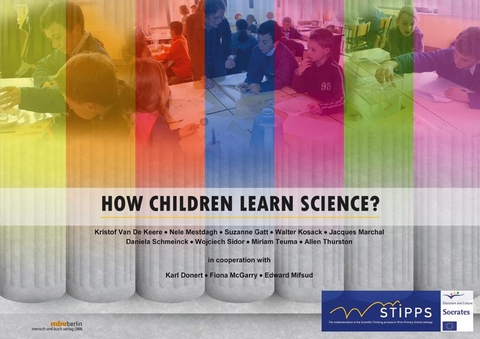
How Children learn science?
Mensch & Buch (Verlag)
978-3-86664-519-6 (ISBN)
- Keine Verlagsinformationen verfügbar
- Artikel merken
Improving learning and teaching in science is as important today as it has ever been. Major debates are taking place in the scientific community, the political debating chambers, within the media and amongst the general public at large. Some of the issues that are driving these debates are human cloning, nanotechnology, global warming and the potential of alternative fuels. To fully engage and be stake holders in these debates it is vital that citizens are informed about science.
The ability to think in a scientific manner to approach problems in a logical and coherent way is a desirable outcome of schooling for young persons. Not only is scientific thinking important for the cognitive development of young persons, then it also provides them with skills that may be able to be transferred to other learning and social contexts. This aspect of science literacy is a cornerstone of the Scientific Thinking in (Pre) Primary School Settings (STIPPS) project. The project emphasises cognitive development of scientific reasoning in (pre) primary school education and provides materials for continuing professional development of teachers in this area. The project presents a research led model for what constitutes effective methods of learning and teaching in science.
Children come to school with powerful resources (in terms of their previous learning and skills at investigating how the world works) on which science instruction can build. Even young children can learn to explain natural phenomena, design and conduct empirical investigations, and engage in meaningful evidence-based argumentation. This makes it necessary to question and reflect on the best approaches to learning and teaching in science. The STIPPS project presents a research led theoretical model that debates how and why peer learning should be an effective approach to learning and teaching in science.
Through the use of appropriate pedagogical approaches, teachers can build on the previous knowledge, understanding and skills that children bring to school. The tutor can play a central role in promoting children’s curiosity and independence, by directing their attention, structuring their experiences, supporting and scaffolding their learning, and regulating the complexity and difficulty of levels of information for them. Both teachers and peer tutors can play an important part in helping children fulfil these critical goals.
The STIPPS project focuses on what teachers and peer tutors can do to structure, support and develop the knowledge and understanding of scientific process skills. In order to do this it presents a learning line for the development of science process skills and suggests how these skills can be developed in children in an increasingly complex manner. Curricular materials and exemplars from classrooms throughout Europe seek to illustrate good practice in science teaching. The learning lines are illustrated with resources such as good practices, video clips and lesson plans. The learning lines discuss:
- The effective use of peer learning
- Effective communication skills for learning
- Effective social skills for learning
- Effective classroom organization
- Learning needs to be active
- Ensuring lessons are at the right level
- Children learning science through the scientific thinking circle
- Scaffolding and building learning (mediation)
Through (inter)national workshops and the website http://www.stipps.info, the project and its conclusions are promoted. In this way STIPPS wants to contribute to building democracies across Europe that have citizens that are stake holders in science by virtue of their enhanced levels of scientific literacy. Such literacy is of fundamental importance for Europe’s continued growth and development.
KATHO – Katholieke Hogeschool Zuid-West-Vlaanderen - Tielt, Belgium Kristof Van De Keere (kristof.vandekeere@katho.be) Nele Mestdagh (nele.mestdagh@katho.be) University of Education, Karlsruhe, Germany Walter Kosack (walter.kosack@ph-karlsruhe.de) Daniela Schmeinck (daniela.schmeinck@ph-karlsruhe.de) Academic Inspection, Nancy, France Jacques Marchal (j.marchal@ac-nancy-metz.fr) Teacher Training Centre in Lomza, Poland Wojciech Sidor (sidowoj@interia.pl) University of Dundee, Scotland Allen Thurston (allen.thurston@stirling.ac.uk) Fiona McGarry (f.mcGarry@dundee.ac.uk) University of Malta Suzanne Gatt (suzanne.gatt@um.edu.mt) Miriam Teuma (miriam.teuma@um.edu.mt) Edward Mifsud (emifsud@ioe.ac.uk) External Evaluation Liverpool Hope University, UK Karl Donert (donert@hope.ac.uk) More info http://www.stipps.info
| Verlagsort | Berlin |
|---|---|
| Sprache | Dutch; Flemish; englisch; französisch; deutsch; Polish |
| Maße | 297 x 210 mm |
| Einbandart | gebunden |
| Themenwelt | Sozialwissenschaften ► Pädagogik ► Berufspädagogik |
| Sozialwissenschaften ► Pädagogik ► Erwachsenenbildung | |
| Sozialwissenschaften ► Pädagogik ► Schulpädagogik / Grundschule | |
| Schlagworte | children • how children learn science? • Lernmotivation von Kindern • Peer-Learning • Science • scientific Thinking in Pre Primary and Primary School Settings • STIPPS |
| ISBN-10 | 3-86664-519-8 / 3866645198 |
| ISBN-13 | 978-3-86664-519-6 / 9783866645196 |
| Zustand | Neuware |
| Informationen gemäß Produktsicherheitsverordnung (GPSR) | |
| Haben Sie eine Frage zum Produkt? |
aus dem Bereich