


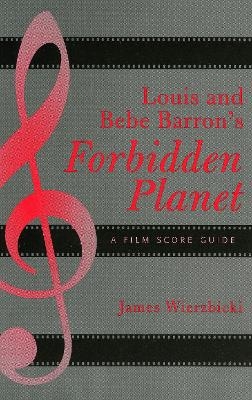
Louis and Bebe Barron's Forbidden Planet
A Film Score Guide
Seiten
2005
Scarecrow Press (Verlag)
978-0-8108-5670-7 (ISBN)
Scarecrow Press (Verlag)
978-0-8108-5670-7 (ISBN)
Forbidden Planet is a product of the MGM studio, which at the time of the production of this film was hardly in the business of making science-fiction films. Originally planned as a "B" picture, the 1956 Forbidden Planet was praised for its spectacular special effects and brilliant color cinematography. The plot practically tingles with sexual innuendo and the dialogue is rich in references to Freudian psychology. However, in spite of all this, the film was marketed to a juvenile audience.
Notwithstanding its uncommon look and "feel," perhaps the most unusual aspect of the film is the way it sounds. Never before had a major Hollywood effort utilized a score generated entirely by electronic means, yet seldom does one find commentary on how Louis and Bebe Barron's score again and again challenges Hollywood norms.
In addition to placing the composers and film in historical context, James Wierzbicki's study offers a deep and thorough analysis of not only the music as used in the film, but also of the decontextualized music as presented by the Barrons on the 1977 "original soundtrack album." The text is generously illustrated with transcriptions and graphs, and can serve as a model for the examination of other extended works of electronic music for which no written score has ever existed.
Notwithstanding its uncommon look and "feel," perhaps the most unusual aspect of the film is the way it sounds. Never before had a major Hollywood effort utilized a score generated entirely by electronic means, yet seldom does one find commentary on how Louis and Bebe Barron's score again and again challenges Hollywood norms.
In addition to placing the composers and film in historical context, James Wierzbicki's study offers a deep and thorough analysis of not only the music as used in the film, but also of the decontextualized music as presented by the Barrons on the 1977 "original soundtrack album." The text is generously illustrated with transcriptions and graphs, and can serve as a model for the examination of other extended works of electronic music for which no written score has ever existed.
James Wierzbicki teaches musicology at the University of Michigan and serves as executive editor of the American Musicological Society's MUSA (Music of the United States of America) series of critical editions.
Part 1 Editor's Foreword
Part 2 Preface
Chapter 3 1 Origins and Connections
Chapter 4 2 Compositional Techniques
Chapter 5 3 Historical and Critical Contexts
Chapter 6 4 The Music
Chapter 7 5 The Film Score
Part 8 Notes
Part 9 Bibliography
Part 10 Index
Part 11 About the Author
| Erscheint lt. Verlag | 30.8.2005 |
|---|---|
| Reihe/Serie | Film Score Guides |
| Verlagsort | Lanham, MD |
| Sprache | englisch |
| Maße | 167 x 214 mm |
| Gewicht | 272 g |
| Themenwelt | Kunst / Musik / Theater ► Musik |
| Sonstiges ► Geschenkbücher | |
| ISBN-10 | 0-8108-5670-0 / 0810856700 |
| ISBN-13 | 978-0-8108-5670-7 / 9780810856707 |
| Zustand | Neuware |
| Informationen gemäß Produktsicherheitsverordnung (GPSR) | |
| Haben Sie eine Frage zum Produkt? |
Mehr entdecken
aus dem Bereich

aus dem Bereich


