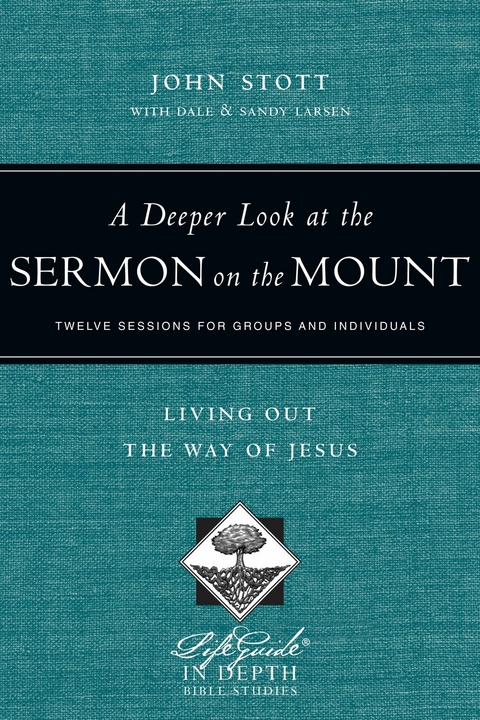
Deeper Look at the Sermon on the Mount (eBook)
InterVarsity Press (Verlag)
978-0-8308-9690-5 (ISBN)
John R. W. Stott (1921-2011) has been known worldwide as a preacher, evangelist and communicator of Scripture. For many years he served as rector of All Souls Church in London, where he carried out an effective urban pastoral ministry. A leader among evangelicals in Britain, the United States and around the world, Stott was a principal framer of the landmark Lausanne Covenant (1974). His many books have sold millions of copies around the world and in dozens of languages. Stott's best-known work, Basic Christianity, has sold two million copies and has been translated into more than 60 languages. Other titles include The Cross of Christ, Understanding the Bible, The Contemporary Christian, Evangelical Truth, Issues Facing Christians Today, The Incomparable Christ, Why I Am a Christian and Through the Bible Through the Year, a daily devotional. He has also written eight volumes in The Bible Speaks Today series of New Testament expositions.Whether in the West or in the Two-Thirds World, a hallmark of Stott's ministry has been expository preaching that addresses the hearts and minds of contemporary men and women. Stott was honored by Time magazine in 2005 as one of the '100 Most Influential People in the World' and was named in the Queen?s New Years Honours list as Commander of the Order of the British Empire.In 1969, Stott founded the Langham Trust to fund scholarships for young evangelical leaders from the Majority World. He then founded the Evangelical Literature Trust, which provided books for students, pastors and theological libraries in the Majority World. These two trusts continued as independent charities until 2001, when they were joined as a single charity: the Langham Partnership. Langham's vision continues today to see churches in the Majority World equipped for mission and growing to maturity in Christ through nurturing national movements for biblical preaching, fostering the creation and distribution of evangelical literature, and enhancing evangelical theological education.
A deep look at Scripture-God's very words-is never wasted. In fact, not only is it never wasted; it's richly rewarded. The more deeply we dive into the riches of the Bible, the more deeply we can experience and serve God, the giver of all truth, wisdom, love and understanding.The new LifeGuide(R) in Depth Bible Studies help you do just that, taking you further into themes and books of Scripture than you might have gone before. As you see new connections between the Old and New Testament, gain an understanding of the historical and cultural background of passages, engage in creative exercises, and concretely apply what you've learned, you'll be amazed at the breadth of the knowledge and wisdom you gain and the transformation God can work in you as you meet him in his Word. Each session provides enough material for a week's worth of Scripture study along with a weekly group discussion guide that pulls all of the elements together.This guide is based on and includes the inductive Bible study Sermon on the Mount from the bestselling LifeGuide(R) Bible Study Series--only now it has been expanded for a new kind of study experience.Drawn from John Stott's Sermon on the Mount LifeGuide Bible Study and his The Message of the Sermon on the Mount commentary, A Deeper Look at the Sermon on the Mount will help you discover- how powerful meekness is- how you can influence the desolate places of society (hint: it has to do with character)- how to experience God's law as delightful- how to treat your enemiesand much more.If you're longing to go deeper in your understanding of God and his Word, LifeGuide in Depth Bible Studies are for you. These new studies will meet your need for both rich, solidly researched content and personal application. They'll meet your need for Bible study that challenges your head and your heart. Most of all, we pray you'll meet God in them.
John R. W. Stott (1921-2011) has been known worldwide as a preacher, evangelist and communicator of Scripture. For many years he served as rector of All Souls Church in London, where he carried out an effective urban pastoral ministry. A leader among evangelicals in Britain, the United States and around the world, Stott was a principal framer of the landmark Lausanne Covenant (1974). His many books have sold millions of copies around the world and in dozens of languages. Stott's best-known work, Basic Christianity, has sold two million copies and has been translated into more than 60 languages. Other titles include The Cross of Christ, Understanding the Bible, The Contemporary Christian, Evangelical Truth, Issues Facing Christians Today, The Incomparable Christ, Why I Am a Christian and Through the Bible Through the Year, a daily devotional. He has also written eight volumes in The Bible Speaks Today series of New Testament expositions.Whether in the West or in the Two-Thirds World, a hallmark of Stott's ministry has been expository preaching that addresses the hearts and minds of contemporary men and women. Stott was honored by Time magazine in 2005 as one of the "100 Most Influential People in the World" and was named in the Queen?s New Years Honours list as Commander of the Order of the British Empire.In 1969, Stott founded the Langham Trust to fund scholarships for young evangelical leaders from the Majority World. He then founded the Evangelical Literature Trust, which provided books for students, pastors and theological libraries in the Majority World. These two trusts continued as independent charities until 2001, when they were joined as a single charity: the Langham Partnership. Langham's vision continues today to see churches in the Majority World equipped for mission and growing to maturity in Christ through nurturing national movements for biblical preaching, fostering the creation and distribution of evangelical literature, and enhancing evangelical theological education. Sandy Larsen is a writer living in Rochester, Minnesota. She and her husband, Dale, have written more than thirty books and Bible studies together including Living Your Legacy and more than ten LifeGuide® Bible studies. They have also coauthored eight N.T. Wright for Everyone Bible Study Guides with Wright. Dale Larsen is a writer living in Rochester, Minnesota. He and his wife, Sandy, have written more than thirty books and Bible studies together including Living Your Legacy and more than ten LifeGuide® Bible studies. They have also coauthored eight N.T. Wright for Everyone Bible Study Guides with Wright.
PART 2. CONNECT
Scripture to Scripture
(On Your Own)
BLESSINGS FROM A MOUNTAIN
For a start, it is interesting to look at the setting of Jesus’ discourse: “He went up on a mountainside and sat down” (v. 1). Mountains are significant throughout the Old Testament. (We should not picture something like a peak in the Rocky Mountains. Jesus was in Galilee, where the highest peak is just under four thousand feet.)
God gave Moses the Ten Commandments on Mount Sinai. In addition, once the Israelites entered Canaan, half the tribes stood on Mount Gerizim and repeated the blessings for obeying the law that Moses had given them, and the other half stood on Mount Ebal and proclaimed the curses for disobeying the law that Moses had also taught them. This happened under Joshua’s leadership, but Moses was the one who had instructed them to do it (Joshua 8:33).
Similar to those mountain experiences in Israel’s history, from a mountain in Galilee Jesus proclaimed his radical interpretation of the Old Testament law. And he began by pronouncing the blessings known as the Beatitudes (Matthew 5:3-12). (In Luke’s version of Jesus’ discourse, Jesus pronounces both blessings and woes [Luke 6:20-26], while in Matthew’s account Jesus pronounces only blessings.)
OLD TESTAMENT BEATITUDES
In the Beatitudes, Jesus pronounced people with eight qualities as “blessed.” The idea of declaring someone to be blessed stretches far back into the Old Testament.
Read Genesis 12:1-9.
How did the Lord promise to bless Abram (later called Abraham)?
How would Abram bless the world?
In each of the following excerpts from the Psalms, someone is called “blessed.” Match up the description of whomever is blessed with the reference of the psalm it comes from.
| Psalm 34:8 | the person who delights and meditates on the law of the Lord and does not follow the way of sinners |
| Psalm 41:1 | the nation whose God is the Lord, whom God has chosen for his inheritance |
| Psalm 146:5-6 | the person who takes refuge in the Lord |
| Psalm 1:1-3 | the person who has regard for the weak |
| Psalm 33:12 | those who dwell in the Lord’s house and praise him, those whose strength is in him and whose hearts are set on pilgrimage |
| Psalm 84:4-5 | those whose help is the Lord and whose hope is in the Lord |
What similarities do you see among the various people who are called “blessed” in these psalms?
From these psalms and the passage in Genesis 12, what new insights have you gained about the meaning of being “blessed”?
THE POOR IN SPIRIT
Read Isaiah 61:1-3. Jesus quoted the first part of this passage in the synagogue in his hometown of Nazareth. What connections do you see between this passage and the first Beatitude (Matthew 5:3)? List them below.
Why do you think the gospel is “good news to the poor” (Isaiah 61:1)?
What kinds of spiritual poverty do you see around you in your everyday experience?
When and how have you seen the poor in spirit being blessed by God?
THOSE WHO MOURN
In its plainest and most familiar meaning, mourning is grief over some kind of profound loss. Old Testament mourning took dramatic forms. Ezekiel 27:30-32, in which the prophet predicts the fall of Tyre, lists several kinds of mourning practiced by the Israelites: “loud lamentation, putting earth on the head, rolling in ashes or dust, shaving the head, putting on sackcloth, intense weeping and chanting a lament.”1
In Matthew 5:4, Jesus is specifically addressing mourning over sin. In the Old Testament we find several examples of people who grieve about their own sins or those of the entire nation of Israel.
Read Ezra 9:1–10:6. When the exiled Jews began to return to Jerusalem, Ezra the priest learned that they were intermarrying with the pagan people around them, a practice which God had forbidden. Even the leaders had disobeyed God in this area.
The people’s sin drove Ezra into deep mourning and intense prayer. He could have kept his mourning and his prayers private. Why do you think he displayed his mourning and his grief-stricken prayers in such a public manner (9:3-6; 10:1, 6)?
Psalm 32 is another Scripture passage that demonstrates mourning over sin and the comfort of God’s forgiveness. Read Psalm 32. Note the numbers of the verses which reveal:
Mourning over sin: _ _ _ _ _ _ _ _ _ _ _ _ _ _ _ _ _ _ _ _ _
God’s comfort: _ _ _ _ _ _ _ _ _ _ _ _ _ _ _ _ _ _ _ _ _
THE MEEK
Jesus’ next Beatitude, “Blessed are the meek, for they will inherit the earth” (Matthew 5:5), is very close to Psalm 37:11. Read Psalm 37:1-11. Where do you see meekness (or humility) expressed in this passage?
In the seventh century B.C. the prophet Zephaniah foresaw the coming destruction of Jerusalem. Read Zephaniah 3:1-13.
What had gone wrong with the people and the leaders of Jerusalem?
How would the meek and humble fare in the coming destruction (vv. 12-13)?
Read 2 Kings 25:8-12, part of the account of the predicted fall of Jerusalem to the Babylonians. How was Zephaniah’s prophecy about the meek and humble fulfilled?
In the Old Testament, meekness is a long way from weakness. The meek are those who humbly submit to God’s will and put their lives into God’s hands. Read Numbers 12:1-15. Scholar Peter Davids notes, “Moses is the chief example of a meek person (Nu. 12:3). In the story in which he is called ‘meek’ (or ‘humble’) he was being wrongly attacked by two other leaders. Instead of retaliating (after all, he had had visions and revelations from God beyond anything they had had), he humbly said nothing, not even defending himself. In the end God stepped in and defended him.”2 In the Old Testament pride was the downfall of both individuals and nations. Meanwhile God quietly kept lifting up those who humbled themselves and submitted to his will.
THOSE WHO HUNGER AND THIRST FOR RIGHTEOUSNESS
Jesus declared next, “Blessed are those who hunger and thirst for righteousness, for they will be filled” (Matthew 5:6). The theme of righteousness or being righteous pervades the Old Testament, and is applied both to God and to people. Scot McKnight writes, “Throughout Jewish literature we find two dominant ideas: God is righteous and his people are to be righteous in their behavior. The righteousness of God, primarily understood as his impeccable holiness and the conformity of his actions to that holy nature, is commonplace in Jewish thought. . . . In addition, as recent scholarship has shown, righteousness attributed to God’s people refers to moral behavior conforming to God’s will.”3
Human beings have no hope of being righteous unless their Creator is first righteous. Read Psalm 71, in which the psalmist repeatedly speaks of the righteousness of God. Fill in the missing phrases for verses 15 to 19:
My mouth will tell of _ _ _ _ _ _ _ _ _ _ _ _ _ _ _ _ _ _ _ _ _ _ _ _ _ _ _ _ _ _,
of _ _ _ _ _ _ _ _ _ _ _ _ _ _ _ _ _ _ _ _ _ _ _ _ all day long—
though I know not how to relate them all.
I will come and proclaim _ _ _ _ _ _ _ _ _ _ _ _ _ _ _ _ _ _ _, Sovereign LORD;
I will proclaim _ _ _ _ _ _ _ _ _ _ _ _ _ _ _ _ _ _ _ _, yours alone.
Since my youth, God, you have taught me,
and to this day I declare your marvelous deeds.
Even when I am old and gray,
do not forsake me, my God,
till I declare your power to the next generation,
your mighty acts to all who are to come.
Your _ _ _ _ _ _ _ _ _ _ _ _ _ _ _ _ _ _ _ _ _ _ _ _ _ _ _ _ _ _ _ _ _ _ _,
you who have done great things.
Who is like you, God?
How does the writer of Psalm 71 show hunger and thirst for righteousness?
Following God’s righteousness, the Old Testament also documents people who were righteous. Perhaps the most well-known example—and the first person in Scripture of whom the word righteousness is used—is Abraham (called Abram here). Read Genesis 15:1-6.
Write out verse 6:
Based on this passage and on the rest of this section on Matthew 5:5, explain in your own words what it means that Abraham had righteousness.
THE MERCIFUL
The next Beatitude addresses the merciful: “Blessed are the merciful, for they will be shown...
| Erscheint lt. Verlag | 16.12.2013 |
|---|---|
| Reihe/Serie | LifeGuide in Depth Series | LifeGuide in Depth Series |
| Co-Autor | Dale Larsen, Sandy Larsen |
| Verlagsort | Lisle |
| Sprache | englisch |
| Themenwelt | Sonstiges ► Geschenkbücher |
| Religion / Theologie ► Christentum ► Kirchengeschichte | |
| Schlagworte | Beatitudes • Bible • Bible study • Character • Christ • Cultural • Discipleship • discussion • Enemies • Exercises • God • Historical • homoily • in depth • inductive • Law • Lid • Lifeguide • lords prayer • Love • Matthew • meek • New • Old • Peacemaker • Scripture • scripture study • small group • Study • study Scripture • study the bible • Teaching • Testament • Weekly |
| ISBN-10 | 0-8308-9690-2 / 0830896902 |
| ISBN-13 | 978-0-8308-9690-5 / 9780830896905 |
| Informationen gemäß Produktsicherheitsverordnung (GPSR) | |
| Haben Sie eine Frage zum Produkt? |
 EPUB (Adobe DRM)
Kopierschutz: Adobe-DRM
Adobe-DRM ist ein Kopierschutz, der das eBook vor Mißbrauch schützen soll. Dabei wird das eBook bereits beim Download auf Ihre persönliche Adobe-ID autorisiert. Lesen können Sie das eBook dann nur auf den Geräten, welche ebenfalls auf Ihre Adobe-ID registriert sind.
Details zum Adobe-DRM
Dateiformat: EPUB (Electronic Publication)
EPUB ist ein offener Standard für eBooks und eignet sich besonders zur Darstellung von Belletristik und Sachbüchern. Der Fließtext wird dynamisch an die Display- und Schriftgröße angepasst. Auch für mobile Lesegeräte ist EPUB daher gut geeignet.
Systemvoraussetzungen:
PC/Mac: Mit einem PC oder Mac können Sie dieses eBook lesen. Sie benötigen eine
eReader: Dieses eBook kann mit (fast) allen eBook-Readern gelesen werden. Mit dem amazon-Kindle ist es aber nicht kompatibel.
Smartphone/Tablet: Egal ob Apple oder Android, dieses eBook können Sie lesen. Sie benötigen eine
Geräteliste und zusätzliche Hinweise
Buying eBooks from abroad
For tax law reasons we can sell eBooks just within Germany and Switzerland. Regrettably we cannot fulfill eBook-orders from other countries.
aus dem Bereich