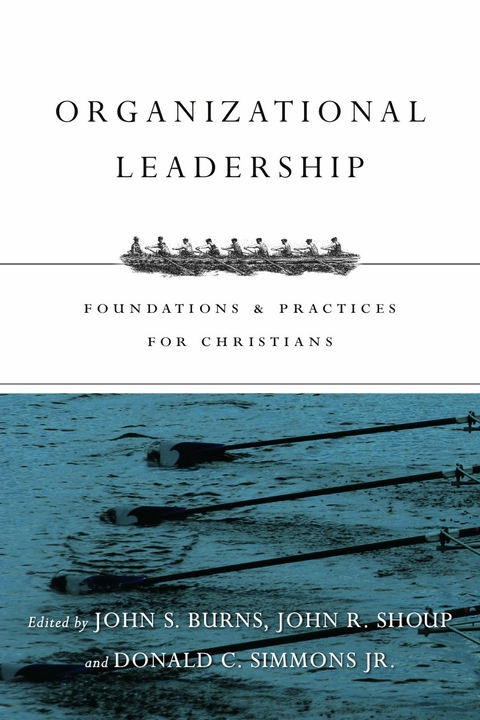
Organizational Leadership (eBook)
287 Seiten
IVP Academic (Verlag)
978-0-8308-9617-2 (ISBN)
John S. (Jack) Burns is professor of leadership studies at Whitworth University in Spokane, Washington, where he coordinates the Interdisciplinary Leadership Studies Program. He has been teaching leadership studies since 1985 and has developed leadership studies programs at two universities. He has been director of an Eisenhower Leadership Program Grant, and has published several articles and book chapters on leadership pedagogy, organizational theory and leadership theory. He received his Ph.D. in higher education administration and M.A. in counseling from Washington State University. Donald C. Simmons Jr. is an internationally recognized leadership consultant, pastor for Christ Lutheran Church in Cullman, Alabama, and Director of Pastoral Care for one of the largest rural hospital systems in the US. He teaches graduate courses in leadership for the University of Nebraska-Omaha and was the founding dean of the College of Leadership and Public Service at Dakota Wesleyan University. He is the editor of Organizational Leadership and the coauthor of the textbook Leadership and Service: An Introduction with Senator George McGovern and Dan Gaken. He is most recognized in academic circles as producer of the public television documentary Hungry for Green: Feeding the World Sustainably, which premiered at Harvard University Medical School's Center for Health and the Global Environment in 2009 and aired nationally. Dr. Simmons holds a certificate of ministry from Truett Theological Seminary at Baylor University, and a Ph.D. in history and international studies from The University of Denver. He is currently pursuing a doctorate in ministry at Christ School of Theology in Brookings South Dakota. John R. Shoup serves as the dean of the School of Education at California Baptist University in Riverside, California. He teaches leadership and educational history and policy at the graduate level, and has presented and conducted research and workshops on leadership development and best practices and educational policy. Shoup has also served as a school principal and in various social service settings. He has a Ph.D. in education with an emphasis in institutional leadership and policy studies from the University of California, Riverside. He also has a Master of Divinity and a Master of Arts in counseling psychology from Trinity Evangelical Divinity School in Deerfield, Illinois.
John S. (Jack) Burns is professor of leadership studies at Whitworth University in Spokane, Washington, where he coordinates the Interdisciplinary Leadership Studies Program. He has been teaching leadership studies since 1985 and has developed leadership studies programs at two universities. He has been director of an Eisenhower Leadership Program Grant, and has published several articles and book chapters on leadership pedagogy, organizational theory and leadership theory. He received his Ph.D. in higher education administration and M.A. in counseling from Washington State University. John R. Shoup serves as the dean of the School of Education at California Baptist University in Riverside, California. He teaches leadership and educational history and policy at the graduate level, and has presented and conducted research and workshops on leadership development and best practices and educational policy. Shoup has also served as a school principal and in various social service settings. He has a Ph.D. in education with an emphasis in institutional leadership and policy studies from the University of California, Riverside. He also has a Master of Divinity and a Master of Arts in counseling psychology from Trinity Evangelical Divinity School in Deerfield, Illinois. Donald C. Simmons Jr. is an internationally recognized leadership consultant, pastor for Christ Lutheran Church in Cullman, Alabama, and Director of Pastoral Care for one of the largest rural hospital systems in the US. He teaches graduate courses in leadership for the University of Nebraska-Omaha and was the founding dean of the College of Leadership and Public Service at Dakota Wesleyan University. He is the editor of Organizational Leadership and the coauthor of the textbook Leadership and Service: An Introduction with Senator George McGovern and Dan Gaken. He is most recognized in academic circles as producer of the public television documentary Hungry for Green: Feeding the World Sustainably, which premiered at Harvard University Medical School's Center for Health and the Global Environment in 2009 and aired nationally. Dr. Simmons holds a certificate of ministry from Truett Theological Seminary at Baylor University, and a Ph.D. in history and international studies from The University of Denver. He is currently pursuing a doctorate in ministry at Christ School of Theology in Brookings South Dakota.
Preface
Whoever aspires to be an overseer desires a noble task.
1 Timothy 3:1
This book is ideal for those who study leadership, organizations, theology and/or Christianity. The contributors aim to provide a practical theology of leadership from a Christian worldview for emerging and established Christian leaders who want to conduct leadership in a manner consistent with their faith in both religious and nonreligious organizational contexts. The book is also for non-Christians who are eager to see how the Christian worldview manifests itself in leadership perspectives and practices.
More specifically, this book explores various facets of leadership from a Christian worldview so as to equip people, especially Christians, to conduct leadership more authentically than would be possible under alternative paradigms. The hope is that this book will demonstrate that the word Christian in front of the word leadership proposes something substantively different and qualitatively better than when other adjectives are used or implied.
It may be legitimate to wonder if a book on organizational leadership from a Christian perspective is even necessary given that Christians believe that the whole counsel of God, as revealed in the Bible, provides a complete guidebook to instruct them in all areas of their lives. In addition to the Bible, the Holy Spirit is a helper who engages with believers so that they can accomplish more than they could on their own. The Holy Spirit works in individuals and the collective body found in Christ’s church to reveal truth, bear fruit, give courage in a hostile world and glorify Jesus (John 14:16–16:33).
Given all that is readily available to Christians, what can this book contribute to improve Christians’ abilities to practice organizational leadership? We offer three justifications for why this book will be a unique and critical asset for those wishing to improve their understanding of Christian leadership.
The first justification is that there is a significant need in the leadership literature for a systematic theology of Christian leadership. In general, the Christian leadership genre falls into two large categories. The first and most common category includes books written by or about successful Christian leaders. These books discuss the anatomy of these leaders’ successes and failures, using Scripture to add biblical relevance to the leaders’ activity and behavior. It is assumed that readers will be able to generalize the lessons these leaders have learned to their own organizational contexts and experiences. The second category in this genre is more biblically centered. Here authors take a biblical leader like Jesus or Nehemiah and extract biblical principles about leadership from the biblical account of the leader. Readers are expected to extract some sort of universal Christian principles of leadership from these accounts.
We believe that the theology of Christian leadership is too complex to be understood by extrapolating universal principles of leadership from isolated examples from the personal life stories of Christian leaders or isolated teachings from the Bible. The structure of Scripture itself speaks to the need to develop a far more comprehensive biblical foundation for a theology of leadership. While the Bible contains relevant truths specific to leadership, the different genres within the Bible reveal different facets of God’s message in a progressive fashion. Systematizing and developing explicit truths and principles germane to Christian leadership from God’s progressive revelation of truth serves the intent of Scripture. The Bible provides a commentary on itself when it states that “all Scripture is God-breathed and is useful for teaching, rebuking, correcting and training in righteousness, so that the servant of God may be thoroughly equipped for every good work” (2 Timothy 3:16-17). While the Bible is not strictly a book on leadership, we have found that it develops a comprehensive and profound theology of leadership that provides a foundation for Christian leadership.
The greatest social scientist of all provides a second justification for a book on Christian leadership. King Solomon, who studied life and reported his vast conclusions into over 3,000 proverbs and 1,005 songs (1 Kings 4:32), encouraged people to learn from general revelation to gain wisdom (Proverbs 6:6). While the Bible is all true, all of our understanding about truth is not restricted to the Bible. God has always made himself known through general revelation, the truth about creation that is accessible to all people regardless of worldview. Thus, there is much that can be learned about leadership found in the truths that have been revealed through general revelation (e.g., the social sciences) that can enhance the Christian and non-Christian leadership practices.
The third justification for a comprehensive model of Christian leadership is that while not all Christians are necessarily leaders, all Christians are called to serve in different leadership capacities at different times during their earthly tenure. The apostle Paul in 1 Timothy 3 details the qualifications for the formal leaders of the church, which implies leaders are a distinct subset of the community. Even though not everyone has the gift or calling to be a leader (Romans 12:8; 1 Corinthians 12:28), and not everyone has every gift, Christians are called to demonstrate the responsibilities associated with all of the gifts as necessary. The Christian cannot disengage from evangelism or exercising mercy because he or she claims to not have either of these specific gifts. Christians are called to be “salt and light” in the world (Matthew 5:13-14), which conveys taking a leadership role at strategic times.
This book calls for bold action on the part of Christians who conduct leadership from all kinds of formal and informal positions in organizations. Christians are citizens of heaven and ambassadors to this world. As ambassadors we have a great responsibility to represent our King’s wishes here. Kingdom leadership does not begin and end at the church door. Christians are called to conduct leadership in government, commerce, schools, neighborhoods, churches, parachurch ministries and a myriad of other contexts. God has given us many gifts, and our responsibility is to be stewards (not owners) of those gifts and use them to do the King’s work.
People from all worldviews can (and perhaps should) learn leadership theories and skills. Christians have a high and unique calling when it comes to conducting leadership. Not only should they learn about leadership theories and skills, but they must also use their knowledge for kingdom work, no matter what kind of organizational context they find themselves in. Christians submit their knowledge and gifts to the King as they walk into leadership by faith and not by sight (2 Corinthians 5:7), trusting in God and not leaning on their own understanding (Proverbs 3:5-6). Christians who conduct leadership lean on a vibrant faith as seen in the fruit and types of works the believer demonstrates (Matthew 7:17; James 2:18).
Regardless of what adjective or set of values is used to frame the study and practice of leadership, the word leadership by itself needs to be clarified. In the countless number of words written about leadership by thousands of authors, there is no universally accepted definition for this word. That fact alone makes it a very tricky word to study and write about. It also becomes complicated because the word has common uses that are inexact and rather sloppy when they are applied to a scholarly discussion of the term. For example, leadership can refer to a person or persons in charge of a group or organization (“We will need to get the leadership to agree to this plan”) or as an adjective to describe a leader’s place in an organization (“I hold a leadership position”). Perhaps the greatest confusion is when it is used as a description to qualify an activity (“What she just did showed real leadership”).
Another difficulty in unpacking the term leadership is the tendency to emphasize the leader when leadership is discussed or exercised. Certainly leaders have a role in the activity of leadership, but leaders do not conduct leadership on their own. Others are also engaged in the activity of leadership. Indeed leadership is a collective, not a solo, activity. A helpful metaphor developed by legendary business-tycoon-turned-leadership-scholar Max Dupree comes from jazz music! A jazz band usually has a conductor (leader). The conductor doesn’t make the music, but the conductor has a very important role and must fulfill that role or the music likely won’t happen. Each member of the band also has a role, and each must perform their role or, again, the music will not happen. The conductor and the band members all work together to produce music.
This also happens in organizations. Leaders have roles, but so do the others in the organization. When everyone fulfills their roles, leadership “happens.” For this reason, the verb we most often pair with the word leadership throughout this book is conduct. Hopefully this pairing will remind the reader of the collective nature of leadership. It won’t be easy because of the common association of leadership with whatever good behavior leaders practice.
To meet the challenge of combining the Christian worldview with organizational leadership, the book is divided into three sections. Sections 1 and 2 provide the theological and theoretical foundations for constructing a model of...
| Erscheint lt. Verlag | 16.5.2014 |
|---|---|
| Verlagsort | Lisle |
| Sprache | englisch |
| Themenwelt | Sonstiges ► Geschenkbücher |
| Religion / Theologie ► Christentum ► Kirchengeschichte | |
| Religion / Theologie ► Christentum ► Moraltheologie / Sozialethik | |
| Wirtschaft ► Betriebswirtschaft / Management ► Unternehmensführung / Management | |
| Schlagworte | Christian leadership • Communication • Decision-Making • financial stewardship • kingdom leadership • Negotiation |
| ISBN-10 | 0-8308-9617-1 / 0830896171 |
| ISBN-13 | 978-0-8308-9617-2 / 9780830896172 |
| Informationen gemäß Produktsicherheitsverordnung (GPSR) | |
| Haben Sie eine Frage zum Produkt? |
 EPUB (Wasserzeichen)
DRM: Digitales Wasserzeichen
Dieses eBook enthält ein digitales Wasserzeichen und ist damit für Sie personalisiert. Bei einer missbräuchlichen Weitergabe des eBooks an Dritte ist eine Rückverfolgung an die Quelle möglich.
Dateiformat: EPUB (Electronic Publication)
EPUB ist ein offener Standard für eBooks und eignet sich besonders zur Darstellung von Belletristik und Sachbüchern. Der Fließtext wird dynamisch an die Display- und Schriftgröße angepasst. Auch für mobile Lesegeräte ist EPUB daher gut geeignet.
Systemvoraussetzungen:
PC/Mac: Mit einem PC oder Mac können Sie dieses eBook lesen. Sie benötigen dafür die kostenlose Software Adobe Digital Editions.
eReader: Dieses eBook kann mit (fast) allen eBook-Readern gelesen werden. Mit dem amazon-Kindle ist es aber nicht kompatibel.
Smartphone/Tablet: Egal ob Apple oder Android, dieses eBook können Sie lesen. Sie benötigen dafür eine kostenlose App.
Geräteliste und zusätzliche Hinweise
Buying eBooks from abroad
For tax law reasons we can sell eBooks just within Germany and Switzerland. Regrettably we cannot fulfill eBook-orders from other countries.
aus dem Bereich