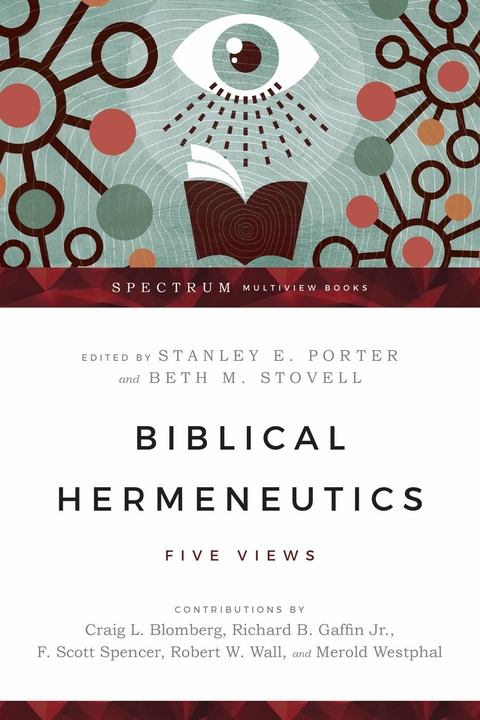
Biblical Hermeneutics (eBook)
InterVarsity Press (Verlag)
978-0-8308-6999-2 (ISBN)
Stanley E. Porter (Ph.D., University of Sheffield) is president, dean and professor of New Testament at McMaster Divinity College in Hamilton, Ontario. At McMaster he also holds the Roy A. Hope Chair in Christian Worldview. He is the author of numerous studies in the New Testament and Greek language, including The Paul of Acts: Essays in Literary Criticism, Rhetoric, and Theology; Idioms of the Greek New Testament and Verbal Aspect in the Greek of the New Testament, with Reference to Tense and Mood. He has also edited volumes such as History of Classical Rhetoric in the Hellenistic Period, 330 B.C.-A.D. 400 and Handbook to Exegesis of the New Testament. Beth M. Stovell (PhD, McMaster Divinity College) is associate professor of Old Testament at Ambrose Seminary of Ambrose University, Calgary, Alberta, Canada.
In this Spectrum Multiview volume five experts in biblical hermeneutics gather to state and defend their approach to the discipline. Contributors include:- Craig Blomberg with the historical-critical/grammatical approach- Richard Gaffin with the redemptive-historical approach- Scott Spencer with the literary/postmodern approach- Robert Wall with the canonical approach- Merold Westphal with the philosophical/theological approachSpectrum Multiview Books offer a range of viewpoints on contested topics within Christianity, giving contributors the opportunity to present their position and also respond to others in this dynamic publishing format.
Beth M. Stovell (PhD, McMaster Divinity College) is associate professor of Old Testament at Ambrose Seminary of Ambrose University, Calgary, Alberta, Canada. Stanley E. Porter (Ph.D., University of Sheffield) is president, dean and professor of New Testament at McMaster Divinity College in Hamilton, Ontario. At McMaster he also holds the Roy A. Hope Chair in Christian Worldview. He is the author of numerous studies in the New Testament and Greek language, including The Paul of Acts: Essays in Literary Criticism, Rhetoric, and Theology; Idioms of the Greek New Testament and Verbal Aspect in the Greek of the New Testament, with Reference to Tense and Mood. He has also edited volumes such as History of Classical Rhetoric in the Hellenistic Period, 330 B.C.-A.D. 400 and Handbook to Exegesis of the New Testament.
Introduction
Trajectories in Biblical Hermeneutics
Stanley E. Porter and Beth M. Stovell
The issue of interpreting the Bible has a long history and vast complexity,[1] even if the term hermeneutics, which is often used in conjunction with biblical interpretation, is of more recent vintage.[2] Students and scholars alike struggle to differentiate between the meaning of terms like biblical exegesis, interpretation and hermeneutics.[3] This very tension in defining the concepts of biblical interpretation, hermeneutics and exegesis leads to one of the major questions influencing the debates in this book, which in turn justifies its creation. Anthony Thiselton, one of the leading figures in biblical hermeneutics, especially in evangelical circles, provides a helpful distinction among these important terms:
Whereas exegesis and interpretation denote the actual processes of interpreting texts, hermeneutics also includes the second-order discipline of asking critically what exactly we are doing when we read, understand, or apply texts. Hermeneutics explores the conditions and criteria that operate to try to ensure responsible, valid, fruitful, or appropriate interpretation.[4]
This book thus focuses on the question of what hermeneutics is specifically as it applies to biblical interpretation. While other books have addressed this issue in the past, this book uses a new format to address the question of biblical hermeneutics. One can broadly classify most books on the topics of biblical hermeneutics or biblical interpretation according to two major types.[5] The first type of book presents students with step-by-step instructions on how one should interpret the biblical text; in other words, hermeneutics is an exegetical procedure.[6] These books may provide some explanation of the variety of methods available, but their goal is primarily the practical application of a specific method as a tool for biblical interpretation. A second type of book provides an introduction to the variety of different methods of biblical interpretation. These books may move historically through the various methods, or they may discuss the strategies, goals and outcomes of these methods in synchronic perspective. In either case the authors of these books frequently display (whether intentionally or unintentionally) their own preference through their presentations of the various views, or sometimes they present the range of positions in a historical fashion rather than directly engaging the debate.[7] Both types of book tend to overlook the larger hermeneutical issues involved in biblical interpretation and often do not do justice to the diverse range of opinions in biblical hermeneutics. In other words, they fail to raise and address questions regarding the nature of interpretation itself: what it involves, what its presuppositions and criteria are, what its foundations need to be, and how it affects the practice of interpretation and its results. We are not saying that there are no books on biblical hermeneutics that present hermeneutics as hermeneutics,[8] only that it is difficult to capture the diversity of the discipline from a vantage point that focuses on procedure, history, or even the perspective of a single viewpoint or author.
This book represents a new way of presenting several of the major views within biblical hermeneutics. Rather than introducing the individual hermeneutical approaches in survey fashion or providing a step-by-step instruction guide to interpretation, this book provides a forum for discussion by including contributions from several of the major advocates of these diverse models.[9] Each contributor provides a position essay describing the traits that characterize his perspective and a response essay describing his position in comparison to the other approaches.[10] By using this format, this book allows the reader to assess the strengths and weaknesses of each position by listening in on a scholarly debate over the major hermeneutical stances and issues. This introduction and the conclusion of the book, prepared by the editors, are designed to orient the discussion and set it within the wider history of biblical hermeneutics. Toward this goal of orientation, this introduction will survey many of the key issues of biblical hermeneutics by tracing their context within the history of traditional and modern biblical interpretation, using the literary categories of “behind the text,” “within the text” and “in front of the text.”[11] This survey will highlight some of the key questions and issues in debates surrounding the subject of biblical hermeneutics. It will then place the particular views represented in this book in that broader context and explain the structure of the book.
A Brief History of the Development of Biblical Hermeneutics
This is not the place to offer a full or complete history of biblical hermeneutics. Such histories are offered in a number of works and in more detail than we can present here.[12] Nevertheless, our threefold orientation to the text provides a useful framework for capturing the major issues in biblical hermeneutics as they have unfolded. As a result of the shape of this volume, we will orient our comments specifically, though not exclusively, to New Testament hermeneutics on interpretation, but without neglecting the Old Testament.
Behind the text. In some ways, the history of biblical hermeneutics begins as early as the biblical account itself. In the Old Testament, the latter writings, like the Psalms and the Prophets, reinterpret the story of Israel presented in the Torah, and the New Testament continues to reinterpret this continuing story in light of the life, death and resurrection of Jesus Christ (an approach that later redemptive-historical scholars would appropriate).[13] Some scholars trace the beginnings of historical exegesis to the historically based exegesis of the Antiochene school, which was responding to the allegorical methods of the Alexandrian school.[14] The majority of scholars, however, point to the Enlightenment as a critical turning point in the field of biblical interpretation.[15] Through the influences of Cartesian thought, Pyrrhonian skepticism and English deism, Enlightenment scholars began to question the historicity of miracles,[16] to search for the historical Jesus,[17] to explore different types of texts and sources[18] and generally to ask the kinds of historical questions we see in contemporary Old and New Testament introductions.[19]
Responding to this Enlightenment tradition, Friedrich Schleiermacher—often said to be the founder of modern hermeneutics—introduced a form of interpretation frequently described as romantic hermeneutics.[20] This form of hermeneutics focused on the mind of the author, along with the impact of his or her sociohistorical setting, as the means of gaining meaning from a given text. Wilhelm Dilthey followed in Schleiermacher’s footsteps in focusing on the relationship between author and text in interpretation.[21]
These various developments had a formative influence on the hermeneutical model that we will broadly call “traditional criticism,” which is still frequently associated with biblical exegesis. One can delineate three salient features that distinguish traditional criticism: evolutionary models of biblical texts, historical reconstructions, original meaning[22]—although not all traditional critics would accept all of them or emphasize them in the same way.
As Norman Petersen explains, “Essential to the historical-critical theory of biblical literature is the evolutionary model upon which it is constructed.”[23] This feature of traditional criticism points to the desire to determine the backgrounds of our biblical texts and to develop theories tracing how we gained our current text from that background.[24] For example, form criticism—often a tool employed in traditional criticism—uses the theories of the religionsgeschichtliche Schule (“history of religions school”) to differentiate the individual units of the oral tradition that evolved into our biblical text.[25] This form-critical analysis is usually based on source-critical analysis; thus this evolutionary model begins with the existence and relationship of sources as part of their evolution. Redaction criticism—another of the tools of traditional criticism, and usually dependent on source and form criticism—seeks the context within the church that caused the editing of the biblical text to be tailored to meet the theological needs of the community at hand.[26]
Often the goal of traditional criticism is to access the authenticity of the biblical texts or the stories behind the texts. We can see this trend in the source-critical attempts to identify the earliest sayings of Jesus and stories within the biblical accounts.[27] The various levels of authenticity...
| Erscheint lt. Verlag | 25.5.2012 |
|---|---|
| Reihe/Serie | Spectrum Multiview Book Series | Spectrum Multiview Book Series |
| Verlagsort | Lisle |
| Sprache | englisch |
| Themenwelt | Sonstiges ► Geschenkbücher |
| Religion / Theologie ► Christentum ► Bibelausgaben / Bibelkommentare | |
| Religion / Theologie ► Christentum ► Kirchengeschichte | |
| Geisteswissenschaften ► Sprach- / Literaturwissenschaft ► Sprachwissenschaft | |
| Schlagworte | Bible • Biblical Studies • Exegesis • hermeneutics • Scripture |
| ISBN-10 | 0-8308-6999-9 / 0830869999 |
| ISBN-13 | 978-0-8308-6999-2 / 9780830869992 |
| Informationen gemäß Produktsicherheitsverordnung (GPSR) | |
| Haben Sie eine Frage zum Produkt? |
 EPUB (Adobe DRM)
Kopierschutz: Adobe-DRM
Adobe-DRM ist ein Kopierschutz, der das eBook vor Mißbrauch schützen soll. Dabei wird das eBook bereits beim Download auf Ihre persönliche Adobe-ID autorisiert. Lesen können Sie das eBook dann nur auf den Geräten, welche ebenfalls auf Ihre Adobe-ID registriert sind.
Details zum Adobe-DRM
Dateiformat: EPUB (Electronic Publication)
EPUB ist ein offener Standard für eBooks und eignet sich besonders zur Darstellung von Belletristik und Sachbüchern. Der Fließtext wird dynamisch an die Display- und Schriftgröße angepasst. Auch für mobile Lesegeräte ist EPUB daher gut geeignet.
Systemvoraussetzungen:
PC/Mac: Mit einem PC oder Mac können Sie dieses eBook lesen. Sie benötigen eine
eReader: Dieses eBook kann mit (fast) allen eBook-Readern gelesen werden. Mit dem amazon-Kindle ist es aber nicht kompatibel.
Smartphone/Tablet: Egal ob Apple oder Android, dieses eBook können Sie lesen. Sie benötigen eine
Geräteliste und zusätzliche Hinweise
Buying eBooks from abroad
For tax law reasons we can sell eBooks just within Germany and Switzerland. Regrettably we cannot fulfill eBook-orders from other countries.
aus dem Bereich