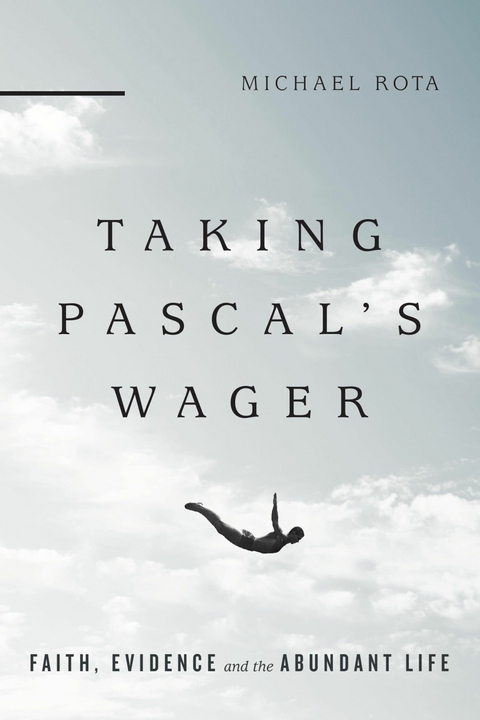
Taking Pascal's Wager (eBook)
255 Seiten
IVP Academic (Verlag)
978-0-8308-9999-9 (ISBN)

Michael Rota (PhD, Saint Louis University) is associate professor of philosophy at the University of St. Thomas in St. Paul, Minnesota. He was a post-doctoral fellow at Harvard from 2006-2007, and he is the author of several academic articles in philosophy and philosophical theology.
Michael Rota (PhD, Saint Louis University) is associate professor of philosophy at the University of St. Thomas in St. Paul, Minnesota. He was a post-doctoral fellow at Harvard from 2006 to 2007, and is the author of several academic articles in philosophy and philosophical theology.
Introduction
Is it rational to believe in God? Is it reasonable to commit oneself to God—to live a deeply religious life? And how much certainty does one need before the time has come to decide? If you’ve pondered these questions before, this book is for you.
I was raised Catholic, although religion was not a major part of our family life. We prayed before meals and went to church on most Sundays, but there was little discussion of religious matters and no regular personal prayer, at least not on my part. Sometime in my early teens I began to wonder about the truth of the religion I had been born into. Does God really exist? If he does, then relationship with God is the most important part of human life. But if he doesn’t, then the religious person is enmeshed in a massive deception. “We believe in one God, the Father, the Almighty . . . ,” I found myself saying at Mass. But did I really mean it? I wasn’t sure, and the fear that I was being dishonest concerned me.
I continued to wonder about God and the rationality of Christianity throughout high school, in college and in graduate school. Now, as a professor of philosophy, it’s my job to think about these topics every day. My research focuses on the rationality of religious belief, and I wrestle with arguments for and against God, with classes full of students from every point of view, almost every semester. I have become convinced that it is rational to live a deeply religious Christian life. Indeed, it may be irrational not to.
When contemplating the choice to commit to living a Christian life, one might suppose that one should refrain from making a commitment in the absence of rock-solid evidence for the truth of Christianity. Reflection on personal relationships suggests otherwise. In The Will to Believe, William James asks us to consider a man who hesitates “indefinitely to ask a certain woman to marry him because he [is] not perfectly sure that she would prove [to be] an angel after he brought her home. Would he not cut himself off from that particular angel-possibility as decisively as if he went and married some one else?”1 In the area of romantic love, it can be reasonable to invest deeply in a relationship, and eventually make a lifelong commitment to the beloved, despite the absence of airtight evidence that the marriage will be a happy one. Because there is so much at stake, it can be reasonable to make a commitment to a personal relationship even when absolute certainty proves elusive. Applying this to the question of God: even if the evidence for God left some room for doubt, considerations about the possible value of a relationship with God might favor the decision to make a religious commitment.
Seventeenth-century French mathematician and theologian Blaise Pascal gave an argument that expands on this insight. Pascal’s wager, as the argument has come to be known, addresses those who aren’t sure whether Christianity is true but think that it might be true. The argument can be summed up in a single sentence: It is rational to seek a relationship with God and live a deeply Christian life, because there is very much to gain and relatively little to lose.
As the wager is usually presented, what’s to gain is eternal happiness for the wagerer. An alternative and more powerful version of the argument, however, focuses not just on self-interest but also on goods that go beyond self-interest. If one commits to God and God does in fact exist, one brings joy to God, and one is better able to help others attain union with God. And if Jesus really is who he claimed to be, we may even have a moral duty to commit to living a Christian life. If Christianity is true, we have a duty to love God and have been called by God himself, who has given us everything good that we have, to live a deeply religious life. More than just self-interest can motivate one to take the wager.
On the other hand, if Christianity is false, the committed Christian has still lived a meaningful life, has pursued moral excellence and has enjoyed the many empirically well-attested benefits of belonging to a religious community. Much to gain, relatively little to lose.
In part one of this book (chapters one through four), I’ll present an updated version of Pascal’s wager, strengthened by cutting-edge research from psychologists, sociologists and philosophers. After introducing and laying out the basic argument in chapters one and two, I turn to objections to the wager in chapters three and four. These include the objections that committing to God on the basis of pragmatic considerations is immoral, that the cost of religious commitment is too high, that the existence of religions other than Christianity nullifies the argument and that Christian doctrine itself casts doubt on the wager. When addressing this last issue, I discuss grace, free will and predestination.
In part two (chapters five through twelve), I’ll take a careful look at arguments for the existence of God and the truth of Christianity, showing how—once we no longer demand certainty—the available evidence is sufficient to make serious Christian commitment entirely reasonable. Together, parts one and two present the book’s main argument, which can be summarized as follows:
If Christianity has at least a 50 percent chance of being true, then it is rational to commit to living a Christian life (the conclusion of part one).
Christianity does have at least a 50 percent chance of being true (the conclusion of part two).
Thus, it is rational to commit to living a Christian life.
The argument of part two proceeds in two stages. First, I present evidence for theism (the view that there is a God); second, I present evidence for the more specific view of Christian theism. I begin by asking the question of why physical reality exists at all. Chapter five argues that there is at least one necessarily existing being, which explains the existence of contingent beings. (Contingent beings are things that reality didn’t have to include, like all the physical objects we see around us.) Chapters six through eight then provide an argument that the cause of physical reality is an intelligent being. In the last several decades mainstream physicists and astronomers have come to realize that the life-permitting character of our universe is balanced on a knife’s edge: if several features had been ever-so-slightly different from what they in fact are, then stable, self-reproducing life would not have been able to arise. Chapter six introduces some of the scientific evidence for this conclusion and gives a preliminary statement of what has come to be known as the fine-tuning argument. This argument has been summarized for nonspecialists in several places, but not always with enough rigor and background for the strength of the case to be fully displayed. In chapter seven I explain the parts of probability theory required to appreciate the power of the evidence that our universe is the product of an intelligence. Chapter eight contains an original reply to the strongest alternative to design, the multiverse hypothesis. (This is the hypothesis that our universe is just one of a vast number of universes, most of which are not life permitting.) Taken together, chapters five through eight provide evidence for God, drawing on the best recent research but written so as to be accessible to the general reader.
In chapter nine I turn to specifically Christian doctrines, suggesting that the beauty and existential resonance of Christianity are clues to its truth. Chapter ten concerns the two most powerful arguments against theism, the argument from divine hiddenness and the argument from evil. (As arguments against all forms of theism, they are arguments against Christian theism as well.) These topics deserve not a single chapter but whole books of their own. And they have them. So in chapter ten I summarize what I take to be the strongest replies to the arguments from hiddenness and evil, focusing on the recent work of Peter van Inwagen and Eleonore Stump. Finally, in chapters eleven and twelve, I turn to arguments for the resurrection of Jesus. This is just one of many Christian doctrines, of course, but logically speaking it holds a special place. If one has reason to believe that Jesus rose from the dead, then one has reason to believe that Jesus’ teachings have the divine stamp of approval and are therefore true. So an argument for the resurrection is an argument for the truth of Christianity (or at least the larger part of one). In this pair of chapters I draw on the most recent work on the issue by historians, theologians and philosophers. While I think that the evidence of part two is by itself sufficient to justify belief in Christianity, agreement on this point is not required for the main argument of the book to succeed. For, given the argument of part one, all that is required for a demonstration of the rationality of Christian commitment is that the evidence render Christianity at least as likely as not.
It’s sometimes said that the longest distance in the world is the distance from the head to the heart. And so in part three I’ll try to illustrate how a life of Christian commitment is not just reasonable but worth desiring as well—satisfying both the head and the heart. To do this, I’ll tell the stories of three exemplary individuals who took Jesus up on his invitation to follow him. The lives of these individuals were enriched, and in turn enriched countless others, in ways all of us would want to be true for our own lives. Dietrich Bonhoeffer, Jean Vanier and Immaculée Ilibagiza show how heroic, noble...
| Erscheint lt. Verlag | 21.5.2016 |
|---|---|
| Verlagsort | Lisle |
| Sprache | englisch |
| Themenwelt | Sonstiges ► Geschenkbücher |
| Religion / Theologie ► Christentum ► Kirchengeschichte | |
| Schlagworte | Apologetics • Atheism • believe in God • Blaise Pascal • Christian • Christian Apologetics • Christian Faith • Christianity • christian worldview • Commitment • Decision-Making • Doubt • Evidence • Faith • Faith in God • God • go to hell • Heaven • hell • Leap of Faith • PASCAL • Pascal's Wager • Philosophy • Uncertainty • Wager • Worldview |
| ISBN-10 | 0-8308-9999-5 / 0830899995 |
| ISBN-13 | 978-0-8308-9999-9 / 9780830899999 |
| Informationen gemäß Produktsicherheitsverordnung (GPSR) | |
| Haben Sie eine Frage zum Produkt? |
 EPUB (Wasserzeichen)
DRM: Digitales Wasserzeichen
Dieses eBook enthält ein digitales Wasserzeichen und ist damit für Sie personalisiert. Bei einer missbräuchlichen Weitergabe des eBooks an Dritte ist eine Rückverfolgung an die Quelle möglich.
Dateiformat: EPUB (Electronic Publication)
EPUB ist ein offener Standard für eBooks und eignet sich besonders zur Darstellung von Belletristik und Sachbüchern. Der Fließtext wird dynamisch an die Display- und Schriftgröße angepasst. Auch für mobile Lesegeräte ist EPUB daher gut geeignet.
Systemvoraussetzungen:
PC/Mac: Mit einem PC oder Mac können Sie dieses eBook lesen. Sie benötigen dafür die kostenlose Software Adobe Digital Editions.
eReader: Dieses eBook kann mit (fast) allen eBook-Readern gelesen werden. Mit dem amazon-Kindle ist es aber nicht kompatibel.
Smartphone/Tablet: Egal ob Apple oder Android, dieses eBook können Sie lesen. Sie benötigen dafür eine kostenlose App.
Geräteliste und zusätzliche Hinweise
Buying eBooks from abroad
For tax law reasons we can sell eBooks just within Germany and Switzerland. Regrettably we cannot fulfill eBook-orders from other countries.
aus dem Bereich