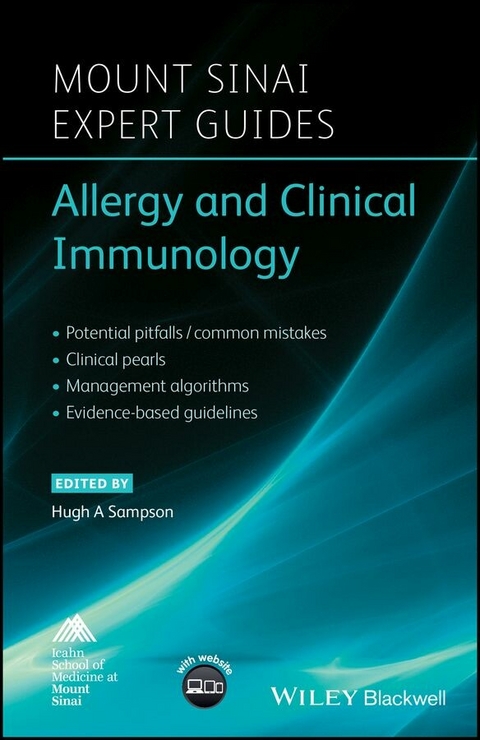
Allergy and Clinical Immunology (eBook)
John Wiley & Sons (Verlag)
978-1-118-60915-6 (ISBN)
Perfect as a point-of-care resource on the hospital wards and also as a refresher for board exam preparation, the focus throughout is on providing rapid reference, essential information on each disorder to allow for quick, easy browsing and assimilation of the must-know information. All chapters follow a consistent template including the following features:
- An opening bottom-line/key points section
- Classification, pathogenesis and prevention of disorder
- Evidence-based diagnosis, including relevant algorithms, laboratory and imaging tests, and potential pitfalls when diagnosing a patient
- Disease management including commonly used medications with dosages, management algorithms and how to prevent complications
- How to manage special populations, ie, in pregnancy, children and the elderly
- The very latest evidence-based results, major society guidelines and key external sources to consult
In addition, the book comes with a companion website housing extra features such as case studies with related questions for self-assessment, key patient advice and ICD codes. Each guide also has its own mobile app available for purchase, allowing you rapid access to the key features wherever you may be.
If you're specialising in allergy and immunology and require concise, practical and clinical guidance from one of the world's leading institutions in this field, then this is the perfect book for you.
This title is also available as a mobile App from MedHand Mobile Libraries. Buy it now from iTunes, Google Play or the MedHand Store.
Edited by
Hugh A. Sampson, MD
Kurt Hirschhorn Professor of Pediatrics
Dean for Translational Biomedical Sciences. Director, Elliot and Roslyn Jaffe Food Allergy Institute Division of Allergy/Immunology; Department of Pediatrics, Icahn School of Medicine at Mount Sinai, New York, NY, USA
Series Editor
Scott L. Friedman MD, Fishberg Professor of Medicine, Dean for Therapeutic Discovery, Chief, Division of Liver Diseases, Icahn School of Medicine at Mount Sinai, New York, NY, USA
Mount Sinai Expert Guides: Allergy and Clinical Immunology will provide trainees in allergy and immunology with an extremely clinical and accessible handbook covering the major disorders and symptoms, their diagnosis and clinical management. Perfect as a point-of-care resource on the hospital wards and also as a refresher for board exam preparation, the focus throughout is on providing rapid reference, essential information on each disorder to allow for quick, easy browsing and assimilation of the must-know information. All chapters follow a consistent template including the following features: An opening bottom-line/key points section Classification, pathogenesis and prevention of disorder Evidence-based diagnosis, including relevant algorithms, laboratory and imaging tests, and potential pitfalls when diagnosing a patient Disease management including commonly used medications with dosages, management algorithms and how to prevent complications How to manage special populations, ie, in pregnancy, children and the elderly The very latest evidence-based results, major society guidelines and key external sources to consult In addition, the book comes with a companion website housing extra features such as case studies with related questions for self-assessment, key patient advice and ICD codes. Each guide also has its own mobile app available for purchase, allowing you rapid access to the key features wherever you may be. If you're specialising in allergy and immunology and require concise, practical and clinical guidance from one of the world's leading institutions in this field, then this is the perfect book for you.This title is also available as a mobile App from MedHand Mobile Libraries. Buy it now from iTunes, Google Play or the MedHand Store.
Edited by Hugh A. Sampson, MD Kurt Hirschhorn Professor of Pediatrics Dean for Translational Biomedical Sciences. Director, Elliot and Roslyn Jaffe Food Allergy Institute Division of Allergy/Immunology; Department of Pediatrics, Icahn School of Medicine at Mount Sinai, New York, NY, USA Series Editor Scott L. Friedman MD, Fishberg Professor of Medicine, Dean for Therapeutic Discovery, Chief, Division of Liver Diseases, Icahn School of Medicine at Mount Sinai, New York, NY, USA
CHAPTER 1
Atopic Dermatitis in Infants and Young Children
Jean-Christoph Caubet1 and Anna Nowak-Węgrzyn2
1Division of Allergy, Department of Pediatrics, University Hospitals of Geneva, Geneva, Switzerland
2Department of Pediatrics, Division of Allergy/Immunology, Jaffe Food Allergy Institute, Icahn School of Medicine at Mount Sinai, New York, NY, USA
OVERALL BOTTOM LINE
- Atopic dermatitis (AD) is a common, chronic, relapsing, inflammatory skin disorder and may be the initial step of the so-called atopic march.
- Pathogenesis is complex and not fully understood, but recent investigations have highlighted two cornerstone features of AD: defective epidermal barrier and cutaneous inflammation involving both IgE- and T-cell-mediated responses.
- Diagnosis of AD is based on clinical features.
- A complete allergy investigation is required in patients with moderate to severe AD or a history of exacerbation after food ingestion. The younger the age of onset and the more severe the rash, the more likely foods are to trigger AD in children.
- Although there is no cure for AD, the goals of treatment are to reduce symptoms, prevent exacerbations, minimize side effects, and provide adequate psychological support.
Section 1: Background
Definition of disease
- AD is a familial, common, inflammatory skin disorder characterized by chronically relapsing course and intensely pruritic eczematous flares. The term “eczema” alone generally refers to AD and these terms are often used interchangeably.
Disease classification
- Although clinically indistinguishable, AD has been categorized into an immunoglobulin E (IgE) associated form (true AD, formerly called extrinsic AD) and a non-IgE-associated form (“non-atopic” dermatitis, formerly called intrinsic AD). However, this classification is controversial as the absence of sensitization to common food allergens and aeroallergens may be only a transient factor.
Incidence/prevalence
- AD affects an estimated 18 million people in the United States.
- The estimated lifetime prevalence in children ranges from 10–30%.
- Wide variations in prevalence have been observed between countries, suggesting that environmental factors determine AD expression.
Economic impact
- The economic impact of AD is important and will likely increase in proportion to increasing disease prevalence. The current estimates range widely, from $364 million to $3.8 billion dollars per year.
Etiology
- The exact etiologic factors leading to AD are not well defined.
- Genetically predisposed patients with AD have an epidermal barrier dysfunction, linked to decreased or impaired function of essential barrier proteins (i.e. filaggrin and ceramide).
- Common triggers in AD include food proteins, aeroallergens, stress, climate, irritants, and microbes.
Pathology/pathogenesis
- AD is mainly characterized by a defective epidermal barrier and cutaneous inflammation.
- Genetically predisposed patients with AD have an epidermal barrier dysfunction; contributing factors include decreased ceramide levels and loss of function of crucial protein (e.g. filaggrin). This can result in enhanced transepidermal water loss and facilitated penetration of environmental allergens, promoting allergic skin inflammation.
- The complex underlying immune response of AD involves both IgE-mediated and T-cell-mediated delayed immune responses. Acute skin lesions of AD are characterized by cells containing Th2 cytokines (i.e. IL-4, IL-5, IL-13 and IL-22), whereas Th1 cells expressing γ-interferon (IFN-γ) are most commonly found in more chronic lesions.
- Although elevated serum total IgE levels can be found in 80–85% of patients with AD, the clinical relevance of associated sensitizations has been difficult to ascertain.
- Foods can cause exacerbation in a subset of patients (i.e. approximately one-third of young children with a moderate or severe AD). Similarly, exacerbation of AD can occur with exposure to aeroallergens such as house dust mites, animal danders, and pollens.
- Most patients with AD have an inadequate innate immune response to epicutaneous microbes, in part responsible for increased susceptibility to infections (bacteria, yeast, viruses) and colonization with Staphylococcus aureus. These microbes contribute, at least partially, to the skin inflammation and can potentially lead to exacerbations of the disease.
Predictive/risk factors
| Risk factor | Odds ratio |
| Genetic factors (filaggrin mutation) | 3.73–7.1 |
| Breastfeeding | Controversial |
| Tobacco | 1.97 |
| Familial history of atopy | 2–6 |
Section 2: Prevention
BOTTOM LINE/CLINICAL PEARL
- For infants at high risk of atopy, exclusive breastfeeding for at least 4 months and/or feeding with extensively hydrolyzed formula decreases cumulative incidence of AD in the first 2 years of life. There is no prevention strategy proven to protect beyond the first few years of life.
Screening
Not applicable for this topic. Studies on screening for filaggrin mutations are ongoing.
Primary prevention
- Exclusive breastfeeding for at least 4 months and/or feeding with extensively hydrolyzed formula decreases cumulative incidence of AD in the first 2 years of life.
- Although several studies support a preventative effect of treating with probiotics during pregnancy or early infancy to delay the onset of AD, controversy persists and more studies are needed to confirm these data.
Secondary prevention
- Optimal skin care remains the cornerstone of the management of AD.
- Avoidance of common irritants and specific allergen triggers (foods and/or aeroallergens) in selected patients constitute a large part of secondary prevention of AD.
- Other important measures include control of household temperature and humidity; use of mild soaps for bathing (neutral pH and minimal defatting capabilities); bathing in warm water once a day for 15–20 minutes, pat dry and immediate application of emollients; nails trimming to decrease abrasion to skin; use of clothing made of cotton instead of synthetic fibers and wool.
Section 3: Diagnosis (Algorithm 1.1)
Algorithm 1.1 Diagnosis of atopic dermatitis
BOTTOM LINE/CLINICAL PEARLS
- The diagnosis of AD is based on a constellation of clinical features.
- Recurrent pruritus is the only symptom of AD.
- Physical examination reveals xerosis and typical eczematous lesions with different morphologic aspects and locations depending on the age of the patient. Eczematous rashes tend to be generalized and affect the face and extensor surfaces of the limbs in infants and toddlers, while in older children and adults rashes localize to the peri-orbital area, flexor surfaces of the joints, and about the wrists and ankles.
- Allergic investigations are usually not indicated for patients with mild AD.
- In patients with moderate–severe atopic dermatitis or with a positive history of exacerbation after exposure to a specific allergen, an allergy investigation including skin tests, specific IgE measurement, and/or an oral provocation test are indicated.
Differential diagnosis
| Differential diagnosis | Features |
| Scabies | Papules, finger web involvement, positive scraping for scabies mite |
| Allergic contact dermatitis | Positive exposure history, rash in area of exposure, absence of family history |
| Seborrheic dermatitis | Greasy, scaly lesions, absence of family history |
| Zinc and biotin deficiency | Eczematous lesions localized in peri-oral area and rectum (oral, anal) |
| Psoriasis | Localized patches on extensor surfaces, scalp, buttocks, pitted nails |
| Ichthyosis | Usually non-pruritic, not the typical distribution pattern seen in AD, no inflammatory lesions (except in Netherton’s syndrome) |
| Netherton’s syndrome (severe, autosomal recessive form of ichthyosis associated with mutations in the SPINK5 gene) | Chronic skin inflammation, universal pruritus, severe dehydration and stunted growth, hair shaft defect (trichorrhexis invaginata), also known as “bamboo hair” |
| Immunodeficiency: severe combined immunodeficiency syndrome, hyper-IgE syndrome, Wiskott–Aldrich syndrome | Severe eczema, positive history of multiple infections, growth failure |
Typical...
| Erscheint lt. Verlag | 24.3.2015 |
|---|---|
| Reihe/Serie | Mount Sinai Expert Guides |
| Mount Sinai Expert Guides | Mount Sinai Expert Guides |
| Mitarbeit |
Herausgeber (Serie): Scott L. Friedman |
| Sprache | englisch |
| Themenwelt | Sonstiges ► Geschenkbücher |
| Medizin / Pharmazie ► Medizinische Fachgebiete | |
| Studium ► Querschnittsbereiche ► Infektiologie / Immunologie | |
| Schlagworte | ACCESS • across • algorithms • Allergieforschung u. Klinische Immunologie • Allergy & Clinical Immunology • area • Clinical • Common • complications • Diagnosis • emphasize • Expert • Guides • Information • Key • Medical Science • Medicine • Medizin • Medizin des Atmungssystems • Physicians • Pitfalls • pointofcare • provide • Quick • Range • Respiratory Medicine • Scientific • Sinai • Specialist • Therapeutic • Treatment |
| ISBN-10 | 1-118-60915-8 / 1118609158 |
| ISBN-13 | 978-1-118-60915-6 / 9781118609156 |
| Informationen gemäß Produktsicherheitsverordnung (GPSR) | |
| Haben Sie eine Frage zum Produkt? |
 EPUB (Adobe DRM)
Kopierschutz: Adobe-DRM
Adobe-DRM ist ein Kopierschutz, der das eBook vor Mißbrauch schützen soll. Dabei wird das eBook bereits beim Download auf Ihre persönliche Adobe-ID autorisiert. Lesen können Sie das eBook dann nur auf den Geräten, welche ebenfalls auf Ihre Adobe-ID registriert sind.
Details zum Adobe-DRM
Dateiformat: EPUB (Electronic Publication)
EPUB ist ein offener Standard für eBooks und eignet sich besonders zur Darstellung von Belletristik und Sachbüchern. Der Fließtext wird dynamisch an die Display- und Schriftgröße angepasst. Auch für mobile Lesegeräte ist EPUB daher gut geeignet.
Systemvoraussetzungen:
PC/Mac: Mit einem PC oder Mac können Sie dieses eBook lesen. Sie benötigen eine
eReader: Dieses eBook kann mit (fast) allen eBook-Readern gelesen werden. Mit dem amazon-Kindle ist es aber nicht kompatibel.
Smartphone/Tablet: Egal ob Apple oder Android, dieses eBook können Sie lesen. Sie benötigen eine
Geräteliste und zusätzliche Hinweise
Buying eBooks from abroad
For tax law reasons we can sell eBooks just within Germany and Switzerland. Regrettably we cannot fulfill eBook-orders from other countries.
aus dem Bereich