


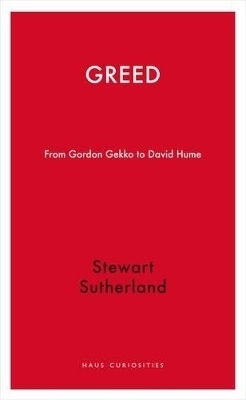
Greed
From Gordon Gekko to David Hume
Seiten
2014
Haus Publishing (Verlag)
978-1-908323-79-8 (ISBN)
Haus Publishing (Verlag)
978-1-908323-79-8 (ISBN)
In 'Wall Street' Gordon Gekko proclaims 'Greed is good'. On the contrary, the philosopher David Hume describes greed as the most destructive of the vices. After the banking crisis, Sutherland examines this most controversial of issues, once again at the heart of how we view our society.
In a riveting scene in the film Wall Street, Gordon Gekko proclaims, 'Greed is good'. The great philosopher David Hume, on the contrary, describes greed as the most destructive of the vices. The banking debacle and the continuing row about bonuses has placed the controversial issue of greed at the very heart of how we view our society. Is Gekko's maxim merely in need of some moderation? After all, incentives are essential to achieve results. Or is it Hume who, uncharacteristically in this instance, lacks moderation? His claim be greed is 'directly destructive of society'. Can this be true? This example of Hume's reasoning illustrates very clearly his attachment to the idea of 'a science of man' rather than religion or sentiment as a basis for moral, social and political practice. Sutherland examines this science and questions its practical applications for the modern age.
In a riveting scene in the film Wall Street, Gordon Gekko proclaims, 'Greed is good'. The great philosopher David Hume, on the contrary, describes greed as the most destructive of the vices. The banking debacle and the continuing row about bonuses has placed the controversial issue of greed at the very heart of how we view our society. Is Gekko's maxim merely in need of some moderation? After all, incentives are essential to achieve results. Or is it Hume who, uncharacteristically in this instance, lacks moderation? His claim be greed is 'directly destructive of society'. Can this be true? This example of Hume's reasoning illustrates very clearly his attachment to the idea of 'a science of man' rather than religion or sentiment as a basis for moral, social and political practice. Sutherland examines this science and questions its practical applications for the modern age.
Stewart Sutherland has been a Crossbench Peer in the House of Lords since 2001, with special interests in education, care needs and research. Prior to that he served as Vice Chancellor of the Universities of Edinburgh and London, as Principal of King's College London, and as Her Majesty's Chief Inspector of Schools.
| Erscheint lt. Verlag | 1.10.2014 |
|---|---|
| Reihe/Serie | Haus Curiosities |
| Verlagsort | London |
| Sprache | englisch |
| Maße | 15 x 25 mm |
| Gewicht | 680 g |
| Themenwelt | Sonstiges ► Geschenkbücher |
| Geisteswissenschaften ► Philosophie ► Ethik | |
| Sozialwissenschaften ► Soziologie | |
| ISBN-10 | 1-908323-79-5 / 1908323795 |
| ISBN-13 | 978-1-908323-79-8 / 9781908323798 |
| Zustand | Neuware |
| Informationen gemäß Produktsicherheitsverordnung (GPSR) | |
| Haben Sie eine Frage zum Produkt? |
Mehr entdecken
aus dem Bereich



aus dem Bereich
Buch | Hardcover (2025)
Suhrkamp (Verlag)
CHF 32,15
eine Philosophie des Lebenssinns
Buch | Hardcover (2025)
Suhrkamp (Verlag)
CHF 36,40


