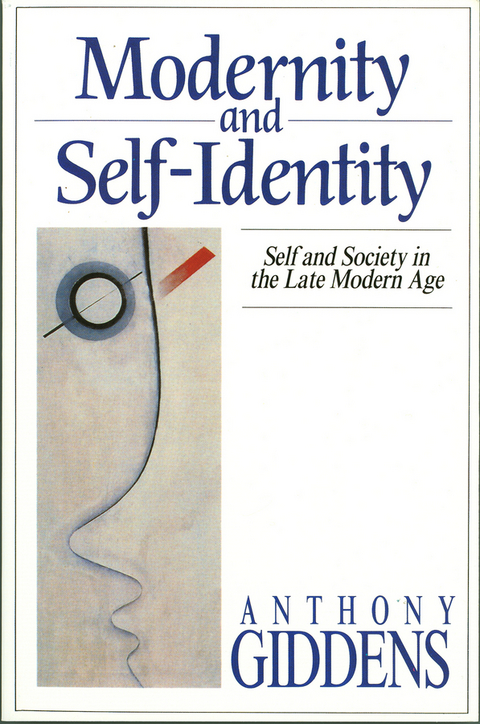
In this book Giddens concerns himself with themes he has often been accused of unduly neglecting, including especially the psychology of self and self-identity. The volumes are a decisive step in the development of his thinking, and will be essential reading for students and professionals in the areas of social and political theory, sociology, human geography and social psychology.
Anthony Giddens is Director of the London School of Economics and Political Science, and also Professor of Sociology at the University of Cambridge.
This major study develops a new account of modernity and its relation to the self. Building upon the ideas set out in The Consequences of Modernity, Giddens argues that 'high' or 'late' modernity is a post traditional order characterised by a developed institutional reflexivity. In the current period, the globalising tendencies of modern institutions are accompanied by a transformation of day-to-day social life having profound implications for personal activities. The self becomes a 'reflexive project', sustained through a revisable narrative of self identity. The reflexive project of the self, the author seeks to show, is a form of control or mastery which parallels the overall orientation of modern institutions towards 'colonising the future'. Yet it also helps promote tendencies which place that orientation radically in question - and which provide the substance of a new political agenda for late modernity. In this book Giddens concerns himself with themes he has often been accused of unduly neglecting, including especially the psychology of self and self-identity. The volumes are a decisive step in the development of his thinking, and will be essential reading for students and professionals in the areas of social and political theory, sociology, human geography and social psychology.
Anthony Giddens is Director of the London School of Economics and Political Science, and also Professor of Sociology at the University of Cambridge.
Acknowledgements vii
Introduction 1
1 The Contours of High Modernity 10
2 The Self: Ontological Security and Existential Anxiety 35
3 The Trajectory of the Self 70
4 Fate, Risk and Security 109
5 The Sequestration of Experience 144
6 Tribulations of the Self 181
7 The Emergence of Life Politics 209
Notes 232
Glossary of Concepts 242
Index 245
'In this book Anthony Giddens brings back in personality, the psyche, human nature itself. It is a pleasure and a real intellectual advance to have a social theorist of his stature revive the once central but long ignored study of personality and culture, character and society, especially a theorist with his very precise sense of what is truly modern in contemporary life.' Professor Dennis Wrong, New York University
1
The Contours of High Modernity
Let me open my discussion by describing some of the findings of a specific sociological study, plucked rather arbitrarily from a particular area of research. Second Chances, by Judith Wallerstein and Sandra Blakeslee, is an investigation of divorce and remarriage.1 The book describes the impact of marriage breakup, over a period of some ten years, on sixty sets of parents and children. Divorce, the authors point out, is a crisis in individuals’ personal lives, which presents dangers to their security and sense of well-being, yet also offers fresh opportunities for their self-development and future happiness. Separation and divorce, and their aftermath, can cause long-lasting anxieties and psychological disturbances; but at the same time the changes brought about by the dissolution of a marriage provide possibilities, as the authors put it, to ‘grow emotionally’, to ‘establish new competence and pride’ and to ‘strengthen intimate relationships far beyond earlier capacities’.
The marital separation, Wallerstein and Blakeslee say, is a marker ‘that freezes certain images which frame the courses of action that ensue. Anger is often rooted in and feeds on the way in which the marriage came apart: one partner suddenly finding the other having an affair with a mutual best friend; one partner leaving a note informing the other, without warning, that the marriage is dead; one parent departing suddenly, taking the children, providing no address …’ A marriage that has come apart tends to be mourned, no matter how unhappy or desperate the partners may have been while they were together.
The longer two people have been with one another, the more protracted tends to be the period of mourning. Mourning derives from the loss of shared pleasures and experiences, plus the necessary abandoning of the hopes once invested in the relationship. Where no process of mourning occurs, the result is often the long-term persistence of hurt feelings, leading perhaps to despair and psychological breakdown. For the majority of people, in fact, the feelings engendered by divorce seem not to disappear completely with the passing of the years; they may be brought violently alive again by subsequent events, such as the remarriage of the previous partner, financial hardship, or quarrels over how the children should be brought up. Where a partner remains quite strongly involved emotionally with the other, even in a largely negative way, the results in such situations tends to be an upsurge of bitterness.
Going through a phase of mourning, according to Wallerstein and Blakeslee, is the key to ‘reclaiming oneself after divorce. Anyone who successfully ‘decouples’ from his or her previous spouse faces the task of establishing a ‘new sense of self, a ‘new sense of identity’. In a long-term marriage, each individual’s sense of self-identity becomes tied to the other person, and indeed to the marriage itself. Following a broken marriage, each person must ‘reach back into his or her early experience and find other images and roots for independence, for being able to live alone, and for undertaking the second chances provided by divorce’.
A separated or divorced person needs moral courage to try new relationships and find new interests. Many people in such circumstances lose confidence in their own judgements and capabilities, and may come to feel that planning for the future is valueless. ‘They sense that life gives hard knocks and is essentially unpredictable; they conclude that the best-laid plans go awry and become discouraged about setting long-range or even short-range goals, much less working towards these goals’. Overcoming such feelings demands persistence in the face of setbacks and a willingness to alter established personal traits or habits. Similar qualities are needed by the children of divorced parents, who often suffer profoundly from the dissolution of the family household. ‘The children of divorce’, Wallerstein and Blakeslee say, ‘face a more difficult task than the children of bereavement. Death cannot be undone, but divorce happens between living people who can change their minds. A reconciliation fantasy taps deep into children’s psyches … they may not overcome this fantasy of reconciliation until they themselves finally separate from their parents and leave home.’2
Personal problems, personal trials and crises, personal relationships: what can these tell us, and what do they express, about the social landscape of modernity? Not much, some would be inclined to argue, for surely personal feelings and concerns are much the same at all times and in all places. The coming of modernity, it might be accepted, brings about major changes in the external social environment of the individual, affecting marriage and the family as well as other institutions; yet people carry on their personal lives much as they always did, coping as best they can with the social transformations around them. Or do they? For social circumstances are not separate from personal life, nor are they just an external environment to them. In struggling with intimate problems, individuals help actively to reconstruct the universe of social activity around them.
The world of high modernity certainly stretches out well beyond the milieux of individual activities and personal engagements. It is one replete with risks and dangers, to which the term ‘crisis’, not merely as an interruption, but as a more or less continuous state of affairs, has particular application. Yet it also intrudes deeply into the heart of self-identity and personal feelings. The ‘new sense of identity’ which Wallerstein and Blakeslee mention as required following divorce is an acute version of a process of ‘finding oneself which the social conditions of modernity enforce on all of us. This process is one of active intervention and transformation.
Wallerstein and Blakeslee summarise the results of their research in a chapter called ‘Danger and Opportunity’. Trite as it is, the phrase applies not only to marriage and its perturbations, but to the world of modernity as a whole. The sphere of what we have today come to term ‘personal relationships’ offers, opportunities for intimacy and self-expression lacking in many more traditional contexts. At the same time, such relationships have become risky and dangerous, in certain senses of these terms. Modes of behaviour and feeling associated with sexual and marital life have become mobile, unsettled and ‘open’. There is much to be gained; but there is unexplored territory to be charted, and new dangers to be courted.
Consider, as an example, a phenomenon discussed extensively by Wallerstein and Blakeslee: the changing nature of stepfamilies. Many people, adults and children, now live in stepfamilies – not usually, as in previous eras, as a consequence of the death of a spouse, but because of the re-forming of marriage ties after divorce. A child in a stepfamily may have two mothers and fathers, two sets of brothers and sisters, together with other complex kin connections resulting from the multiple marriages of parents. Even the terminology is difficult: should a stepmother be called ‘mother’ by the child, or called by her name? Negotiating such problems might be arduous and psychologically costly for all parties; yet opportunities for novel kinds of fulfilling social relations plainly also exist. One thing we can be sure of is that the changes involved here are not just external to the individual. These new forms of extended family ties have to be established by the very persons who find themselves most directly caught up in them.
Anxiety is the natural correlate of dangers of all types. It is caused by disturbing circumstances, or their threat, but also helps mobilise adaptive responses and novel initiatives. Terms such as pain, worry and mourning are repeatedly used by the authors of Second Chances. So are ones like courage and resolution. Life throws up personal problems in an apparently random way and, acknowledging this, some people take refuge in a sort of resigned numbness. Yet many are also able more positively to grasp the new opportunities which open up as pre-established modes of behaviour become foreclosed, and to change themselves. How new are these anxieties, dangers and opportunities? In what ways are they distinctively influenced by the institutions of modernity? These are the questions I shall try to answer in the pages that follow.
Second Chances is a work of sociology, but it will not only be read by sociologists. Therapists, family counsellors, social workers and other concerned professionals are likely to turn its pages. It is perfectly possible that members of the lay public, particularly if they have been recently divorced, will read the book and relate its ideas and conclusions to the circumstances of their own lives. The authors are clearly aware of this likelihood. Although the book is written mainly as a research study presenting a definite set of results, numerous passages scattered through the text suggest practical responses and courses of action which the newly separated or divorced might follow. No doubt few individual books influence overall social behaviour very much. Second Chances is one small contribution to a vast and more or less continuous outpouring of writings, technical and more popular, on the subject of marriage and intimate relationships. Such...
| Erscheint lt. Verlag | 30.4.2013 |
|---|---|
| Sprache | englisch |
| Themenwelt | Sonstiges ► Geschenkbücher |
| Geisteswissenschaften ► Psychologie ► Psychoanalyse / Tiefenpsychologie | |
| Sozialwissenschaften ► Politik / Verwaltung | |
| Sozialwissenschaften ► Soziologie ► Allgemeine Soziologie | |
| Schlagworte | accompanied • argues • characterised • Consequences • current period • developed • Gesellschaftstheorie • Giddens • Globalising • High • Ideas • institutional • Life • Major • Modernity • new account • Order • Post • reflexivity • Relation • self • Social Theory • Sociology • Soziologie • Study • Traditional |
| ISBN-13 | 9780745666488 / 9780745666488 |
| Informationen gemäß Produktsicherheitsverordnung (GPSR) | |
| Haben Sie eine Frage zum Produkt? |
 EPUB (Adobe DRM)
Kopierschutz: Adobe-DRM
Adobe-DRM ist ein Kopierschutz, der das eBook vor Mißbrauch schützen soll. Dabei wird das eBook bereits beim Download auf Ihre persönliche Adobe-ID autorisiert. Lesen können Sie das eBook dann nur auf den Geräten, welche ebenfalls auf Ihre Adobe-ID registriert sind.
Details zum Adobe-DRM
Dateiformat: EPUB (Electronic Publication)
EPUB ist ein offener Standard für eBooks und eignet sich besonders zur Darstellung von Belletristik und Sachbüchern. Der Fließtext wird dynamisch an die Display- und Schriftgröße angepasst. Auch für mobile Lesegeräte ist EPUB daher gut geeignet.
Systemvoraussetzungen:
PC/Mac: Mit einem PC oder Mac können Sie dieses eBook lesen. Sie benötigen eine
eReader: Dieses eBook kann mit (fast) allen eBook-Readern gelesen werden. Mit dem amazon-Kindle ist es aber nicht kompatibel.
Smartphone/Tablet: Egal ob Apple oder Android, dieses eBook können Sie lesen. Sie benötigen eine
Geräteliste und zusätzliche Hinweise
Buying eBooks from abroad
For tax law reasons we can sell eBooks just within Germany and Switzerland. Regrettably we cannot fulfill eBook-orders from other countries.
aus dem Bereich