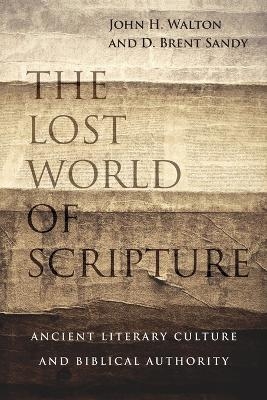
The Lost World of Scripture – Ancient Literary Culture and Biblical Authority
Inter-Varsity Press,US (Verlag)
978-0-8308-4032-8 (ISBN)
Readers' Choice Awards Honorable Mention
Preaching's Preacher's Guide to the Best Bible Reference
From John H. Walton, author of the bestselling Lost World of Genesis One, and D. Brent Sandy, author of Plowshares and Pruning Hooks, comes a detailed look at the origins of scriptural authority in ancient oral cultures and how they inform our understanding of the Old and New Testaments today.
Stemming from questions about scriptural inerrancy, inspiration and oral transmission of ideas, The Lost World of Scripture examines the process by which the Bible has come to be what it is today. From the reasons why specific words were used to convey certain ideas to how oral tradition impacted the transmission of biblical texts, the authors seek to uncover how these issues might affect our current doctrine on the authority of Scripture.
"In this book we are exploring ways God chose to reveal his word in light of discoveries about ancient literary culture," write Walton and Sandy. "Our specific objective is to understand better how both the Old and New Testaments were spoken, written and passed on, especially with an eye to possible implications for the Bible?s inspiration and authority."
The books in the Lost World Series follow the pattern set by Bible scholar John H. Walton, bringing a fresh, close reading of the Hebrew text and knowledge of ancient Near Eastern literature to an accessible discussion of the biblical topic at hand using a series of logic-based propositions.
John H. Walton is professor of Old Testament at Wheaton College. He is the author of several books and commentaries on the Old Testament and its background. His Lost World of Genesis One (IVP Academic) is widely regarded as offering a game-changing perspective. D. Brent Sandy teaches New Testament and Greek at Wheaton College. He is the author of Plowshares and Pruning Hooks: Rethinking the Language of Biblical Propecy and Apocalyptic (IVP Academic).
Preface
Introduction
Part I. The Old Testament World of Composition and Communication
Proposition 1: Ancient Near Eastern societies were hearing-dominant and had nothing comparable to authors and books as we know them
Proposition 2: Expansions and revisions were possible as documents were copied generation after generation and eventually compiled into literary works
Proposition 3: Effective communication must accommodate to the culture and nature of the audience
Proposition 4: The Bible contains no new revelation about the workings and understanding of the material world
Stepping Back and Summing Up: How the composition of the Old Testament may be understood differently in light of what is known of ancient literary culture
Part II. The New Testament World of Composition and Communication
Proposition 5: Much of the literature of the Greco-Roman world retained elements of a hearing-dominant culture
Proposition 6: Oral and written approaches to literature entail significant differences
Proposition 7: Greek historians, philosophers, and Jewish rabbis offer instructive examples of ancient oral culture
Proposition 8: Jesus' world was predominantly non-literate and oral
Proposition 9: Logos/Word referred to oral communication, not to written texts
Proposition 10: Jesus proclaimed truth in oral forms and commissioned his followers to do the same
Proposition 11: Variants were common in the oral texts of Jesus' words and deeds
Proposition 12: Throughout the New Testament the primary focus was on spoken rather than written words
Proposition 13: Exact wording was not necessary to preserve and transmit reliable representations of inspired truth
Stepping Back and Summing Up: How the composition of the New Testament may be understood differently in light of what is known of ancient literary culture
Part III. The Biblical World of Literary Genres
Proposition 14: The authority of Old Testament narrative literature is more connected to revelation than to history
Proposition 15: The authority of Old Testament legal literature is more connected to revelation than to law
Proposition 16: The authority of Old Testament prophetic literature is more connected to revelation than to future-telling
Proposition 17: The genres of the New Testament are more connected to orality than textuality
Part IV. Concluding Affirmations on the Origin and Authority of Scripture
Proposition 18: Scripture confirms its fundamental oral nature
Proposition 19: Scripture asserts its divine source and illocution
Proposition 20: Inerrancy has its strengths and weaknesses
Proposition 21: Belief in authority not only involves what the Bible is but also what we do with it
Faithful Conclusions for Virtuous Readers
Name and Subjest Index
Scripture Index
| Erscheint lt. Verlag | 1.12.2013 |
|---|---|
| Verlagsort | Illinois |
| Sprache | englisch |
| Maße | 154 x 229 mm |
| Gewicht | 462 g |
| Themenwelt | Sonstiges ► Geschenkbücher |
| Religion / Theologie ► Christentum ► Bibelausgaben / Bibelkommentare | |
| Religion / Theologie ► Christentum ► Kirchengeschichte | |
| ISBN-10 | 0-8308-4032-X / 083084032X |
| ISBN-13 | 978-0-8308-4032-8 / 9780830840328 |
| Zustand | Neuware |
| Informationen gemäß Produktsicherheitsverordnung (GPSR) | |
| Haben Sie eine Frage zum Produkt? |
aus dem Bereich