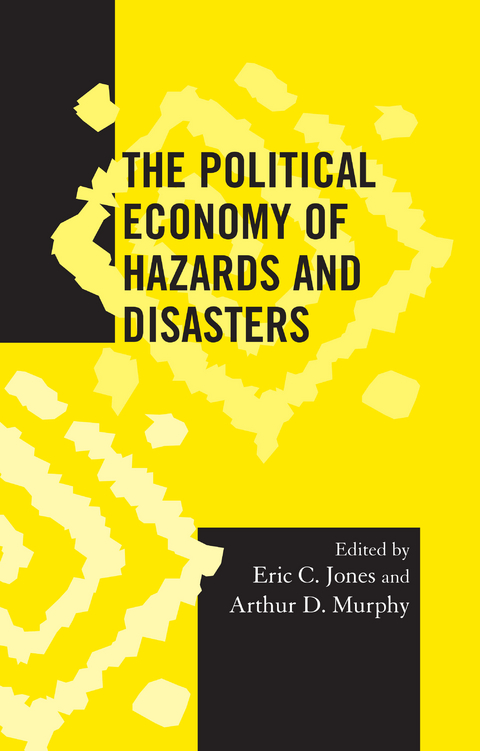
Political Economy of Hazards and Disasters (eBook)
366 Seiten
Altamira Press (Verlag)
978-0-7591-1311-4 (ISBN)
Throughout history, societies have had to decide whom to "e;sacrifice"e; and whom to help in times of disaster. This volume examines how elite groups attempt to maintain power through the use of particular economic, political, and ideological instruments and how both ruling elites and common people endeavor to create meaningful traditions while enduring hardship.The Political Economy of Hazards and Disasters demonstrates how vulnerability is economically constructed, primary producers adapt their production regimes, how traders and merchants adapt their practices, and how political economic objectives play out in recovery efforts.
Eric C. Jones is research scientist in the department of anthropology at the University of North Carolina at Greensboro. Arthur D. Murphy is professor in the department of anthropology at the University of North Carolina at Greensboro.
Chapter 1 I. Economic Parameters of Disasters Chapter 2 Chapter 1. Linking Broad-scale Political Economic Contexts to Fine-scale Economic Consequences in Disaster Research Chapter 3 Chapter 2. Anthropology and the Political Economy of Disasters Chapter 4 II. Class-Based Vulnerability in Disaster Exposure, Impact and Recovery Chapter 5 Chapter 3. The Dam Is Becoming Dangerous and May Possibly Go: The paleodemography and political economy of the Johnstown flood of 1889 Chapter 6 Chapter 4. The invisible toll of Katrina: How social and economic resources are altering the recovery experience among Katrina evacuees in Colorado Chapter 7 Chapter 5. Recovering inequality: Democracy, the market economy and the 1906 San Francisco earthquake and fire Chapter 8 III. The Line between Hazard and Disaster for Primary Producers Chapter 9 Chapter 6. Weak Winters: Dynamic decision-making in the face of extended drought in Ceará, northeast Brazil Chapter 10 Chapter 7. The Impact of Volcanic Hazards on the Ancient Olmec and Epi-Olmec Economies in Los Tuxtlas Region, Veracruz, Mexico Chapter 11 Chapter 8. If the Pyroclastic Flow Doesn't Kill You, the Recovery Will: Cascading impacts of Mt. Tungurahua's eruptions in rural Ecuador Chapter 12 IV. Product Distribution in Hazardous Settings Chapter 13 Chapter 9. When the Lights Go Out: Understanding natural hazard and merchant brownout behavior in the provincial Philippines Chapter 14 Chapter 10. Where Others Fear to Trade: Modeling adaptive resilience in ethnic trading networks to famines, maritime warfare and imperial stability in the growing Indian Ocean economy, ca. 1500-1700 CE Chapter 15 Chapter 11. Madagascar's Cyclone Vulnerability and the Global Vanilla Economy Chapter 16 V. Political Economic Mitigation of Disasters Chapter 17 Chapter 12. Learning from Disaster? Mad cows, squatter fires and temporality in repeated crises Chapter 18 Chapter 13. . Hurricanes Did Not Just Start Happening: Expectations of intervention in the Mississippi Gulf Coast casino industry Chapter 19 Chapter 14. From the Phoenix Effect to Punctuated Entropy: The culture of response as a unifying paradigm of disaster mitigation and recovery
| Erscheint lt. Verlag | 16.5.2009 |
|---|---|
| Reihe/Serie | Society for Economic Anthropology Monograph Series |
| Co-Autor | Margaret Brown, Donald R. Nelson, Rahul Oka, Anthony Oliver-Smith, Christopher Pool, Alan Smart, Josephine Smart, Graham A. Tobin, Jennifer Trivedi, Megan Underhill, Linda M. Whiteford, Shelly Brown, Leslie Lea Williams, Christopher L. Dyer, Timothy J. Finan, Vishwas D. Gogte, Olaf Jaime-Riveron, Steve Kroll-Smith, Chapurukha M. Kusimba, Ty Matejowsky |
| Sprache | englisch |
| Themenwelt | Sonstiges ► Geschenkbücher |
| Sozialwissenschaften ► Ethnologie | |
| Sozialwissenschaften ► Pädagogik | |
| Sozialwissenschaften ► Soziologie | |
| Schlagworte | Economic anthropology |
| ISBN-10 | 0-7591-1311-4 / 0759113114 |
| ISBN-13 | 978-0-7591-1311-4 / 9780759113114 |
| Informationen gemäß Produktsicherheitsverordnung (GPSR) | |
| Haben Sie eine Frage zum Produkt? |
 PDF (Adobe DRM)
Kopierschutz: Adobe-DRM
Adobe-DRM ist ein Kopierschutz, der das eBook vor Mißbrauch schützen soll. Dabei wird das eBook bereits beim Download auf Ihre persönliche Adobe-ID autorisiert. Lesen können Sie das eBook dann nur auf den Geräten, welche ebenfalls auf Ihre Adobe-ID registriert sind.
Details zum Adobe-DRM
Dateiformat: PDF (Portable Document Format)
Mit einem festen Seitenlayout eignet sich die PDF besonders für Fachbücher mit Spalten, Tabellen und Abbildungen. Eine PDF kann auf fast allen Geräten angezeigt werden, ist aber für kleine Displays (Smartphone, eReader) nur eingeschränkt geeignet.
Systemvoraussetzungen:
PC/Mac: Mit einem PC oder Mac können Sie dieses eBook lesen. Sie benötigen eine
eReader: Dieses eBook kann mit (fast) allen eBook-Readern gelesen werden. Mit dem amazon-Kindle ist es aber nicht kompatibel.
Smartphone/Tablet: Egal ob Apple oder Android, dieses eBook können Sie lesen. Sie benötigen eine
Geräteliste und zusätzliche Hinweise
Buying eBooks from abroad
For tax law reasons we can sell eBooks just within Germany and Switzerland. Regrettably we cannot fulfill eBook-orders from other countries.
aus dem Bereich