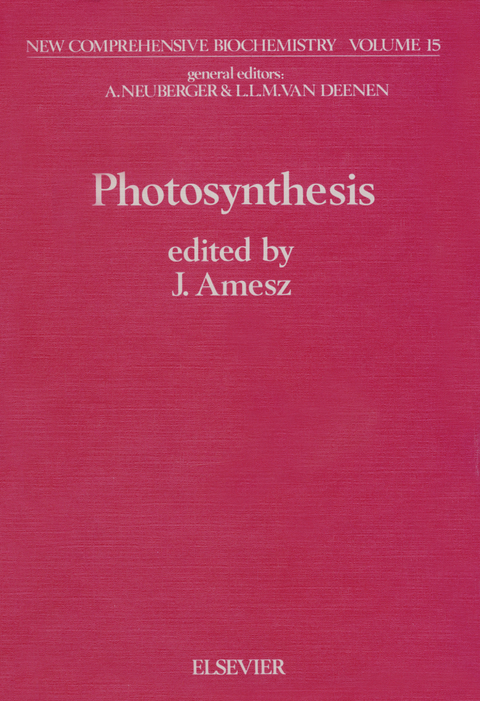
Photosynthesis (eBook)
354 Seiten
Elsevier Science (Verlag)
978-0-08-086074-9 (ISBN)
It is based on the international literature available in the summer of 1986 and much unpublished material. The new material contained in this book, together with a basic framework of established concepts, provide a useful source of reference on the biochemical and biophysical aspects of photosynthesis in plants and bacteria.
The book is written by specialists in the various areas of photosynthesis and is useful both for workers in these areas as a source of specialized information as well as for non-photosynthesists who want to become informed about recent developments and basic concepts in this area.
Photosynthesis is an active area of research in which many exciting developments have taken place in the last few years. This book gives an overview of the present understanding of all areas of molecular processes of photosynthesis. It is based on the international literature available in the summer of 1986 and much unpublished material. The new material contained in this book, together with a basic framework of established concepts, provide a useful source of reference on the biochemical and biophysical aspects of photosynthesis in plants and bacteria. The book is written by specialists in the various areas of photosynthesis and is useful both for workers in these areas as a source of specialized information as well as for non-photosynthesists who want to become informed about recent developments and basic concepts in this area.
Front Cover 1
Photosynthesis 4
Copyright Page 5
Contents 8
Introduction 6
Non-standard abbreviations used in this volume 16
Chapter 1. Energy conversion in higher plants and algae 18
1. Introduction 18
2. Electron transport from water to NADP: an overview 19
3. Photosynthetic phosphorylation 25
4. Molecular and supramolecular structure of thylakoids 29
References 34
Chapter 2. Photosynthetic bacteria 38
1. Introduction 38
2. Filamentous photosynthetic bacteria 40
3. Green sulfur bacteria 43
4. Heliobacterium chlorum – the gram-positive line 45
5. Purple bacteria 46
6. Bacteriochlorophyll a-containing non-phototrophic bacteria 51
7. Phylogeny 52
8. Halobacteria 54
9. Summary 55
References 56
Chapter 3.The bacterial reaction center 60
1. Introduction 60
2. Purification and crystallization of reaction centers 63
3. Protein structure 64
4. BChl, BPh and other prosthetic groups 68
5. Spectroscopic properties and the distinction between BPhL and BPhM 70
6. Electron transfer kinetics and mechanisms 72
Acknowledgements 74
References 74
Chapter 4. The primary reactions of photosystems I and II of algae and higher plants 80
1. Introduction 80
2. Photosystem I reactions 81
3. Photosystem II reactions 92
References 108
Chapter 5. Electron paramagnetic resonance in photosynthesis 114
1. Introduction 114
2. Magnetic resonance for the layman 114
3. Physics of EPR 116
4. EPR of primary reactants in photosynthesis 123
5. The triplet state 130
6. The oxygen-evolving complex 132
7. Electron spin polarization 133
8. New techniques: ESE and RYDMAR 134
9. Conclusions and prospects 136
Acknowledgements 136
References 137
Chapter 6. The photosynthetic oxygen-evolving process 142
1. Introduction 142
2. Oxygen evolution – the minimal unit 143
3. Electron transfer in the oxygen-evolving unit 156
4. Water oxidation in the oxygen-evolving unit 163
5. Conclusions 168
Acknowledgements 169
References 169
Chapter 7. Photophosphorylation in chloroplasts 176
1. History 176
2. General characteristics 177
3. Partial reactions 179
4. Mechanism 182
5. The ATP synthase 184
6. Reverse reactions 186
7. Conclusion 187
References 188
Chapter 8. Carbon dioxide assimilation 192
1. Introduction 192
2. The reductive pentose phosphate cycle 193
3. The C4 pathway 195
4. Crassulacean acid metabolism 197
5. Regulation of the reductive pentose phosphate cycle 200
6. Compartmentation and triose phosphate transport 204
7. Coordination of CO2 fixation and sucrose synthesis 205
8. Regulation of C4 photosynthesis 208
9. Regulation of Crassulacean acid metabolism 210
10. Concluding comments 211
Acknowledgements 212
References 213
Note added in proof 214
Chapter 9. Substrate oxidation and NAD+ reduction by phototrophic bacteria 216
1. Introduction 216
2. Energy-dependent vs. direct reduction of NAD(P)+ 218
3. Succinate oxidation 220
4. Sulfide oxidation 221
5. Thiosulfate oxidation 224
Acknowledgements 225
References 225
Chapter 10. Structure and function of protein complexes in the photosynthetic membrane 230
1. Introduction 230
2. Cytochrome b6-f complex 231
3. The proton-A TPase complex 233
4. Photosystem I reaction center 236
5. Photosystem II 240
References 244
Chapter 11. Structure and function of light-harvesting pigment-protein complexes 250
1. Introduction 250
2. Light-harvesting antennae of photosynthetic bacteria 253
3. Accessory light-harvesting antenna systems (phycobilisomes) of cyanobacteria, red algae and of cryptomonads 264
4. Light-harvesting antennae of algae and higher plants 278
References 283
Chapter 12. Molecular organization of thylakoid membranes 290
1. Introduction 290
2. Transverse organization of thylakoid membranes 291
3. Lateral distribution of thylakoid components 298
4. Consequences of lateral heterogeneity 305
5. Thylakoid stacking 309
6. Epilogue 311
References 312
Chapter 13. Structure and exciton effects in photosynthesis 316
1. Introduction 316
2. Theoretical concepts 316
3. Purple bacterial antennas 318
4. Chl a/b-protein complex 323
5. BChl a-protein from P. aestuarii 325
6. Purple bacterial reaction centers 328
7. C-phycocyanin 331
References 332
Chapter 14. Genetics and synthesis of chloroplast membrane proteins 336
1. Introduction 336
2. Photosystem II 336
3. Cytochrome b-f complex 346
4. Photosystem I 349
5. ATP synthase 352
6. Conclusions and future directions 355
Acknowledgements 355
References 356
Chapter 15. Evolution of photosynthesis 360
1. Introduction 360
2. The origin of chloroplasts 360
3. The origin of photosynthesis 362
4. Reaction center structure 362
5. A minimal model 365
6. Photosynthesis 366
References 367
| Erscheint lt. Verlag | 1.7.1987 |
|---|---|
| Sprache | englisch |
| Themenwelt | Sonstiges ► Geschenkbücher |
| Naturwissenschaften ► Biologie ► Biochemie | |
| Naturwissenschaften ► Biologie ► Botanik | |
| Naturwissenschaften ► Physik / Astronomie ► Angewandte Physik | |
| Technik | |
| ISBN-10 | 0-08-086074-5 / 0080860745 |
| ISBN-13 | 978-0-08-086074-9 / 9780080860749 |
| Informationen gemäß Produktsicherheitsverordnung (GPSR) | |
| Haben Sie eine Frage zum Produkt? |
 PDF (Adobe DRM)
Kopierschutz: Adobe-DRM
Adobe-DRM ist ein Kopierschutz, der das eBook vor Mißbrauch schützen soll. Dabei wird das eBook bereits beim Download auf Ihre persönliche Adobe-ID autorisiert. Lesen können Sie das eBook dann nur auf den Geräten, welche ebenfalls auf Ihre Adobe-ID registriert sind.
Details zum Adobe-DRM
Dateiformat: PDF (Portable Document Format)
Mit einem festen Seitenlayout eignet sich die PDF besonders für Fachbücher mit Spalten, Tabellen und Abbildungen. Eine PDF kann auf fast allen Geräten angezeigt werden, ist aber für kleine Displays (Smartphone, eReader) nur eingeschränkt geeignet.
Systemvoraussetzungen:
PC/Mac: Mit einem PC oder Mac können Sie dieses eBook lesen. Sie benötigen eine
eReader: Dieses eBook kann mit (fast) allen eBook-Readern gelesen werden. Mit dem amazon-Kindle ist es aber nicht kompatibel.
Smartphone/Tablet: Egal ob Apple oder Android, dieses eBook können Sie lesen. Sie benötigen eine
Geräteliste und zusätzliche Hinweise
Buying eBooks from abroad
For tax law reasons we can sell eBooks just within Germany and Switzerland. Regrettably we cannot fulfill eBook-orders from other countries.
aus dem Bereich