


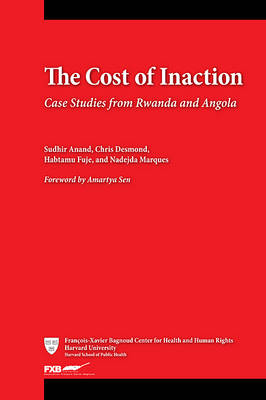
The Cost of Inaction
Case Studies from Rwanda and Angola
Seiten
2012
Fxb Center for Health and Human Rights (Verlag)
978-0-674-06558-1 (ISBN)
Fxb Center for Health and Human Rights (Verlag)
978-0-674-06558-1 (ISBN)
Case studies from Rwanda and Angola show how the cost of inaction can be greater than the cost of action. Failure to reduce extreme poverty, for example, often results in malnutrition, preventable morbidity, premature death, and incomplete basic education. Differences between the COI approach and traditional benefit-cost analysis are highlighted.
This book is motivated by the idea that the cost of inaction can be much greater than the cost of action. Inaction can lead to serious negative consequences—for individuals, the economy, and society. The consequences of a failure to reduce extreme poverty, for example, typically include malnutrition, preventable morbidity, premature mortality, incomplete basic education, and other human and social development costs. In this volume, the authors seek to clarify exactly what is meant by “cost of inaction.” They develop a methodology to account for the consequences and estimate the costs of a failure to respond to the needs of children and their families. Their conceptual framework emphasizes the need to select appropriate actions against which inaction is evaluated. The authors present the results of applying the cost of inaction (COI) approach to six case studies from Rwanda and Angola. The case studies highlight important differences between the COI approach and benefit-cost analysis as it is traditionally implemented.
This book is motivated by the idea that the cost of inaction can be much greater than the cost of action. Inaction can lead to serious negative consequences—for individuals, the economy, and society. The consequences of a failure to reduce extreme poverty, for example, typically include malnutrition, preventable morbidity, premature mortality, incomplete basic education, and other human and social development costs. In this volume, the authors seek to clarify exactly what is meant by “cost of inaction.” They develop a methodology to account for the consequences and estimate the costs of a failure to respond to the needs of children and their families. Their conceptual framework emphasizes the need to select appropriate actions against which inaction is evaluated. The authors present the results of applying the cost of inaction (COI) approach to six case studies from Rwanda and Angola. The case studies highlight important differences between the COI approach and benefit-cost analysis as it is traditionally implemented.
Sudhir Anand is Professor of Economics at the University of Oxford and Senior Fellow at St. Catherine's College, Oxford. Chris Desmond is Research Associate at the François-Xavier Bagnoud (FXB) Center for Health and Human Rights at Harvard University. Habtamu Fuje is Research Coordinator at the FXB Center for Health and Human Rights, Harvard University. Nadejda Marques is Research Coordinator at the FXB Center for Health and Human Rights, Harvard University. Amartya Sen is Lamont University Professor at Harvard University.
| Erscheint lt. Verlag | 4.7.2012 |
|---|---|
| Vorwort | Amartya Sen |
| Zusatzinfo | 1 black and white illustration, 90 tables |
| Sprache | englisch |
| Maße | 152 x 229 mm |
| Gewicht | 567 g |
| Themenwelt | Sonstiges ► Geschenkbücher |
| Sozialwissenschaften ► Soziologie | |
| Wirtschaft ► Volkswirtschaftslehre | |
| ISBN-10 | 0-674-06558-1 / 0674065581 |
| ISBN-13 | 978-0-674-06558-1 / 9780674065581 |
| Zustand | Neuware |
| Informationen gemäß Produktsicherheitsverordnung (GPSR) | |
| Haben Sie eine Frage zum Produkt? |
Mehr entdecken
aus dem Bereich



aus dem Bereich
Der Junge, der Maulwurf, der Fuchs, das Pferd und der Sturm
Buch | Hardcover (2025)
Penguin (Verlag)
CHF 38,90
Eine besondere Liebeserklärung zum Ausfüllen und Verschenken. Das …
Buch | Hardcover (2023)
riva (Verlag)
CHF 19,90


