


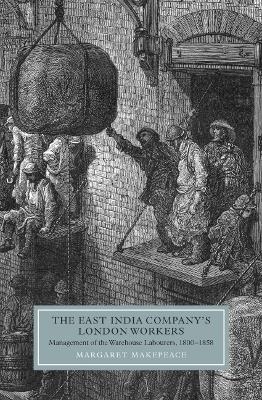
The East India Company's London Workers
Management of the Warehouse Labourers, 1800-1858
Seiten
2010
The Boydell Press (Verlag)
978-1-84383-585-1 (ISBN)
The Boydell Press (Verlag)
978-1-84383-585-1 (ISBN)
An assessment of how the East India Company managed the labourers in its London warehouses, which was one of the largest commercial workforces in its day.
The East India Company, which was by 1800 a commercial organisation of unrivalled size and complexity managing a vast empire in Asia, also played a crucial role in the British economy, particularly in London, where the Company wasthe largest employer of civilian labour in the early nineteenth century, with thousands of workmen in its metropolitan warehouses. This book provides a detailed examination of the management strategies used by the Company to control its London warehouse labourers and to maintain acceptable levels of commercial and corporate efficiency. It shows how benevolence formed an integral part of the Company's domestic business practices, with discipline, punishment, regulation and restriction counterbalanced by incentives, rewards and paternalistic practices, such as fair and regular wages, pensions, a comprehensive welfare scheme, free medical treatment and an in-house savings bank. The book also outlines how, when the Charter Act of 1833 brought about the closure of the vast majority of the Company's London warehouses, the directors instigated a pioneering redundancy compensation scheme for the labourers.
MARGARET MAKEPEACE is a Senior Archivist in the India Office Records at the British Library.
The East India Company, which was by 1800 a commercial organisation of unrivalled size and complexity managing a vast empire in Asia, also played a crucial role in the British economy, particularly in London, where the Company wasthe largest employer of civilian labour in the early nineteenth century, with thousands of workmen in its metropolitan warehouses. This book provides a detailed examination of the management strategies used by the Company to control its London warehouse labourers and to maintain acceptable levels of commercial and corporate efficiency. It shows how benevolence formed an integral part of the Company's domestic business practices, with discipline, punishment, regulation and restriction counterbalanced by incentives, rewards and paternalistic practices, such as fair and regular wages, pensions, a comprehensive welfare scheme, free medical treatment and an in-house savings bank. The book also outlines how, when the Charter Act of 1833 brought about the closure of the vast majority of the Company's London warehouses, the directors instigated a pioneering redundancy compensation scheme for the labourers.
MARGARET MAKEPEACE is a Senior Archivist in the India Office Records at the British Library.
Introduction
The East India Company Warehouses
The Warehouse Labourers
Management Strategies: Incentives, Rewards and Benevolence
Management Strategies: Systems of Internal Control
The Royal East India Volunteers: The 'Union of Civil and Military Dependence'
The Relationship between the East India Company and its London Warehouse Labourers
The Warehouse Closures
Management of the Warehouse Labourers and Pensioners 1838-1858
Conclusion: 'Good Masters to the Lower Class of their Dependents'
| Erscheint lt. Verlag | 21.10.2010 |
|---|---|
| Reihe/Serie | Worlds of the East India Company |
| Zusatzinfo | 3 b/w illus. |
| Verlagsort | Woodbridge |
| Sprache | englisch |
| Maße | 156 x 234 mm |
| Gewicht | 467 g |
| Themenwelt | Sonstiges ► Geschenkbücher |
| Geschichte ► Allgemeine Geschichte ► Neuzeit (bis 1918) | |
| Wirtschaft ► Volkswirtschaftslehre ► Makroökonomie | |
| ISBN-10 | 1-84383-585-1 / 1843835851 |
| ISBN-13 | 978-1-84383-585-1 / 9781843835851 |
| Zustand | Neuware |
| Informationen gemäß Produktsicherheitsverordnung (GPSR) | |
| Haben Sie eine Frage zum Produkt? |
Mehr entdecken
aus dem Bereich



aus dem Bereich
Geschichte einer wilden Handlung
Buch | Hardcover (2024)
C.H.Beck (Verlag)
CHF 47,60


