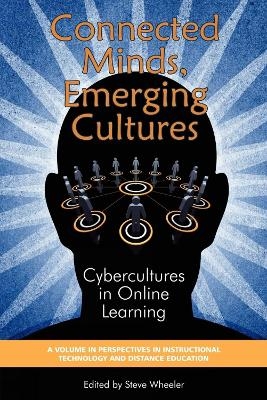
Connected Minds, Emerging Cultures
Information Age Publishing (Verlag)
978-1-60752-015-3 (ISBN)
- Titel z.Zt. nicht lieferbar
- Versandkostenfrei
- Auch auf Rechnung
- Artikel merken
As the title indicates, this book highlights the shifting and emergent features that represent life online, specifically in and around the territory of e-learning.
Cybercultures in themselves are complex conglomerations of ideas, philosophies, concepts, and theories, some of which are fiercely contradictory. As a construct, 'cyberculture' is a result of sustained attempts by diverse groups of people to make sense of multifarious activities, linguistic codes, and practices in complicated and ever-changing settings. It is an impossibly convoluted field. Any valid understanding of cyberculture can only be gained from living within it, and as Bell suggests, it is 'made up of people, machines and stories in everyday life.' Although this book contains a mix of perspectives, as the chapters progress, readers should detect some common threads.
Technology-mediated activities are featured throughout, each evoking its particular cultural nuances and, as Derrick de Kerckhove (1997) has eloquently argued, technology acts as the skin of culture. All the authors are passionate about their subjects, every one engages critically with his or her topics, and each is fully committed to the belief that e-learning is a vitally important component in the future of education. All of the authors believe that digital learning environments will contribute massively to the success of the information society we now inhabit. Each is intent on exploration of the touchstone of 'any time, any place' learning where temporal and spatial contexts cease to become barriers to learning, and where the boundaries are blurring between the formal and informal.
This book is divided into four sections. In Part I, which has been titled 'Digital Subcultures,' we begin an exploration of 'culture' and attempt to locate the learner within a number of digital subcultures that have arisen around new and emerging technologies such as mobile and handheld devices, collaborative online spaces, and podcasting. The chapters in this section represent attempts by the authors to demonstrate that there are many subdivisions present on the Web, and that online learners cannot and should not be represented as one vast amorphous mass of 'Internet' users.
Foreword; Howard Rheingold.
Introduction; Steve Wheeler.
Part I. Digital Subcultures.
Chapter 1. Learning in Collaborative Spaces: Encouraging a Culture of Sharing; Steve Wheeler.
Chapter 2. Mobile Subcultures; John Traxler.
Chapter 3. Podcasting: A Listening Culture; Palitha Edirisingha.
Chapter 4. The Emergence of Ubiquitous and Pervasive Learning Cultures; Mark A. M. Kramer.
Part II. Roles and Identities.
Chapter 5. Identity in Cyberspace; Hugh Miller and Jill Arnold.
Chapter 6. Digital Tribes, Virtual Clans; Steve Wheeler.
Chapter 7. Gaming and the Network Generation; Nichola Whitton.
Chapter 8. Creating an Online Course Generational Community; Leon James.
Chapter 9. The Social Impact of Personal Learning Environments; Graham Attwell.
Part III. Cyber Perspectives.
Chapter 10. Emerging Online Practices: An Endo-Aesthetic Approach to E-tutoring and E-learning; Viv Tucker.
Chapter 11. Cyberculture and Poststructural Approaches; Ken Gale.
Chapter 12. Cyborg Theory and Learning; Vasi van Deventer.
Chapter 13. Transfer Through Learning Flexibility and Hypertextuality; Gorg Mallia.
Part IV. Narratives and Case Studies.
Chapter 14. Cybercrime in Society; Steven Furnell.
Chapter 15. Language Evolution in Txting Environments; Tim Shortis.
Chapter 16. The Cultural Impact of E-learning and Intranets on Corporate Employees; David Guralnick and Deb Larson.
Chapter 17. Imagined Worlds, Emerging Cultures; Steve Wheeler and Helen Keegan.
Author Biographies.
Index.
| Erscheint lt. Verlag | 30.3.2009 |
|---|---|
| Reihe/Serie | Perspectives in Instructional Technology and Distance Education |
| Sprache | englisch |
| Maße | 156 x 234 mm |
| Gewicht | 430 g |
| Themenwelt | Schulbuch / Wörterbuch ► Unterrichtsvorbereitung ► Unterrichts-Handreichungen |
| Sozialwissenschaften ► Pädagogik | |
| ISBN-10 | 1-60752-015-X / 160752015X |
| ISBN-13 | 978-1-60752-015-3 / 9781607520153 |
| Zustand | Neuware |
| Informationen gemäß Produktsicherheitsverordnung (GPSR) | |
| Haben Sie eine Frage zum Produkt? |
aus dem Bereich