


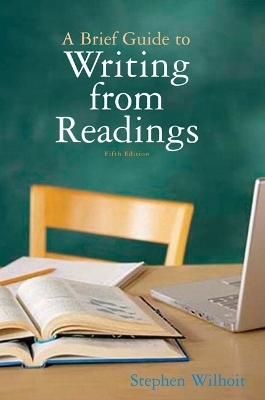
A Brief Guide to Writing from Readings
Pearson (Verlag)
978-0-205-67459-6 (ISBN)
- Titel erscheint in neuer Auflage
- Artikel merken
Comprehensive enough to serve as a primary text yet compact enough to serve as a supplement, this clear and concise writing guide teaches you how to critically read, clearly summarize, carefully respond to, precisely critique, creatively synthesize, and accurately quote or paraphrase texts. A Brief Guide is a valuable teaching and reference tool that many disciplines find useful for class work and for independent study.
Preface.
1. Critical Reading.
Definition and Purpose.
Asking Questions about What You Read.
Marking Texts.
Sample Annotated Reading: “Hard Choices” by Patrick Moore.
Note-Taking.
Additional Reading: “Getting Serious about Eradicating Binge Drinking” by Henry Wechsler.
Summary Chart-Critical Reading: Asking Questions.
Summary Chart-Critical Reading: Marking Texts.
Summary Chart-Critical Reading: Note Taking.
2. Quotation.
Definition and Purpose.
Guidelines on When to Quote Material.
Guidelines on When Not to Quote Material.
Integrating Quotations into Your Writing.
Reading: “Missing Link.”
Altering Quoted Material and Avoiding Misquotations.
Summary Chart: Guidelines on Quotations.
Summary Chart: Integrating Quotations into Your Writing.
3. Paraphrase.
Definition and Purpose.
Qualities of a Good Paraphrase.
How to Paraphrase Material.
Documentation.
Summary Chart: How to Write Paraphrase Material.
4. Summary.
Definition and Purpose.
Types of Summaries.
Qualities of a Good Summary.
How to Summarize a Text.
Documentation.
Sample Summaries.
Reading: “AIDS and Population `Control'” by Gerard Piel.
Sample Informative Summary.
Sample Explanatory Summary.
Summary Chart: How to Write a Summary.
5. Response Essays.
Definition and Purpose.
Qualities of a Good Response Essay.
Writing the Response Essay.
Sample Response Essay: A Response to “AIDS and Population `Control’.”
Summary Chart: How to Write a Response Essay.
6. Critique.
Definition and Purpose.
The Film Review as Critique.
Writing a Critique.
* Reading: “Should Cell Phones Be Banned from the Classroom? Yes,” by Josh Allen
* Reading: “Should Cell Phones Be Banned from the Classroom? No,” by Liz Kolb
* Sample Critique: “An Unconvincing Argument against Cell Phones”
* Additional Reading: “Crafting a Workable Cell Phone Policy,” by Ellen R. DeLisioSummary Chart: How to Write a Critique.
7. Rhetorical Analysis.
Definition and Purpose.
The Rhetorical Situation.
Rhetorical Strategies.
Analyzing a Text's Rhetorical Strategies-An Example.
Writing a Rhetorical Analysis Essay.
Sample Rhetorical Analysis Essay.
Summary Chart: How to Write a Rhetorical Analysis Essay.
8. Reading and Writing about Visual Texts.
Definition and Purpose
Reading Visual Texts Critically
Reading a Visual Text: An Example
Writing an Evaluation of a Visual Text
Step 1—Carefully Read the Assignment
Step 2—Analyze and Describe the Text
Step 3—Establish the Text’s Rhetorical Situation
Step 4—Determine How the Text Attempts to Achieve Its Rhetorical Goal
Step 5—Determine Your Thesis
Step 6—Write a Rough Draft
Step 7—Revise Your Essay
* Sample Evaluation of a Visual Text
Summary Chart: How to Write an Evaluation of a Visual Text.
9. Informative Synthesis.
Definition and Purpose.
Types of Synthesis Essays.
* Reading: “Bombs Trump Big Ideas in Potent `Vendetta,’” by Ty Burr.
* Reading: “Can a Popcorn Movie also Be Political? This One Can,” by Richard Corliss.
* Reading: “Quite the Bomb: `V for Vendetta’ Can Blow Away Parliament, but Not Its Audience,” by Stephen Hunter
Informative Synthesis.
* Sample Informative Synthesis Essay.Summary Chart: How to Write an Informative Synthesis. 10. Argumentative Synthesis.
Definition.
The Elements of Argument.
Argument and Persuasion.
Writing an Argumentative Synthesis Essay.
* Sample Argumentative Synthesis (Focusing on the Quality of the Readings).
* Sample Argumentative Synthesis (Focusing on the Topic of the Readings).
Additional Reading: "College Prep: Adapting to College Life in an Era of Heightened Stress" by Glenn C. Altschuler.
Additional Reading: "More in College Seek Help for Psychological Problems" by Erica Goode.
Additional Reading: "Complex Set of Ills Spurs Rising Teen Suicide Rate" by Jessica Portner.
Additional Reading: "Suicide and Depression Among College Students: A Decade Later" by Susan R. Furr, John S. Westefeld, Gaye N. McConnell, and J. Marshall Jenkins.
Summary Chart: How to Write an Argumentative Synthesis.
11. Plagiarism.
Definition.
Forms of Plagiarism.
How to Avoid Plagiarism.
Summary Chart: Plagiarism.
12. Documentation.
Definition and Purpose.
Types of Documentation.
Primary Academic Style Manuals.
APA Guidelines.
CSE Guidelines.
MLA Guidelines.
13. Reference Lists and Works Cited Entries.
Definition and Purpose.
APA Format.
CSE Format.
MLA Format.
14. Timed Writing Assignments.
Definition.
A Range of Timed Writing Assignments, Purposes, and Conditions.
Qualities of a Good Timed Essay.
Writing Timed Assignments.
Final Thoughts.
Summary Chart: How to Write Timed Essays.
Appendix 1.
Revision Checklists
Appendix 2.
Peer Review Guidelines.
Appendix 3.
Revision Guidelines.
Index.
Credits.
* New to this edition
| Erscheint lt. Verlag | 28.5.2009 |
|---|---|
| Sprache | englisch |
| Maße | 228 x 151 mm |
| Gewicht | 434 g |
| Themenwelt | Schulbuch / Wörterbuch ► Wörterbuch / Fremdsprachen |
| Geisteswissenschaften ► Sprach- / Literaturwissenschaft ► Sprachwissenschaft | |
| ISBN-10 | 0-205-67459-3 / 0205674593 |
| ISBN-13 | 978-0-205-67459-6 / 9780205674596 |
| Zustand | Neuware |
| Informationen gemäß Produktsicherheitsverordnung (GPSR) | |
| Haben Sie eine Frage zum Produkt? |
aus dem Bereich


