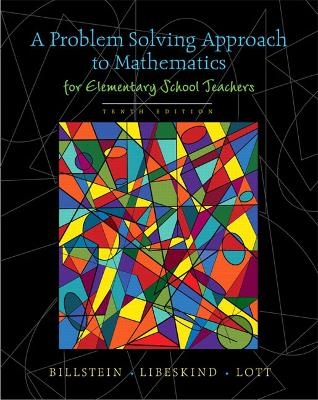
A Problem Solving Approach to Mathematics for Elementary School Teachers
Pearson
9780321570550 (ISBN)
- Titel erscheint in neuer Auflage
- Artikel merken
This is a standalone book, if you want the book/access card order the ISBN listed below:
0321573307 / 9780321573308 Problem Solving Approach to Mathematics for Elementary School Teachers plus MyMathLab Student Access Kit, A
Package consists of:
0321431308 / 9780321431301 MyMathLab/MyStatLab -- Glue-in Access
0321570553 / 9780321570550 Problem Solving Approach to Mathematics for Elementary School Teachers, A
0321654064 / 9780321654069 MyMathLab Inside Star Sticker
Rick Billstein is a Professor of Mathematics at the University of Montana. He has worked in mathematics teacher education at this university for over 40 years and his current research is in the areas of curriculum development and mathematics teacher education. He teaches courses for future teachers in the Mathematics Department. He served as the site director for the Show-Me Project, an NSF-funded project supporting the dissemination and implementation of standards-based middle grades mathematics curricula. He worked on the NSF grant Tinker Plots to develop new data analysis software and he serves on the Advisory Boards for several other national projects. From 1992-1997, he directed the NSF-funded Six Through Eight Mathematics (STEM) middle school mathematics curriculum project and is now directing the Middle Grades MATHThematics Phase II Project. Dr. Billstein has published articles in over 20 different journals, and has co-authored over 40 books, including ten editions ofA Problem Solving Approach to Mathematics for Elementary Teachers. He typically does about 25 regional and national presentations per year and has worked in mathematics education at the international level. He presently serves on the Editorial Board of NCTM’s Mathematics Teaching in the Middle School. Dr. Billstein was recently awarded the George M. Dennison Presidential Faculty Award for Distinguished Accomplishment at the University of Montana. Shlomo Libeskind is a professor in the mathematics department at the University of Oregon in Eugene, Oregon, and has been responsible there for the mathematics teaching major since 1986. In addition to teaching and advising pre-service and in-service teachers, Dr. Libeskind has extensive writing experience (books, articles, and workshop materials) as well as in directing mathematics education projects. In teaching and in writing, Dr. Libeskind uses a heuristic approach to problem solving and proof; in this approach the reasonableness of each step in a solution or proof is emphasized along with a discussion on why one direction might be more promising than another. As part of his focus on the improvement of the teaching of mathematics, Dr. Libeskind is also involved at many levels locally, nationally, and worldwide in the evaluation of mathematics teacher preparation programs. In his home state, he is actively involved in schools and councils, as well as in reviewing materials for the state standards for college admission. Most recently (spring 2008) he visited teacher colleges in Israel as a Fulbright Fellow. During this visit he conducted observations and critiques of the preparation of mathematics teachers at several colleges in Northern Israel. Dr. Libeskind received his Bachelor’s and Master’s Degrees in Mathematics at the Technion (Israel Institute of Technology) and his PhD in Mathematics at the University of Wisconsin, Madison. Johnny W. Lott began his teaching career in the public schools of DeKalb County, Georgia, outside Atlanta. There he taught mathematics in grades 8-12. He also taught one year at the Westminster Schools, grades 9-12, and one year in the Pelican, Alaska, school, grades 6-12. Johnny is the co-author of several books and has written numerous articles and other essays in the "Arithmetic Teacher", "Teaching Children Mathematics", "The Mathematics Teacher", "School Science and Mathematics", "Student Math Notes", and "Mathematics Education Dialogues". He was the Project Manager for the "Figure This!" publications and website developed by the National Council of Teachers of Mathematics (NCTM) and was project co-director of the State Systemic Initiative for Montana Mathematics and Science (SIMMS) Project. He has served on many NCTM committees, has been a member of its Board of Directors, and was its president from April 2002-April 2004. Dr. Lott is Professor Emeritus from the Department of Mathematical Sciences at The University of Montana, having been a full professor. He is currently the Director of the Center for Excellence in Teaching and Learning, Professor of Mathematics, and Professor of Education at the University of Mississippi. Additionally, he is on the Steering Committee of the Park City Mathematics Institute, works with the International Seminar, the Designing and Delivering Professional Development Seminar, and is editor for its high school publications. His doctorate is in mathematics education from Georgia State University.
1. An Introduction to Problem Solving
1-1 Mathematics and Problem Solving
1-2 Explorations with Patterns
1-3 Reasoning and Logic: An Introduction
2. Numeration Systems and Sets
2-1 Numeration Systems
2-2 Describing Sets
2-3 Other Set Operations and Their Properties
3. Whole Numbers and Their Operations
3-1 Addition and Subtraction of Whole Numbers
3-2 Algorithms for Whole-Number Addition and Subtraction
3-3 Multiplication and Division of Whole Numbers
3-4 Algorithms for Whole-Number Multiplication and Division
3-5 Mental Mathematics and Estimation for Whole-Number Operations
4. Algebraic Thinking
4-1 Variables
4-2 Equations
4-3 Functions
5. Integers and Number Theory
5-1 Integers and the Operations of Addition and Subtraction
5-2 Multiplication and Division of Integers
5-3 Divisibility
5-4 Prime and Composite Numbers
5-5 Greatest Common Divisor and Least Common Multiple
5-6 *Clock and Modular Arithmetic
6. Rational Numbers as Fractions
6-1 The Set of Rational Numbers
6-2 Addition and Subtraction of Rational Numbers
6-3 Multiplication and Division of Rational Numbers
7. Decimals and Real Numbers
7-1 Introduction to Decimals
7-2 Operations on Decimals
7-3 Nonterminating Decimals
7-4 Real Numbers
7-5 Using Real Numbers in Equations
8. Proportional Reasoning, Percents and Applications
8-1 Ratios, Proportions and Proportional Reasoning
8-2 Percents
8-3 Computing Interest
9. Probability
9-1 How Probabilities are Determined
9-2 Multistage Experiments with Tree Diagrams and Geometric Probabilities
9-3 Using Simulations in Probability
9-4 Odds, Conditional Probability, and Expected Value
9-5 Using Permutations and Combinations in Probability
10. Data Analysis/Statistics: An Introduction
10-1 Displaying Data: Part I
10-2 Displaying Data: Part II
10-3 Measures of Central Tendency and Variation
10-4 Abuses of Statistics
10-5 Designing Experiments/Collecting Data (found online on the catalog page under “Take a Closer Look”)
11. Introductory Geometry
11-1 Basic Notions
11-2 Polygons
11-3 More about Angles
11-4 Geometry in Three Dimensions
11-5 *Networks
12. Constructions, Congruence, and Similarity
12-1 Congruence through Constructions
12-2 Other Congruence Properties
12-3 Other Constructions
12-4 Similar Triangles and Similar Figures
12-5 Lines and Linear Equations in a Cartesian Coordinate System
12-6 *Trigonometry Ratios via Similarity (found online on the catalog page under “Take a Closer Look”)
13. Concepts of Measurement
13-1 Linear Measure
13-2 Areas of Polygons and Circles
13-3 The Pythagorean Theorem, Distance Formula, and Equation of a Circle
13-4 Surface Areas
13-5 Volume, Mass, and Temperature
14. Motion Geometry and Tessellations
14-1 Translations and Rotations
14-2 Reflections and Glide Reflections
14-3 Size Transformations
14-4 Symmetries
14-5 Tessellations of the Plane
The Appendices are now full chapters to help students with specific technology tools: Using a Spreadsheet, Graphing Calculators, and Using a Geometry Drawing Utility. These chapters are available in the Technology Manual, which can be shrink-wrapped at no additional cost with the new textbook. See `Packages’ tab for ordering information.
Answers to All/Selected Exercises
Index
Photo Acknowledgments
*Optional Sections
| Erscheint lt. Verlag | 25.2.2009 |
|---|---|
| Sprache | englisch |
| Maße | 259 x 208 mm |
| Gewicht | 2184 g |
| Themenwelt | Schulbuch / Wörterbuch |
| Sozialwissenschaften ► Pädagogik ► Schulpädagogik / Grundschule | |
| ISBN-13 | 9780321570550 / 9780321570550 |
| Zustand | Neuware |
| Informationen gemäß Produktsicherheitsverordnung (GPSR) | |
| Haben Sie eine Frage zum Produkt? |
aus dem Bereich