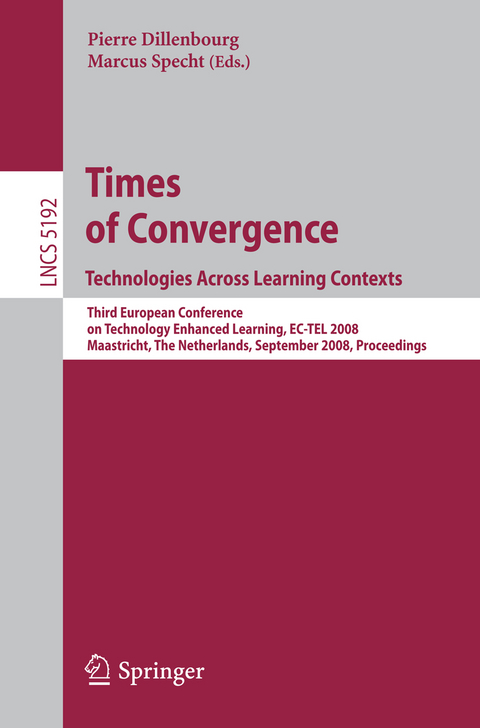
Times of Convergence. Technologies Across Learning Contexts
Springer Berlin (Verlag)
978-3-540-87604-5 (ISBN)

Using Interaction Analysis to Reveal Self-Regulated Learning in Virtual Communities.- Evaluating Spatial Knowledge through Problem-Solving in Virtual Learning Environments.- Role-Play Virtual Environments: Recreational Learning of Software Design.- A Socio-technical Approach towards Supporting Intra-organizational Collaboration.- Reflect: An Interactive Table for Regulating Face-to-Face Collaborative Learning.- Face to Face Cooperation with CoFFEE.- The Influence of the Faculty Attitude on the Adoption of ICTs' Innovations for Learning Purposes: Analysis of a Shared Web.- Flexible Analysis of User Actions in Heterogeneous Distributed Learning Environments.- A Service Providing Awareness of Learning Object Evolutions in a Distributed Environment.- ALOA: A Web Services Driven Framework for Automatic Learning Object Annotation.- Reusing Collaborative Knowledge as Learning Objects -The Implementation and Evaluation of AnnForum.- Evaluation of Interoperability between MOT and Regular Learning Management Systems.- Implications of Writing, Reading, and Tagging on the Web for Reflection Support in Informal Learning.- A Distributed Ontological Approach as a Basis for Software in the Context of Academic Programs.- Systems Engineering for Technology Enhanced Learning.- Defining Adaptation in a Generic Multi Layer Model: CAM: The GRAPPLE Conceptual Adaptation Model.- Imperfect Answers in Multiple Choice Questionnaires.- Towards a Semantic-Rich Collaborative Environment for Learning Software Patterns.- Tinkering or Sketching: Apprentices' Use of Tangibles and Drawings to Solve Design Problems.- Design of an Annotation Tool to Support Simulation Training of Medical Teams.- A Domain-Specific-Modeling Approach to Support Scenarios-Based Instructional Design.- A Heuristic NLPBased Approach for Getting Didactic Resources from Electronic Documents.- Fostering Self-Directed Learning with Social Software: Social Network Analysis and Content Analysis.- Capture of Lifecycle Information to Support Personal Information Management.- A Model of Re-use of E-Learning Content.- Knowledge Services for Work-Integrated Learning.- Designing Software for Pupils with Special Needs: Analysis of an Example for Complementary Action Design.- Adaptation in the Context of Explanatory Visualization.- Interaction Analysis Supporting Participants' Self-regulation in a Generic CSCL System.- WHURLE 2.0: Adaptive Learning Meets Web 2.0.- Towards Accessing Disparate Educational Data in a Single, Unified Manner.- Bridging the Gap between Practitioners and E-Learning Standards: A Domain-Specific Modeling Approach.- Supporting Learners' Organization in Collective Challenges.- When Co-learners Work on Complementary Texts: Effects on Outcome Convergence.- Using LEGO Mindstorms as an Instructional Aid in Technical and Vocational Secondary Education: Experiences from an Empirical Case Study.- Measuring Learning Object Reuse.- Issues in the Design of an Environment to Support the Learning of Mathematical Generalisation.- ISiS: An Intention-Oriented Model to Help Teachers in Learning Scenarios Design.- Open Educational Resources: Inquiring into Author Reuse Behaviors.- No Guru, No Method, No Teacher: Self-classification and Self-modelling of E-Learning Communities.- Extraction of Socio-semantic Data from Chat Conversations in Collaborative Learning Communities.- Knowledge Processing and Contextualisation by Automatical Metadata Extraction and Semantic Analysis.- Knowing What the Peer Knows: The Differential Effect of Knowledge Awareness on Collaborative Learning Performanceof Asymmetric Pairs.- Onto'CoPE: Ontology for Communities of Practice of E-Learning.- A Flexible and Tailorable Architecture for Scripts in F2F Collaboration.- Semantic Technologies for Socially-Enhanced Context-Aware Mobile Learning.- Knowledge Practices Environment: Design and Application of Technology for Trialogical Learning.- Towards Lightweight LMS 2.0: A Blog-Based Approach to Online Assessment.- CoChemEx: S
| Erscheint lt. Verlag | 8.9.2008 |
|---|---|
| Reihe/Serie | Lecture Notes in Computer Science | Programming and Software Engineering |
| Zusatzinfo | XIII, 478 p. |
| Verlagsort | Berlin |
| Sprache | englisch |
| Maße | 155 x 235 mm |
| Gewicht | 753 g |
| Themenwelt | Schulbuch / Wörterbuch ► Unterrichtsvorbereitung ► Unterrichts-Handreichungen |
| Mathematik / Informatik ► Informatik | |
| Schlagworte | Adaptive Systems • Assistive Technology • Collaborative Learning • computer assisted learning • Computer Science • Computer Supported Collaborative Work • conceptual modeling • Contextualisation • Distance Learning • distributed learning • educational modeling languages • Educational technology • E-Learning • Evaluation • Game-based Learning • granularity • Hardcover, Softcover / Informatik, EDV/Allgemeines, Lexika • HC/Informatik, EDV/Allgemeines, Lexika • Human-Computer interaction • Information Retrieval • Intelligent Tutoring Systems • Interface Agents • knowledge management • learning • Learning Design • Learning Management System • Learning Object • Metadata • Mobile Learning • Object-Oriented Design • Organizational Learning • Reusable Learning Object • role-play • Self-Regulated Learning • semantic modeling • teacher training • Teaching Strategies • ubiquitous computing • User Interfaces • user study • virtual learning communities • Web-based Training |
| ISBN-10 | 3-540-87604-9 / 3540876049 |
| ISBN-13 | 978-3-540-87604-5 / 9783540876045 |
| Zustand | Neuware |
| Informationen gemäß Produktsicherheitsverordnung (GPSR) | |
| Haben Sie eine Frage zum Produkt? |
aus dem Bereich