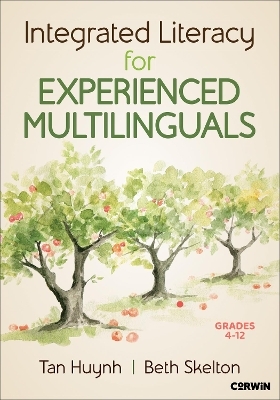
Integrated Literacy for Experienced Multilinguals, Grades 4-12
Corwin Press Inc (Verlag)
978-1-0719-6019-6 (ISBN)
- Noch nicht erschienen (ca. Juli 2026)
- Versandkostenfrei
- Auch auf Rechnung
- Artikel merken
Experienced multilinguals—students who have been in language development programs for five or more years—face unique challenges that traditional English language development (ELD) approaches often fail to address. While newcomers receive immediate attention and support, experienced multilinguals frequently find themselves stuck in programs designed for social language development rather than the sophisticated academic language they need to thrive.
In this follow-up to their bestselling Long-Term Success for Experienced Multilinguals, authors Tan Huynh and Beth Skelton provide ELD and English Language Arts teachers with the Integrated Literacy Framework. This revolutionary approach systematically integrates all four language domains (listening, speaking, reading, and writing) with the four dimensions of academic language (vocabulary, sentence structures, organizational patterns, and context). Through content-based units and intentional academic literacy activities, teachers will learn how to design instruction that moves experienced multilinguals beyond survival language to the complex communication skills required for academic success.
Key features of this resource include:
The complete Integrated Literacy Framework with step-by-step guidance for unit and lesson planning that weaves content and language development together
Four comprehensive sample units progressing from foundational to sophisticated academic language, including an approach to create your own vocabulary set, sentence structures, and organizational patterns
Practical classroom tools including engagement models that cultivate independence, vignettes from Tan’s classroom, "Try It Out" activities, reflection questions, templates, and visual anchor charts
Foundational literacy routines for systematic sentence-level and organizational instruction, including Structured Quick Write, Sentence Deconstruction and Reconstruction, Co-editing, and Co-revising
This essential resource empowers educators to create the optimal conditions experienced multilinguals need to unlock their potential as the mathematicians, scientists, historians, writers, and artists they know themselves to be. Your students will develop the academic language proficiency necessary to express complex ideas with confidence and sophistication.
Tan Huynh (he/him) (tankhuynh.com) is a career international school teacher, consultant, and author specializing in secondary multilinguals and teacher collaboration. Coming to America as a refugee at the age of 5, Tan vividly remembers the difficulties of acquiring a new language and integrating in American culture while nurturing his Asian roots. This experience is the main engine that drives his work today. At school, he spends most of his time collaborating with teachers and in content-area classes to make content accessible. The rest of the time is spent teaching English language and literacy skills. Outside of school, Tan often presents internationally to schools and districts to support their work with multilingual students. Tan also hosts a blog, online courses, and a podcast about teaching multilinguals. With whatever time is left, Tan likes to work out, play badminton, and get lost in nature with his dog child. You can collaborate with Tan at Tan@tankhuynh.com and @TanKHuynh on Twitter. Beth Skelton (she/her) (www.bethskelton.com) is an independent consultant focused on creating equitable educational experiences for multilingual learners. She has been working in the field for over three decades teaching elementary, middle, high school and adult language learners in urban, suburban, rural, and international settings. As a university exchange student to Germany, Beth experienced firsthand the challenges that experienced multilinguals face when studying new content in their non-heritage language. She could communicate with peers, but still needed additional scaffolds to successfully write formal papers, read academic texts, and comprehend dense lectures. This influential experience still informs her work with students, teachers, schools, and districts around the world. Through workshops, coaching, and consulting, she advocates for all multilingual learners, especially those who have years of experience. Beth also enjoys hiking, skiing, yoga, playing marimba, gardening, and spending time with her family. You can connect with Beth by email at ellbeth@bethskelton.com or on Twitter at @easkelton.
PART 1: The Integrated Literacy Framework
Chapter 1: The Instructional Needs of Experienced Multilinguals
Who are experienced multilinguals?
What is the dilemma for experienced multilinguals?
What is the dilemma for ELD teachers?
What is the opportunity for experienced multilinguals and ELD teachers?
What is explicit ELD instruction?
Chapter 2: The Integrated Literacy Framework
Why should we have a framework for ELD classes
The sequence of the Integrated Literacy Framework
Planning with the Integrated Literacy Framework
What is the Input-Output Loop?
Why is the Integrated Literacy Framework specifically for experienced multilinguals?
Chapter 3: Unit Planning
Backward planning at the unit level
Why should we plan the unit with the Integrated Literacy Framework?
5 steps to backwards planning
Chapter 4: Lesson Planning for Academic Literacy
Step 1: Identify the content
Step 2: Write an exit ticket prompt
Step 3: Produce a model response
Step 4: Analyze the model response for content and the dimensions of language
Step 5: Write an integrated objective
Chapter 5: Designing Integrated Vocabulary Instruction
Essential principles of vocabulary instruction
What words should we teach in the unit?
Introducing the vocabulary words
Essential Engagement Models
Integrating reading, writing, oracy, with vocabulary development at the sentence level
Teaching reading through the vocabulary set
Explaining vocabulary within the text
Chapter 6: Sentence-Level Routines
Literacy Routines for Sentence-Level Instruction
Literacy Routines for Organization-Level Instruction
PART 2: The Units
UNIT 1: Forming Foundational Academic Language
Vocabulary-level instruction
Sentences-level instruction
Organizational-level instruction
UNIT 2: Cultivating Complex Academic Language
Vocabulary-level instruction
Sentences-level instruction
Organizational-level instruction
UNIT 3: Acquiring Advanced Academic Language
Vocabulary-level instruction
Sentences-level instruction
Organizational-level instruction
UNIT 4: Seeking Sophisticated Academic Language
Vocabulary-level instruction
Sentences-level instruction
Organizational-level instruction
Closure & Invitation
Building on the framework
Reflections on the framework
Call to action
With gratitude
Appendix A:
Appendix B: Model Response for a Multi-paragraph Essay on Japanese Internment Camps
Appendix C: Lesson-planning template for the Integrated Literacy Framework
References
| Erscheint lt. Verlag | 14.7.2026 |
|---|---|
| Verlagsort | Thousand Oaks |
| Sprache | englisch |
| Maße | 177 x 254 mm |
| Themenwelt | Schulbuch / Wörterbuch ► Unterrichtsvorbereitung |
| Sozialwissenschaften ► Pädagogik | |
| ISBN-10 | 1-0719-6019-9 / 1071960199 |
| ISBN-13 | 978-1-0719-6019-6 / 9781071960196 |
| Zustand | Neuware |
| Informationen gemäß Produktsicherheitsverordnung (GPSR) | |
| Haben Sie eine Frage zum Produkt? |
aus dem Bereich