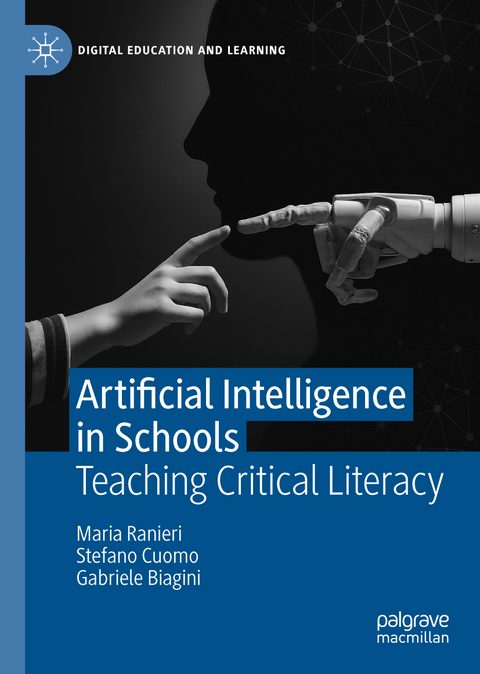
Artificial Intelligence in Schools
Springer International Publishing (Verlag)
978-3-032-15918-2 (ISBN)
- Noch nicht erschienen - erscheint am 07.05.2026
- Versandkostenfrei
- Auch auf Rechnung
- Artikel merken
This book addresses a growing and urgent educational challenge: equipping students and educators with the knowledge and critical tools needed to understand and navigate the complex world of Artificial Intelligence (AI). Drawing on digital literacy education and the ethics of digital media, it adopts an interdisciplinary approach to combine theoretical insights with practical instructional strategies for teaching about AI. Designed with school-age learners in mind, the book includes a wide range of methodologies, such as Philosophy for Children, Inquiry-Based Learning, gamification to offer concrete, adaptable classroom activities suitable for diverse age groups and educational settings.
Responding to the increasing demand from policymakers and educators for clearer guidance on AI education, the book promotes an approach grounded in awareness, inclusion, and responsibility. Structured around the four key dimensions of AI literacy (cognitive, operational, critical, and ethical), it provides a coherent and comprehensive learning pathway that extends beyond technical skills to foster critical thinking, ethical reflection, and democratic participation.
Filling a significant gap in the current literature, this project delivers a practical educational toolkit for schools and teachers, supporting students not only in using AI, but also in questioning, critically evaluating, and shaping its development in alignment with human and civic values. In doing so, it contributes to the growth of informed and responsible digital citizenship.
Maria Ranieri is Full Professor at the University of Florence, Italy, where she leads the Educational Technologies Laboratory. Her research focuses on critical digital literacy, and the pedagogical implications of emerging technologies.
Stefano Cuomo, an engineer by training, is Senior Researcher at the University of Florence, Italy. His research explores the intersection between ICT and pedagogy, with a focus on AI in education.
Gabriele Biagini holds a Master s degree in Data Science and Statistical Learning and is currently a PhD candidate in Artificial Intelligence Literacy at the University of Florence, Italy.
1: The dimensions of Artificial Intelligence Literacy: a pedagogical perspective.- 2: The cognitive dimension: historical framework and basic concepts.- 3: The operational dimension: Uses and applications.- 4: The critical dimension: Understanding and evaluation beyond automation.- 5: The ethical dimension: General principles and educational proposals.
| Erscheint lt. Verlag | 10.5.2026 |
|---|---|
| Reihe/Serie | Digital Education and Learning |
| Zusatzinfo | Approx. 180 p. 10 illus. |
| Verlagsort | Cham |
| Sprache | englisch |
| Maße | 148 x 210 mm |
| Themenwelt | Schulbuch / Wörterbuch ► Unterrichtsvorbereitung ► Unterrichts-Handreichungen |
| Sozialwissenschaften ► Pädagogik ► Schulpädagogik / Grundschule | |
| Schlagworte | AI in education • AI in K-12 Settings • Artificial Intelligence • critical digital literacy • Pedagogy of AI • Teaching about AI |
| ISBN-10 | 3-032-15918-0 / 3032159180 |
| ISBN-13 | 978-3-032-15918-2 / 9783032159182 |
| Zustand | Neuware |
| Informationen gemäß Produktsicherheitsverordnung (GPSR) | |
| Haben Sie eine Frage zum Produkt? |
aus dem Bereich