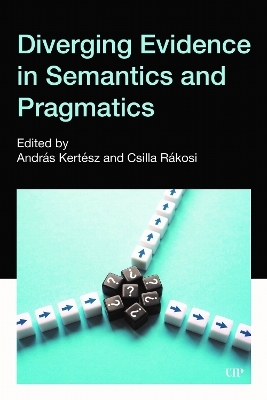
Diverging Evidence in Semantics and Pragmatics
University of Toronto Press (Verlag)
978-1-4875-7570-0 (ISBN)
- Noch nicht erschienen (ca. Mai 2026)
- Versandkostenfrei
- Auch auf Rechnung
- Artikel merken
In recent years, research on the nature of linguistic evidence has gained significant attention. One key finding is that linguistic inquiry should not rely solely on a single source of evidence such as introspection, corpus data, or real or thought experiments, but rather combine several types within a single study. However, integrating these diverse forms of evidence presents serious methodological challenges.
Broadly, two main situations can arise. The first is the convergence of evidence, wherein different types of data jointly support a hypothesis. In such cases, the hypothesis becomes more robust than it would be if supported by only one kind of evidence. Over the past decade, the concept of converging evidence in linguistics has been widely explored and discussed. The second, much less studied situation, is the divergence of evidence. Evidence diverges when different sources point towards incompatible hypotheses about a linguistic phenomenon. While convergence strengthens theoretical claims, divergence exposes inconsistencies that require explanation.
Written accessibly, Diverging Evidence in Semantics and Pragmatics focuses on cases in which diverging evidence in semantics and pragmatics leads to inconsistencies, providing insight on how linguistic theories can account for conflicting data and the challenges they pose for empirical research.
András Kertész is a professor emeritus at the Institute of German Studies, University of Debrecen. Csilla Rákosi is a research professor at the Institute of German Studies, University of Debrecen.
Contributors
Introduction
András Kertész and Csilla Rákosi
Part I: Foundational Issues
1. On the Relation between Thought Experimental and Real Experimental Reports in Pragmatics
András Kertész and Csilla Rákosi
2. The Mask Denial Paradox: A New Approach to the Identification and Analysis of Pseudoscientific Texts
Csilla Rákosi
Part II: Diverging Evidence in Pragmatics
3. How the Conception of Lying Is Interpreted by Hungarian Language Users: Results of a Questionnaire Investigation
Ahmad Adha and Enikő Németh T.
4. Corpus Data in Pragmatics: Conventionally Indirect Requests with Tud ("Can/Know") in Hungarian
Katalin Nagy C.
5. Investigating Particularized Conversational Implicature in Corpora
Zsuzsanna Németh
6. Cyclic Argumentation in Deictic Research: A Case Study on the Use of Demonstratives
Enikő Tóth and Péter Csatár
7. Questioning Strategies to Resolve Inconsistency in Witness Testimony: A Case Study of Hungarian Criminal Trials from a Continental Law Perspective
Marianna Varga
Part III: Diverging Evidence in Semantics
8. A Plausible Conception of Semantically Motivated Syntactic Arguments
Károly Bibok
9. Non-Referring Definites and Intuitive Truth-Value Judgments: A Debate
Approached through the P-Model
Zoltán Vecsey
Index
| Erscheint lt. Verlag | 26.5.2026 |
|---|---|
| Reihe/Serie | Pragmatic Interfaces |
| Zusatzinfo | 10 illustrations |
| Verlagsort | Toronto |
| Sprache | englisch |
| Maße | 152 x 229 mm |
| Gewicht | 1 g |
| Themenwelt | Schulbuch / Wörterbuch ► Wörterbuch / Fremdsprachen |
| Geisteswissenschaften ► Sprach- / Literaturwissenschaft ► Sprachwissenschaft | |
| ISBN-10 | 1-4875-7570-X / 148757570X |
| ISBN-13 | 978-1-4875-7570-0 / 9781487575700 |
| Zustand | Neuware |
| Informationen gemäß Produktsicherheitsverordnung (GPSR) | |
| Haben Sie eine Frage zum Produkt? |
aus dem Bereich