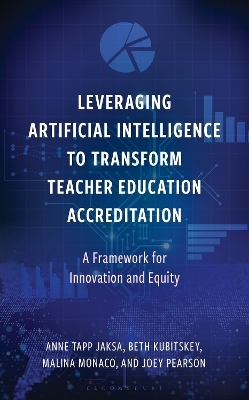
Leveraging Artificial Intelligence to Transform Teacher Education Accreditation
Bloomsbury Academic (Verlag)
979-8-216-37517-3 (ISBN)
- Titel nicht im Sortiment
- Artikel merken
This book explores how emerging technologies are reshaping the landscape of higher education quality assurance. Focused on educator preparation programs (EPPs), this timely volume examines how AI tools can transform data-driven decision-making, streamline accreditation processes, and promote institutional equity and accountability.
Written by accreditation experts, the book moves beyond technical explanations to address the human dimensions of AI—ethics, fairness, transparency, and professional judgment. Through real-world examples and research-based insights, it offers practical guidance for integrating AI responsibly into accreditation systems while maintaining the integrity of educational evaluation.
From automated data analysis to predictive modeling and ethical oversight, the book highlights both the opportunities and risks of AI-driven transformation. Grounded in current scholarship and informed by decades of accreditation practice, this work invites faculty, administrators, and policymakers to imagine a future where innovation and human judgment coexist to advance continuous improvement, educational quality, and professional integrity.
Dr. Anne Tapp Jaksa is a Professor of Teacher Education at Saginaw Valley State University for graduate and undergraduate programs within the College of Education. She is Chair of the American Association for Colleges of Teacher Education (AACTE) Board of Directors and is Past-chair of the AACTE Advisory Council of State Representatives (ACSR) Executive Committee. She previously served as the ACSR Midwest Region Representative and is Past-president of the Michigan Association of Colleges for Teacher Education (MACTE). Dr. Tapp Jaksa serves NASA JPL Education as their Educator in Residence and serves on the Council for the Accreditation of Educator Preparation (CAEP) Board of Directors. She also serves as a Director of Professional Development for the University of Michigan Center for Digital Curricula and Co-Director of the SVSU Center for Experience Research & Design and Usability Research Team. Dr. Tapp Jaksa's research interests include continuous improvement, STEM, and technology integration. She is a frequent presenter at international and national conferences and has published numerous journal articles, book chapters, and texts. Dr. Tapp Jaksa is a board member for several organizations and frequent volunteer within educational communities. She has developed educational curricula for NASA's Europa Clipper and Psyche missions, as well as initiatives for the Deep Space Network and Pi Day. Her recent publications reflect her expertise in artificial intelligence, STEM education, and literacy. She has contributed to journals such as the International Journal of Latest Trends in Engineering and Technology and Science and Children (NSTA). Notable recent works include: -AI-Driven Personalization in Education: VoiceBot as a Catalyst for Engagement and Efficiency (2025) -Pond Explorations: Merging Literacy and Science in Early Childhood Classrooms (2025) -Using Roadmap-Formatted Curriculum in Elementary School to Improve NWEA Reading Growth (2024) As an active researcher and presenter, Dr. Tapp Jaksa has shared her expertise at national and international conferences including AACTE, EdMedia, ISTE, SITE, and ICERI. She is also an editorial board member of the Journal of Technology and Teacher Education and has served on numerous committees for the American Association of Colleges for Teacher Education (AACTE), where she is the Chair-elect of the Board of Directors. Her dedication to education policy and advocacy is evident in her work with the Michigan Department of Education, the Council for the Accreditation of Educator Preparation (CAEP), and AACTE’s Advisory Council of State Representatives. She has led initiatives on AI in education, teacher preparation, and digital equity, engaging with policymakers in Washington, D.C. Dr. Tapp Jaksa’s passion for community service includes leadership roles with the Saginaw Township Community Schools Foundation, the Covenant Health Care Executive Council, and Camp Lu Lay Lea. She has been recognized for her contributions with awards such as the AACTE David G. Imig Award for Distinguished Achievement (2023) and National Residence Hall Honorary Faculty of the Month (2019). Dr. Beth Kubitskey is a passionate educator, researcher, and leader with a career dedicated to advancing quality in teacher preparation and advocating for continuous improvement in education. Her academic journey began with a B.S. in Chemistry from the University of Michigan, followed by an M.S. in Physics Education from Eastern Michigan University, and culminated in a Ph.D. in Education Studies from the University of Michigan. These experiences provided a strong foundation in both science and education. Dr. Kubitskey has been a faculty member at the University of Michigan-Flint, teaching graduate courses in education methods and clinical based symposia focused on urban teaching and inclusion. Her research focuses on continuous improvement, quality educator preparation, and advocacy. Dr. Kubitskey also serves as a contractor for the Michigan Department of Education, where she collaborates with community colleges and universities to create effective policies and pathways for educator preparation. In her administrative roles, including serving as Dean of the School of Education and Human Services at the University of Michigan-Flint and as Associate Dean at Eastern Michigan University, she has worked to enhance teacher preparation programs, promote equity and inclusion, and foster partnerships with community organizations. She has also led efforts to develop innovative teacher preparation initiatives, such as the Woodrow Wilson Teaching Fellowship and special education pathways for paraprofessionals. Her scholarship reflects my commitment to improving education for all students, authoring numerous publications and presentations on professional development, STEM education, and the impact of innovative teaching practices. Dr. Kubitskey has also collaborated on securing multimillion-dollar grants from the National Science Foundation to enhance teacher preparation and professional learning opportunities. Beyond the academic and administrative work, Beth is actively involved in state and national advocacy for policies that support effective teaching for all students. She works with professional organizations such as the Michigan Association of Colleges of Teacher Education and the American Association of Colleges for Teacher Education to lobby for education policies that advance equity, access, and excellence. Through her work with Women in Leadership and other groups, I strive to promote inclusive practices and systemic change. In addition, Dr. Kubitskey works with the American Education Research Association Recognitions such as the AACTE Outstanding Dissertation Award reflect the impact of my work. I remain committed to advancing education by preparing exceptional teachers and contributing to state and national policy development that ensures all students receive the high-quality education they deserve. Dr. Malina Monaco is the Senior Vice President for Accreditation at the Council for the Accreditation of Educator Preparation(CAEP). Having earned a MS and a PhD in Educational Measurement, Dr. Monaco has served on the faculty at both Georgia State University and North Carolina State University. Her teaching areas are in quantitative methodology and educational measurement She has experience in higher education administration having served as graduate admission director and a program coordinator. At North Carolina State University, Dr. Monaco served as the Director of Knowledge Management and Assessment, the CAEP coordinator, and a SACSCOC liaison. She was responsible for accreditation planning, implementation, and assessment reporting in the College of Education. Dr. Monaco previously served as Program Manager in the State of Georgia Department of Education Her responsibilities included designing, administering, and scoring federally mandated K-12 assessments, managing the k-12 assessment budget and accountability reporting for federal peer review requirements. Dr. Malina Monaco is the Senior Vice President for Accreditation at the Council for the Accreditation of Educator Preparation (CAEP). In her role, she leverages her former experience as both a site visitor and lead site visitor to ensure that quality assurance policies, processes, and procedures are designed and implemented with consistency and accountability. Dr. Monaco has an extensive background in higher education, having served on the faculty at Georgia State University and North Carolina State University. Her teaching areas include quantitative methodology and educational measurement. She won several teaching awards and earned professor of the year while at Georgia State University. In addition to her faculty roles, she has experience in higher education administration, having served as a graduate admissions director and program coordinator. At North Carolina State University, Dr. Monaco was the Director of Knowledge Management and Assessment, the CAEP coordinator, and a SACSCOC liaison. She was responsible for accreditation planning, implementation, and assessment reporting in the College of Education. As part of her role, Dr. Monaco shared her examples, templates, and approach to assessment and accreditation with her state-wide counterparts and supported them in their accreditation work. Dr. Monaco's exemplary educator preparation initiatives are rooted in her comprehensive background in accreditation, assessment, and educational measurement. Her efforts integrate research-based strategies and practical applications, ensuring educators are well-prepared to meet diverse student needs. She emphasizes holistic development, hands-on teaching experiences, mentorship, and continuous professional development. Dr. Monaco's collaborative efforts with EPPs and communities foster partnerships that enhance the learning environment, supporting educators at all career stages. Her work significantly impacts teacher quality and student outcomes, setting a high standard for educator preparation programs. Dr. Joseph A. Pearson serves as Head of Community at Moreland University, leading strategic engagement initiatives that enhance teacher professional development and district partnerships. With over a decade of experience, he has designed professional learning for thousands of educators worldwide, focusing on student-led pedagogy, AI in education, international teaching, and Human Resources in education. His leadership extends to the board of the American Association for Employment in Education (AAEE) and committees for the American Association of School Personnel Administrators and the National Association of State Directors of Teacher Education and Certification, shaping national conversations on teacher preparation, recruitment, and retention. A recognized thought leader, his work spans conferences, publications, and podcasts, amplifying research-driven insights into effective educator development. In addition to his work in education, he is a composer and musician whose work explores themes of inclusion, social connection, and personal transformation to foster community and inspire meaningful dialogue.
Chapter 1: Introduction – AI’s Role in Teacher Education Accreditation
Chapter 2: AI in Data-Driven Decision-Making for Accreditation
Chapter 3: Ethical Considerations and Challenges in AI-Driven Accreditation
Chapter 4: AI in Self-Study Reports and Accreditation Compliance
Chapter 5: AI and Continuous Improvement in Educator Preparation
Chapter 6: Strategic Implementation of AI in Accreditation
Chapter 7: The Future of AI in Teacher Education Accreditation
| Erscheint lt. Verlag | 23.7.2026 |
|---|---|
| Zusatzinfo | 12 b/w figures, 14 textboxes |
| Verlagsort | New York |
| Sprache | englisch |
| Maße | 140 x 216 mm |
| Themenwelt | Schulbuch / Wörterbuch ► Unterrichtsvorbereitung ► Unterrichts-Handreichungen |
| Sozialwissenschaften ► Pädagogik ► Erwachsenenbildung | |
| ISBN-13 | 979-8-216-37517-3 / 9798216375173 |
| Zustand | Neuware |
| Informationen gemäß Produktsicherheitsverordnung (GPSR) | |
| Haben Sie eine Frage zum Produkt? |
aus dem Bereich