


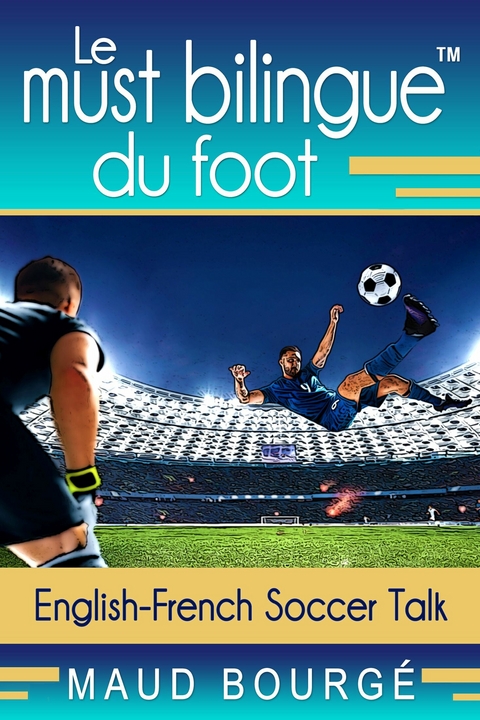
Le must bilingue(TM) du foot (eBook)
433 Seiten
Bookbaby (Verlag)
979-8-3178-1609-4 (ISBN)
Maud Bourgé is passionate about languages, learning, and the journeys books can take us on. Born and raised in France, and having lived in both the United States and England, she brings a unique cross-cultural perspective to her work. Through her bilingual collection Le Must Bilingue?, Maud offers carefully researched books designed to spark curiosity and expand the reader's vocabulary in their areas of interest in French or English, be it literary analysis, corporate law and finance, current affairs, soccer, or even math. She strongly believes that languages open up new worlds to the curious mind and that we learn best when we are naturally interested in a subject - each volume invites readers to explore various topics in French and English, and to see the world with new eyes.
A soccer game will make you shout for joy, make you cry tears of joy and sadness, make you dream - you can experience the full spectrum of emotions. With le must bilingue(TM) du foot, you will enjoy games even more with your new knowledge. You may even catch soccer fever. Beware! It is incurable - it may lay dormant for a while but can be reactivated at any time, especially during the World Cup. Le must bilingue du foot not only abounds in soccer terms, but it also invites you to learn idioms which are useful to "e;speak soccer"e; and read sports news. With more than 1,200 sentences and some 1,200 verbs and 900 adjectives, you will familiarize yourself with expressions that can be used in multiple contexts and are bound to impress. Un match de foot fait crier de joie, fait pleurer de joie et de tristesse, fait rever toute la palette des emotions y passe. Grce au must bilingue du foot, vous apprecierez les matchs encore davantage avec vos nouvelles connaissances. Vous vous laisserez peut-etre meme gagner par la fievre du foot. Prenez garde ! Elle est incurable elle sommeille en vous un certain temps mais peut se reactiver a tout moment, plus particulierement lors de la Coupe du monde. Non seulement le must bilingue du foot foisonne de termes propres au football, mais il vous propose aussi de decouvrir des expressions idiomatiques utiles pour parler foot et lire l'actualite du sport. Avec plus de 1200 phrases et quelque 1200 verbes et 900 adjectifs, vous vous familiariserez avec des expressions qui peuvent s'employer dans de nombreux contextes et qui ne manqueront pas de produire leur petit effet.
2. QUESTIONS AND ANSWERS ABOUT SOCCER – QUESTIONS ET RÉPONSES SUR LE FOOTBALL
“The vision of a champion is someone who is bent over, drenched in sweat, at the point of exhaustion when nobody else is watching.”
« L’image d’un champion, c’est celle de quelqu’un qui est courbé, ruisselant de sueur, jusqu’à l’épuisement lorsque personne ne regarde. »
– Anson Dorance
QUESTION 1
| How far do soccer players run during a game? | Quelle est la distance parcourue par un joueur de football pendant un match ? |
| On average, soccer players run between 5.6 and 7 miles per game. The number can be as low as 1 mile for a goalkeeper who may however run up to 2 miles. Midfielders cover the longest distances (7 to 9 miles,) followed by defenders (5 to 7 miles.) 85% of the distance covered is at low speed, 7% is at average intensity, and 8% at high intensity. During an England-Greece game in 2002, David Beckham ran a total of 9.94 miles. His record was beaten during the 2018 World Cup by Marcelo Brozovic of Croatia who traveled 10.12 miles in the semifinal against England including extra time. Marcelo Brozovic broke his own record during the 2022 World Cup with 10.3 miles in a game which ended in a penalty shootout win over Japan. | Les joueurs de football courent en moyenne entre 9 et 11,5 kilomètres par match. Le nombre peut tomber à 1,6 km pour un gardien qui peut cependant parcourir jusqu’à 3,2 km. Les milieux de terrain parcourent les plus longues distances (11 à 14 km), suivis par les défenseurs (8 à 11 km). 85% de la distance parcourue est à bas régime, 7% à intensité moyenne, et 8% à haute intensité. Lors d’un match Angleterre-Grèce en 2002, David Beckham parcourt un total de 16 km. Son exploit est battu lors de la Coupe du monde de 2018 par Marcelo Brozovic de la sélection croate qui parcourt 16,3 km en demi-finale contre l’Angleterre en comptant la prolongation. Marcelo Brozovic bat son propre record lors de la Coupe du monde de 2022 en couvrant 16,7 km de terrain dans un match qui se termine par une victoire aux tirs au but face au Japon. |
QUESTION 2
| Is it a soccer game or is it a soccer match? | Dit-on « soccer game » ou dit-on « soccer match » pour un match de football ? |
| In the United States, it is generally called a “soccer game” while in England and several other countries, it is called a “football match.” | Aux États-Unis, on parle souvent de « soccer game » tandis qu’en Angleterre et dans de nombreux autres pays, on parle de « football match ». |
| In the United States, sports competitions, whether it be baseball, basketball, or American football, are referred to as games whereas in typically British sports such as golf and cricket, competitions are traditionally called matches. | Aux États-Unis, les compétitions sportives, qu’il s’agisse du baseball, du basket, ou du football américain, sont désignées par le terme « games » alors que pour les sports typiquement anglais tels que le golf et le cricket, les compétitions sont traditionnellement appelées des matchs. |
| However, the U.S. media coverage of international soccer tournaments shows a growing usage of the word “match” as opposed to “game” and expression “soccer match” as opposed to “soccer game.” | Néanmoins, la couverture médiatique américaine des tournois de football internationaux témoigne d’un usage croissant du mot « match » par opposition à « game » et de l’expression « soccer match » par opposition à « soccer game ». |
| Le must bilingueTM collection acts as a bridge between French and American English, and thus throughout this book preference is given to the American terminology “game” and “soccer game” even though the term “soccer match” is commonly used to refer to major soccer events. | La collection Le must bilingueTM servant de trait d’union entre le français et l’anglais américain, elle privilégie tout au long de ce livre la terminologie américaine « game » et « soccer game » même si le terme « soccer match » est couramment employé pour désigner les grandes compétitions de football. |
QUESTION 3
| When and where did the first FIFA World Cup take place? | Quand et où a eu lieu la première Coupe du monde de la FIFA ? |
| The first World Cup took place in 1930 in Uruguay. The final was contested between the Uruguay and Argentina teams. The host country defeated Argentina. | La première Coupe du monde a eu lieu en 1930 en Uruguay. La finale voit s’affronter les équipes d’Uruguay et d’Argentine. Le pays hôte bat l’Argentine. |
QUESTION 4
| How many World Cups have there been? | Combien de Coupes du monde y a-t-il eu ? |
| There has been a total of 22 World Cups: every four years since 1930, except in 1942 and 1946 because of World War II. The most recent one took place in Qatar in 2022. | Il y a eu un total de 22 Coupes du monde : tous les quatre ans depuis 1930, hormis en 1942 et 1946 à cause de la Seconde Guerre mondiale. La plus récente s’est déroulée au Qatar en 2022. |
QUESTION 5
| Which countries have won the World Cup? | Quels pays ont gagné la Coupe du monde ? |
| Winners – Vainqueurs | Years – Années |
| Brazil – le Brésil | 5 times champions – quintuple champion (1958, 1962, 1970, 1994, 2002) |
| Germany – l’Allemagne | 4 times champions – quadruple champion (1954, 1974, 1990, 2014) |
| Italy – l’Italie | 4 times champions – quadruple champion (1934, 1938, 1982, 2006) |
| Argentina – l’Argentine | 3 times champions – triple champion (1978, 1986, 2022) |
| France – la France | 2 times champions – double champion (1998, 2018) |
| Uruguay – l’Uruguay | 2 times champions – double champion (1930, 1950) |
| England – l’Angleterre | 1 time champions – une fois champion (1966) |
| Spain – l’Espagne | 1 time champions – une fois champion (2010) |
Two countries have won back-to-back titles: Italy (1934 and 1938) and Brazil (1958 and 1962.)
Deux pays ont gagné deux Coupes du monde consécutives : l’Italie (1934 et 1938) et le Brésil (1958 et 1962).
QUESTION 6
| Is there a Women’s World Cup? | Existe-t-il une Coupe du monde féminine ? |
| Yes, the first FIFA Women’s World Cup took place in 1991 in China – the United States emerged victorious. The United States won the title three more times, in 1999, in 2015, and in 2019. They also won four Olympic gold medals, in 1996, 2004, 2008, and 2012. | Oui, la première Coupe du monde féminine de football se déroule en 1991 en Chine – les États-Unis sortent vainqueurs. Les joueuses américaines seront sacrées trois autres fois championnes du monde, en 1999, en 2015, et en 2019. Elles remporteront aussi la médaille d’or des Jeux olympiques quatre fois, en 1996, 2004, 2008, et 2012. |
| We must mention here the first two Women’s World Cups, both organized by the Federation of Independent European Female Football (FIEFF) – they were erased from history because they were not endorsed by FIFA. The 1970 Women’s World Cup took place in Italy in July 1970 and featured teams from seven countries: England, West Germany, Denmark, Mexico, Austria, Switzerland, and Italy. Denmark beat Italy 2-0. The 1971 World Cup took place in Mexico in August and September 1971 and featured teams from six national teams out of an expected total of thirteen: Mexico, Argentina, England, Denmark, Italy, France. Denmark beat Mexico 3-0. Some teams had withdrawn in the aftermath of the scandal created by the international soccer authorities who alleged that the organization of the first World Cup stepped on their toes. | Il convient de mentionner ici les deux premières... |
| Erscheint lt. Verlag | 22.10.2025 |
|---|---|
| Sprache | französisch |
| Themenwelt | Schulbuch / Wörterbuch ► Wörterbuch / Fremdsprachen |
| ISBN-13 | 979-8-3178-1609-4 / 9798317816094 |
| Informationen gemäß Produktsicherheitsverordnung (GPSR) | |
| Haben Sie eine Frage zum Produkt? |
 EPUB (Ohne DRM)
Größe: 2,1 MB
Digital Rights Management: ohne DRM
Dieses eBook enthält kein DRM oder Kopierschutz. Eine Weitergabe an Dritte ist jedoch rechtlich nicht zulässig, weil Sie beim Kauf nur die Rechte an der persönlichen Nutzung erwerben.
Dateiformat: EPUB (Electronic Publication)
EPUB ist ein offener Standard für eBooks und eignet sich besonders zur Darstellung von Belletristik und Sachbüchern. Der Fließtext wird dynamisch an die Display- und Schriftgröße angepasst. Auch für mobile Lesegeräte ist EPUB daher gut geeignet.
Systemvoraussetzungen:
PC/Mac: Mit einem PC oder Mac können Sie dieses eBook lesen. Sie benötigen dafür die kostenlose Software Adobe Digital Editions.
eReader: Dieses eBook kann mit (fast) allen eBook-Readern gelesen werden. Mit dem amazon-Kindle ist es aber nicht kompatibel.
Smartphone/Tablet: Egal ob Apple oder Android, dieses eBook können Sie lesen. Sie benötigen dafür eine kostenlose App.
Geräteliste und zusätzliche Hinweise
Buying eBooks from abroad
For tax law reasons we can sell eBooks just within Germany and Switzerland. Regrettably we cannot fulfill eBook-orders from other countries.
aus dem Bereich


