


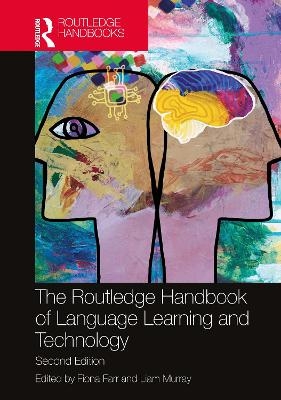
The Routledge Handbook of Language Learning and Technology
Routledge (Verlag)
978-1-032-53473-2 (ISBN)
- Noch nicht erschienen (ca. April 2026)
- Versandkostenfrei
- Auch auf Rechnung
- Artikel merken
The Routledge Handbook of Language Learning and Technology is a comprehensive and accessible resource for teachers, teacher educators, and students navigating the rapid evolution of technology in language education. Now in its second edition, this fully updated volume reflects the accelerated integration of digital tools into pedagogical practices, particularly in the wake of the Covid-19 pandemic.
Building on its original focus—historical and theoretical contexts, interactive and collaborative technologies, corpora and data-driven learning, and computer gaming—the handbook introduces new chapters that explore teacher development and the cultural dimensions of language learning. Emerging voices in the field offer insightful perspectives on cutting-edge technologies such as Artificial Intelligence, advancing a balanced and accessible approach useful to students with a language background who are looking to further their education in the sector. Farr and Murray equip readers with the requisites to make informed pedagogical decisions in both academic and professional settings.
This handbook is essential reference for all students from undergraduate to PhD level, teachers and researchers of Language Learning and TESOL, and professionals in the areas of Applied Linguistics, Education, and Media Studies.
Fiona Farr is Professor of Applied Linguistics and TESOL in the School of Modern Languages and Applied Linguistics at the University of Limerick, Ireland. She is also Adjunct Professor at INN, Hamar, Norway. Her key areas of expertise are teacher education, reflective practice, continuous professional development, applied corpus linguistics, and technology-enhanced language learning. Liam Murray is Professor of French and Applied Linguistics and current Head of the School of Modern Languages and Applied Linguistics at the University of Limerick, Ireland. He has been researching, teaching and publishing in many areas of CALL since 1991, from blogs and gamification to distraction, Critical Digital Literacies, CALL in the Wild and GenAI.
Introduction Part I: 1. Taking a balanced view of technology in language teaching: past, present and future 2. Theory and theories in Computer-Assisted Language Learning research and practice 3. Integrating multimodal theory into CALL: comparative insights from Kress, Mondada and Norris Part II: 4. Language materials development in a digital age 5. Literacies, technology and language teaching 6. Language Testing and Technology 7. Teaching alongside GenAI: affordances for language teaching and shifting agencies 8. MOOCs for Languages: from LMOOCs to LTEMOOCs 9. Online, blended and hybrid language learning Part III: 10. Plurilingualism and CALL 11. Culture, language learning and technology in an AI world 12. Language learning and technology use in varied technology contexts 13. Limitations and boundaries in language learning and technology 14. Sustainable CALL development 15. Foreign language education and digital cultures: perspectives on citizenship and diversity Part IV: 16.Virtual exchange and language learning 17. Social media and language learning 18. Mobile language learning 19. Potentials and challenges of Virtual Reality: Implications for the language classroom 20. Mobile dictionaries and apps for vocabulary learning 21. A Qualitative Analysis of the Affordances of Immersive Technologies in Virtual Exchange 22. The Spoken CALL Shared Task: an Overview Part V: 23. Introduction to Data-Driven Learning 24. Spoken language corpora and pedagogic applications 25. Written language corpora and pedagogic applications 26. Pedagogical applications of learner corpora: A decade in review 27. Corpus types and uses 28. Designing and building corpora for language learning Part VI: 29. Digital Games as a Methodology for Second Language Learning: Exploring New Metaphors and Pedagogical Parallels. 30. Gaming for focused language practice 31. Digital Gaming and Young L2 Learners
| Erscheint lt. Verlag | 1.4.2026 |
|---|---|
| Reihe/Serie | Routledge Handbooks in Applied Linguistics |
| Zusatzinfo | 14 Line drawings, black and white; 29 Halftones, black and white; 43 Illustrations, black and white |
| Verlagsort | London |
| Sprache | englisch |
| Maße | 174 x 246 mm |
| Gewicht | 453 g |
| Themenwelt | Schulbuch / Wörterbuch ► Wörterbuch / Fremdsprachen |
| Geisteswissenschaften ► Sprach- / Literaturwissenschaft ► Sprachwissenschaft | |
| Sozialwissenschaften ► Pädagogik | |
| ISBN-10 | 1-032-53473-7 / 1032534737 |
| ISBN-13 | 978-1-032-53473-2 / 9781032534732 |
| Zustand | Neuware |
| Informationen gemäß Produktsicherheitsverordnung (GPSR) | |
| Haben Sie eine Frage zum Produkt? |
aus dem Bereich


