


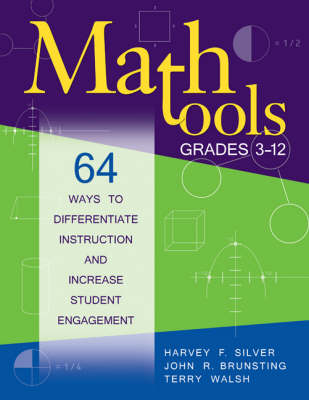
Math Tools, Grades 3-12
Corwin Press Inc (Verlag)
978-1-4129-5782-3 (ISBN)
- Titel erscheint in neuer Auflage
- Artikel merken
Math Tools, Grades 3-12 presents a broad collection of mathematics instruction tools that promote active, in-depth learning and help ensure that all students meet high standards. The authors, experts with years of experience in mathematics education, combine the research on learning styles with 64 classroom-tested tools, and show teachers how to use them to differentiate instruction and meet the needs of all students. Organized around four mathematical learning styles/mastery, understanding, self-expressive, and interpersonal - this resource also covers lesson design and assessment using the math tools.
Harvey F. Silver, president of Silver Strong & Associates and Thoughtful Education Press, was named one of the 100 most influential teachers in the country. He has conducted numerous workshops for school districts and state education departments throughout the United States. He was the principal consultant for the Georgia Critical Thinking Skills Program and the Kentucky Thoughtful Education Teacher Leadership Program. Silver is the author of several educational bestsellers, including So Each May Learn: Integrating Learning Styles and Multiple Intelligences and Teaching Styles and Strategies, both published by the Association for Supervision and Curriculum Design. With Richard Strong, Silver developed The Thoughtful Classroom—a renowned professional development program based on the commitment to “make students as important as standards.” John Brunsting is a mathematics teacher, a staff development specialist, and an author. John serves schools as a teacher and coach as well as a mathematics consultant on practical, style-based tools and strategies. He is a coordinator for Illinois Advanced Placement Institutes and cofounder of Mathematics & Technology Institutes, teacher training organizations committed to the instructional excellence of teachers. Previously an AP Calculus Exam Committee member, John coauthored Preparing for the AP Calculus Examination (2006). In 2008, John coauthored the best-selling Math Tools, Grades 3-12: 64 Ways to Differentiate Instruction and Increase Student Engagement. He has presented at national and international conferences for the National Council of Teachers of Mathematics (NCTM), National Council of Supervisors of Mathematics (NCSM), the Association for Supervision and Curriculum Development (ASCD), the Japan Association for Supervision and Curriculum Development (JASCD), Teachers Teaching with Technology (T3), and the International Conference on Computers in Education (ICCE). Terry Walsh has been a mathematics trainer and consultant for nearly 20 years. After retiring from math and administrative positions in two suburban Chicago high schools, In addition to developing Thoughtful Classroom strategies, Terry was one of the founding editor’s of the EightySomething! graphing calculator newsletter. He not only used the strategies in this book in his own classes, he has worked with teachers across the country to help them do the same. He has also incorporated ideas from Math Tools into a variety of Pre-AP Mathematics workshops that he has been leading for the College Board. Terry has led Pre-AP Math and Learning Styles workshops across the U.S as well as in Europe. He has presented at international, national, state, and local mathematics conferences sponsored by such organizations as NCTM, the Illinois and Colorado Councils of Teachers of Mathematics, Teachers Teaching with Technology (T3), and the metropolitan Math Club of Chicago (MMC). After “retirement”, Terry moved to Colorado. His commitment to educating students and his love of Mathematics brought Terry back into schools—first as the Secondary Math Instructional Coach for Fort Lupton schools and then as a Principal of a secondary charter school. Terry now actively consults with both pre-service and experienced teachers throughout the country to help them incorporate effective mathematics strategies in their classes in order to increase student learning. You can contact him at: trterryw@yahoo.com.
Acknowledgments
About the Authors
1. A User′s Guide to Learning Styles and Math Tools
What Are Learning Styles and Why Do They Matter?
How Do I Select the Right Tool for the Right Learning Situation?
Five Ways to Use Math Tools
2. Mastery Math Tools
Mastery Math Tools Matrix
Knowledge Cards
Memory Box
Most Valuable Point (MVP)
Mathematical Summaries
Fist Lists and Spiders
Procedural Notes
Mathematical Conventions
What′s Wrong?
Mastery Review
Convergence Mastery
Practice Makes Perfect
Mental Math War
Vocabulary Knowledge Rating (VKR)
Glossaries
Word Walls
Vocabulary Organizers
3. Understanding Math Tools
Understanding Math Tools Matrix
Always-Sometimes-Never (ASN)
Support or Refute
Stake Your Claim
Learning From Clues
Pattern Finding
Math Rulebook
P′s and Q′s
Essential Question Notes (EQN)
Compare and Contrast
Mathematical Analogies
Three-Way Tie
Which One Doesn′t Belong?
Yes, But Why?
Yes, But Why^3?
Show Me
4. Self-Expressive Math Tools
Self-Expressive Math Tools Matrix
Picture = 1,000 Words
3-D Approach: Algebraic, Graphical, and Numerical
M + M: Math and Metaphors
Math Recipe
Cinquains
Write to Learn
MATHEMATICS Writing Frames
Storytellers
Math Is Everywhere
Group and Label
And the Question Is . . . ?
What If?
Making Up Is Fun to Do
Create Your Own
Divergent Thinking
5. Interpersonal Math Tools
Interpersonal Math Tools Matrix
Bring Your "A" Game
Paired Learning
Peer Coaching
Where in the World?
Real-World Connections
What′s Your Favorite?
Who′s Right?
Reflective Writing
Writing About the Problem of the Day
Test Feedback
Range Finder
Math Boggle
Vocabulary Games
Cooperative Structures for Promoting Positive Interdependence
6. Designing Lessons, Assessments, and Units in All Four Styles
Task Rotation
Assessment Menus
A Test Worth Taking
The Seven P′s
References
Index
| Erscheint lt. Verlag | 12.2.2008 |
|---|---|
| Verlagsort | Thousand Oaks |
| Sprache | englisch |
| Maße | 215 x 279 mm |
| Gewicht | 770 g |
| Themenwelt | Schulbuch / Wörterbuch |
| Sozialwissenschaften ► Pädagogik | |
| ISBN-10 | 1-4129-5782-6 / 1412957826 |
| ISBN-13 | 978-1-4129-5782-3 / 9781412957823 |
| Zustand | Neuware |
| Informationen gemäß Produktsicherheitsverordnung (GPSR) | |
| Haben Sie eine Frage zum Produkt? |
aus dem Bereich


