Degrees of Change
John Wiley & Sons Inc (Verlag)
978-1-394-41306-5 (ISBN)
- Noch nicht erschienen (ca. März 2026)
- Portofrei ab CHF 40
- Auch auf Rechnung
- Artikel merken
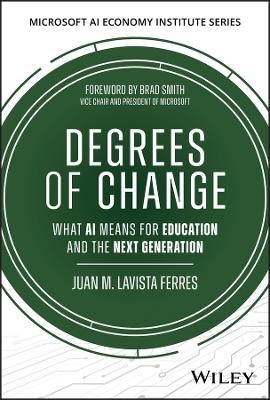
AI is transforming every commercial industry it touches. But it’s also changing the way we perform science, collect and analyze data, and even educate our young people. In Degrees of Change: What AI Means for Education and the Next Generation, Microsoft Chief Data Scientist and Director of AI for Good Lab Juan M. Lavista Ferres along with 14 groups of scholars from 16 prestigious universities share their original scholarship and practical insights on the future of education and workforce readiness.
This first book in the new Microsoft AI Economy Series from Microsoft’s AI Economy Institute explores how AI technologies – both those already existing and some still in the pipeline – should and will shape the education experience for students, educators and institutions. They discuss everything from the way that engineering and computer science will be taught in the future to how labor markets may incorporate a new crop of professionals with different competencies. You’ll also find:
Original research on the necessity of AI literacy in society and ethics literacy in AI development
Discussions of how training and education need to go beyond basic AI competencies and encompass the development of flexible mental models and decision-making heuristics
The latest evidence on how commercially available large language models are impacting college-educated workers and how institutions and educators can adjust to that impact
Benefiting industry, government and policymakers, as well as university and college educators and administrators Degrees of Change delivers eye-opening explorations of issues that will work to transform the way we educate and train students. It offers a clarification of the role that AI will play in higher education and how we can best adapt to these new technologies.
JUAN M. LAVISTA FERRES is Microsoft’s Chief Data Scientist and Corporate Vice President. He serves as Lab Director of Microsoft’s AI for Good Lab and Director of the AI Economy Institute. He leads a team of data scientists and researchers specializing in AI, machine learning, and statistical modeling who partner with domain experts to address some of society’s greatest challenges.
Foreword ix
Introduction xi
Section I: Foundations and Frontiers of Ai and Education 1
Chapter 1: A 75-Year Journey and the Diffusion Divide 2
Chapter 2: AI, Jobs, and the Meaning of Work 23
Chapter 3: How AI Is Changing Education 32
Chapter 4: The Importance of AI Literacy 48
Section II: Human Agency and Ethics In the Ai Era 57
Chapter 5: Is It You? The Importance of Figuring Out What It Means to Be Human in the Age of AI 58
Chapter 6: The Mutual Alignment of AI and Society Cultivating Complementary Literacies in Ethics and AI 69
Chapter 7: Humans in Space: Designing to Foster Trust and Fluencies in Human-AI Relationships 79
Chapter 8: Rethinking AI Accessibility in African Higher Education Institutions Through Inclusive Participation and Policy Reform 94
Section III: Reimagining Higher Education With Ai 113
Chapter 9: Faculty Visions of Academic Futures with Generative AI 114
Chapter 10: Higher Education’s Dual Role in the AI Economy: Balancing Foundational Learning and Micro-Credential Innovation 130
Chapter 11: How Can Higher Education Survive Transformative AI? 141
Section IV: Case Studies in Ai-integrated Learning 161
Chapter 12: Teaching with the Machine: Designing AI-Augmented Novices to Foster Critical Thinking and Computational Thinking in STEM Education 162
Chapter 13: Generative AI Solves Introductory Computer Science Tasks. Now What? 171
Chapter 14: Shaping the Future of Engineering Education: Faculty Insights on AI-Integrated Engineering Education 185
Chapter 15: Bots and Business Schools: Rethinking Education for the Era of Generative AI 213
Section V: Early Signals About Ai Skills And the New Job Market 226
Chapter 16: A Regional and Data-Centered Approach to Workforce Development in an AI Economy 227
Chapter 17: College, Careers, and the Rise of AI 246
Chapter 18: AI Skills Wanted: How AI Technologies Create Demand for Skilled Workers 257
Chapter 19: Higher Education For and In the Age of AI 273
About the Editor and Lead Author 284
About the Authors/Scholars 286
Acknowledgments 305
Appendix: Additional Resources 307
Index 330
| Erscheint lt. Verlag | 19.3.2026 |
|---|---|
| Reihe/Serie | Microsoft AI Economy Institute Series |
| Verlagsort | New York |
| Sprache | englisch |
| Maße | 158 x 229 mm |
| Gewicht | 680 g |
| Themenwelt | Schulbuch / Wörterbuch ► Unterrichtsvorbereitung ► Unterrichts-Handreichungen |
| Informatik ► Theorie / Studium ► Künstliche Intelligenz / Robotik | |
| Sozialwissenschaften ► Pädagogik | |
| ISBN-10 | 1-394-41306-8 / 1394413068 |
| ISBN-13 | 978-1-394-41306-5 / 9781394413065 |
| Zustand | Neuware |
| Informationen gemäß Produktsicherheitsverordnung (GPSR) | |
| Haben Sie eine Frage zum Produkt? |
aus dem Bereich