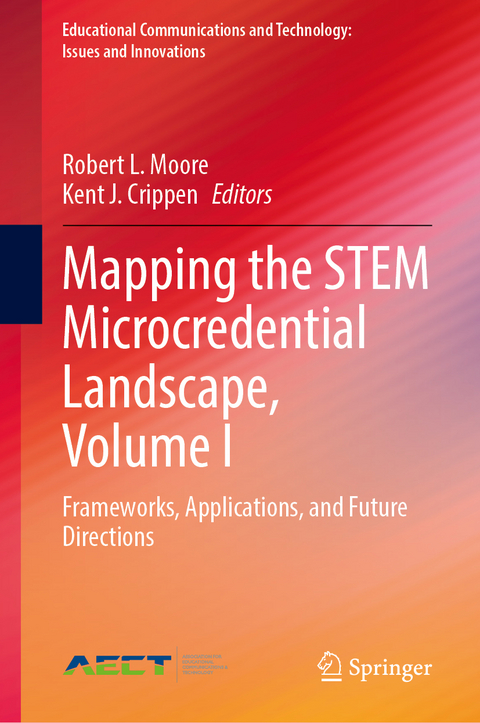
Mapping the STEM Microcredential Landscape, Volume I
Springer International Publishing (Verlag)
978-3-032-06822-4 (ISBN)
- Noch nicht erschienen - erscheint am 10.01.2026
- Versandkostenfrei
- Auch auf Rechnung
- Artikel merken
This edited volume offers a foundational exploration of the STEM microcredential landscape. Bringing together educators, researchers, policymakers, and industry leaders, the chapters in this volume demonstrate the flexibility and targeted nature of STEM microcredentials, meeting the demands of a rapidly evolving job market through competency-based learning. It examines the intricate relationships between learners, higher education institutions, and the workforce through sections focused on an overview, frameworks, and topic studies. By delving into the foundational theories and current practices, this volume sets the stage for the practical case studies and future-oriented discussions presented in Volume II, providing a comprehensive look at the STEM microcredential landscape.
Rob Moore is an Assistant Professor of Educational Technology in the School of Teaching and Learning at the University of Florida, USA and the director of the Investigating Digital Ecologies to Advance Transformative Education (IDEATE) Research Lab in the Institute for Advanced Learning Technologies, University of Florida, USA. His research focuses on how processes and structures affect learner experiences in digital environments, with a particular interest in microcredentials as transformative pathways for education and careers. He investigates the impact of technology integration on learner experiences and outcomes.
Kent Crippen is a Professor of STEM Education in the School of Teaching and Learning at the University of Florida, USA. His research program embraces the grand challenge of providing an inclusive and robust science, technology, engineering, and mathematics (STEM) workforce through designing and evaluating learning environments that offer authentic experiences through networked learning technologies. He is a Fellow of the American Association for the Advancement of Science (AAAS) and Editor-in-Chief of the Journal of Science Education and Technology.
Part 1. Overview.- 1. Badge Summit: Micro-History of Micro-Credentials through the Lens of a Community Retrospective (Noah Geisel).- 2. Building a Framework for Institutional and Industry Collaboration in STEM Microcredential Development (Justin Louder).- 3. Taxonomy (Rob Moore).- Part 2. Frameworks.- 4. The Universal Micro-credential Framework: Creating an Accessible, Usable, and Effective Micro-Credentialing Approach within the Traditional Education System (Rupert Ward).- 5. Building a Provincial Micro-credential Framework in Alberta, Canada A Case Study (Vis Naidoo).- 6. Designing Competency-Based Frameworks for STEM Micro-credentials (Marilys Galindo).- 7. An Illustrative Framework for Microcredentials in STEM: The Kennesaw State University Model (Ashley Doehling).- 8. AI-Enhanced Skill-Based Learning Pathways: Leveraging ESCO for Admissions and Transfers (Wendy Linn Cook).- 9. Achievements in a Digital Learning Environment for STEM Education: A Framework for Using Microcredentials to Reflect Acquired Knowledge (David Bednorz).- 10. Beyond Engineering: Applying a Learning Sciences Framework to the Design, Teaching, and Evaluation of Penn State Engineering Certified Microcredentials (Andrea Gregg).- 11. The Trust Factor: Skills Validation as a Cornerstone of STEM microcredentials (Tara Laughlin).- Part 3.- Topic Studies.- 12. Exploring Policymakers Perspectives on Micro-credentials in K-12 Teacher Professional Development (Madeline Stallard).- 13. Literacy Microcredentials to Complement STEM Microcredentials and Enhance STEM Learning: A Review of Research and Suggestions for Strengthening STEM Education Effectiveness (Stephanie Hammerschmidt-Snidarich).- 14. Empowering Rural K-12 STEM Education: Opportunities and Innovation through Microcredentials (Giovanna Morara).- 15. Breaking Barriers With Micro-Credentials in STEM Prerequisites for the Health Professions (Susan Hibbard).- 16. Collaborative Opportunities Abound in a Global World of STEM Microcredentials (Pamela Wimbush).- 17. The Future of STEM: Aligning Academic Experiences with Workforce Demands through Competency-Based Learning and Micro-Credentialing (Brian Gant).
| Erscheinungsdatum | 29.11.2025 |
|---|---|
| Reihe/Serie | Educational Communications and Technology: Issues and Innovations |
| Zusatzinfo | II, 417 p. 48 illus., 38 illus. in color. |
| Verlagsort | Cham |
| Sprache | englisch |
| Maße | 155 x 235 mm |
| Themenwelt | Schulbuch / Wörterbuch ► Unterrichtsvorbereitung ► Unterrichts-Handreichungen |
| Sozialwissenschaften ► Pädagogik ► Schulpädagogik / Grundschule | |
| Schlagworte | Addressing research gaps in STEM microcredentials • Best practices in STEM microcredential development • Bridging theory and practice in STEM microcredentials • Connecting STEM microcredentials with workforce needs • Future of STEM microcredentials • Implementing STEM microcredentials in higher education • Integrating STEM microcredentials in US higher education • STEM microcredential ecosystem • STEM microcredential landscape • STEM microcredentials for lifelong learning • Success factors for STEM microcredentials • Theoretical framework for STEM microcredentials |
| ISBN-10 | 3-032-06822-3 / 3032068223 |
| ISBN-13 | 978-3-032-06822-4 / 9783032068224 |
| Zustand | Neuware |
| Informationen gemäß Produktsicherheitsverordnung (GPSR) | |
| Haben Sie eine Frage zum Produkt? |
aus dem Bereich