


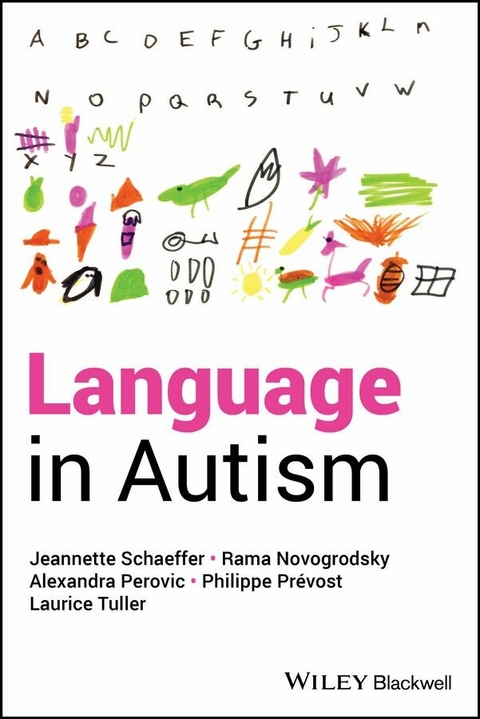
Language in Autism (eBook)
651 Seiten
Wiley-Blackwell (Verlag)
978-1-394-18038-7 (ISBN)

A comprehensive exploration of language development and impairments in Autism
Language is a critical yet understudied component of profiles across the autism spectrum. Language in Autism is a novel, interdisciplinary textbook that addresses this gap by consolidatingcutting-edge linguistic research and evidence-based insights into a single volume accessible to students, teachers, and professionals from a wide variety of disciplines.
Authored by a team of leading experts affiliated with the Language Abilities in Children with Autism (LACA) network, Language in Autism applies what we know about the nature of human languageto the study of language in autism. With 16 finely crafted chapters, the textbook examines a broad range of issues central to language in autism. These include systematic examination of the different language components (the lexicon, phonology, pragmatics, etc.) as well as an array of topics that cut across these components, such as multilingualism, reading, or language in autism compared to other neurodevelopmental disorders.
Designed with students and professionals in mind, Language in Autism incorporates practical tools such as explanatory text boxes, illustrations and structured chapter layouts to enhance comprehension and foster discussion. Each chapter includes foundational knowledge, real-world study examples, and forward-looking perspectives to inspire future research and intervention strategies. Equipping readers with the knowledge to make evidence-based decisions in clinical, educational, and research settings, Language in Autism:
- Features insights from the Language Abilities in Children with Autism (LACA) network, presenting the latest findings from psycholinguistics and clinical linguistics
- Follows a consistent and reader-friendly layout, with chapters organized into sections including 'Anchoring', and 'Focus on a Specific Study'
- Integrates pedagogical tools such as 'What Do You Think?' and 'What Do You Know Now?', to engage readers in critical thinking and self-assessment and encourage them to pursue deeper understanding of each topic
- Provides clear explanations of technical terms and acronyms, supported by accessible summaries and examples to enhance understanding
- Includes discussions on emerging directions in language assessment for autistic individuals
- Raises clearly and coherently the challenging issues raised by current views of autism and language in autism
Language in Autism is ideal for undergraduate and graduate students in psycholinguistics, language acquisition, clinical linguistics, education, and speech-language pathology, as well as for medical students and interns. It is also a valuable reference for speech-language pathologists, teachers, physicians, linguists, clinical researchers, and other professionals working with autistic individuals.
JEANNETTE SCHAEFFER is Professor of Language Acquisition at the University of Amsterdam.
RAMA NOVOGRODSKY is Associate Professor of Communication Sciences and Disorders at the University of Haifa.
ALEXANDRA PEROVIC is Associate Professor of Clinical Linguistics at University College London.
PHILIPPE PRÉVOST is Professor of Linguistics at the University of Tours.
LAURICE TULLER is Professor Emerita of Linguistics at the University of Tours. This team of editors all have established expertise in language acquisition and language disorders, having published widely on language development in both monolingual and bilingual children, with and without language concerns, including, notably, autistic children.
A comprehensive exploration of language development and impairments in Autism Language is a critical yet understudied component of profiles across the autism spectrum. Language in Autism is a novel, interdisciplinary textbook that addresses this gap by consolidatingcutting-edge linguistic research and evidence-based insights into a single volume accessible to students, teachers, and professionals from a wide variety of disciplines. Authored by a team of leading experts affiliated with the Language Abilities in Children with Autism (LACA) network, Language in Autism applies what we know about the nature of human languageto the study of language in autism. With 16 finely crafted chapters, the textbook examines a broad range of issues central to language in autism. These include systematic examination of the different language components (the lexicon, phonology, pragmatics, etc.) as well as an array of topics that cut across these components, such as multilingualism, reading, or language in autism compared to other neurodevelopmental disorders. Designed with students and professionals in mind, Language in Autism incorporates practical tools such as explanatory text boxes, illustrations and structured chapter layouts to enhance comprehension and foster discussion. Each chapter includes foundational knowledge, real-world study examples, and forward-looking perspectives to inspire future research and intervention strategies. Equipping readers with the knowledge to make evidence-based decisions in clinical, educational, and research settings, Language in Autism: Features insights from the Language Abilities in Children with Autism (LACA) network, presenting the latest findings from psycholinguistics and clinical linguistics Follows a consistent and reader-friendly layout, with chapters organized into sections including 'Anchoring', and 'Focus on a Specific Study' Integrates pedagogical tools such as 'What Do You Think?' and 'What Do You Know Now?', to engage readers in critical thinking and self-assessment and encourage them to pursue deeper understanding of each topic Provides clear explanations of technical terms and acronyms, supported by accessible summaries and examples to enhance understanding Includes discussions on emerging directions in language assessment for autistic individuals Raises clearly and coherently the challenging issues raised by current views of autism and language in autism Language in Autism is ideal for undergraduate and graduate students in psycholinguistics, language acquisition, clinical linguistics, education, and speech-language pathology, as well as for medical students and interns. It is also a valuable reference for speech-language pathologists, teachers, physicians, linguists, clinical researchers, and other professionals working with autistic individuals.
Biographical Notes
Editors
Jeannette Schaeffer is Professor of Language Acquisition at the University of Amsterdam. She investigates language acquisition and development across languages and populations, including children with hemispherectomy, Developmental Language Disorder (DLD), autism, and, more recently, in minors in conflict with the law. She founded LACA (Language Abilities in Children with Autism) in 2017, an international, collaborative network focusing on the cross-linguistic investigation of language (development) in autism. She has published in leading journals such as Language Acquisition, Applied Psycholinguistics, Natural Language & Linguistic Theory, and Glossa.
Rama Novogrodsky is Associate Professor at the University of Haifa, Israel. She studies typical and atypical language development in various populations, including children with autism, hearing impairment (also those who use sign language), and Developmental Language Disorder. Her work has appeared in journals such as Journal of Speech, Language, and Hearing Research, First Language, and Applied Psycholinguistics.
Alexandra Perovic is Associate Professor at University College London. Her research explores monolingual and multilingual language development in autism, Down syndrome and Williams syndrome, and language difficulties in children within the youth justice system. She has published in Developmental Science and Journal of Speech, Language, and Hearing Research, among others. She teaches clinical linguistics and language acquisition to postgraduate speech and language therapy students.
Philippe Prévost is Professor of Linguistics at the University of Tours, France. His research, featuring in journals such as Linguistic Approaches to Bilingualism and Autism Research, spans across several domains of language development, such as second language acquisition and language development in the context of a neurodevelopmental disorder, including Developmental Language Disorder and autism, in both children and adults.
Laurice Tuller is Professor Emerita of Linguistics at the University of Tours, France, with expertise in psycholinguistics, language pathology, and bilingual language acquisition. She has investigated language profiles in contexts including hearing loss, epilepsy, Developmental Language Disorder, and autism. Her work has been published in Autism Research, Brain and Language, and Journal of Speech, Language, and Hearing Research, among others.
Other Authors
Flavia Adani is Associate Professor of Language Development at the Free University of Berlin, Germany. Her cross-linguistic research focuses on monolingual and bilingual populations of children with typical and atypical language development (Developmental Language Disorder, Autism Spectrum Disorder). Her work has been published in Journal of Speech, Language, and Hearing Research, Journal of Child Language, and Language Learning and Development.
Stephanie Durrleman leads a group investigating bilingualism in children with and without autism at the Department of Science and Medicine, University of Fribourg, Switzerland. Her work spans diverse languages, age groups, and populations and integrates linguistic theory and empirical methods, to shed light on communication and cognition and to yield concrete applications for language assessment, therapy and policy.
Inge-Marie Eigsti is Professor of Clinical Psychology in the Department of Psychological Sciences at the University of Connecticut, and Director of Research for the Institute for Brain and Cognitive Sciences. Her research on language and communication in autism is funded by multiple grants from the National Institutes of Health and she has authored over 100 peer-reviewed publications.
Carole El Akiki is Associate Professor at the University of Tours, France. Her research focuses on written language acquisition (reading and spelling) in typically developing children and in children with neurodevelopmental disorders (Autism, Specific Learning Disorder). Her work has been published in journals such as Frontiers in Psychology and Applied Psycholinguistics.
Sandrine Ferré is Professor of Linguistics at the University of Tours, France. As a phonologist, her research focuses on phonological abilities in typical and atypical contexts such as autism, Developmental Language Disorder and hearing impairment in children and adults. Her work has been published in Journal of Speech, Language, and Hearing Research, Language Acquisition, and Linguistic Approaches to Bilingualism among others.
Francesca Foppolo is Associate Professor of Psycholinguistics at the University of Milan-Bicocca. Her research focuses on language processing in typically and atypically developing children, bilinguals, and adults by means of off-line and on-line techniques, particularly eye-tracking. She has published in Journal of Memory and Language, Journal of Child language and Journal of Communication Disorders, among others.
Philippine Geelhand is a scientific collaborator at the Université Libre de Bruxelles. Her research explores how linguistic differences shape social interactions between people of different neurotypes. Her work is published in journals such as Autism, Autism in Adulthood, Molecular Autism, Clinical Linguistics and Phonetics, and Journal of Pragmatics.
Petra Hendriks is Professor of Semantics and Cognition at the University of Groningen, the Netherlands. Her research focuses on sentence interpretation and processing in typical and atypical populations, including autistic children. She has published in journals such as Language, Cognition and Neuroscience, Journal of the Acoustical Society of America, Journal of Abnormal Psychology, and Cognitive Science.
Napoleon Katsos is Professor of Experimental Pragmatics at the University of Cambridge. He studies the acquisition and processing of meaning by monolingual, bilingual, neurotypical and neurodivergent individuals. A co-founder of the Cambridge Bilingualism Network, Napoleon has co-edited the Oxford Handbook of Experimental Semantics and Pragmatics and his research has appeared in journals such as PNAS, Cognition, and Journal of Semantics.
Caroline Larson is Assistant Professor at the University of Missouri in the Department of Speech, Language, and Hearing Sciences and Interdisciplinary Neuroscience Program. Her research examines relationships between language and other cognitive factors in individuals with language disorders, including developmental language disorder and autism spectrum disorder, using behavioral and functional neuroimaging methodologies.
Marta Manenti is Assistant Professor at the University of Tours, France. Her research explores language development in neurodevelopmental disorders, including Developmental Language Disorder and autism, with a particular focus on the structural language abilities of autistic adults. Her work has been published in autism journals such as Autism & Developmental Language Impairments and Research in Autism Spectrum Disorders.
Theodoros Marinis is Professor of Multilingualism and Director of the Centre for Multilingualism at the University of Konstanz. His research aims to uncover the nature of language processing in monolingual and multilingual children with typical and atypical language development across languages. He has published in journals such as Applied Psycholinguistics, the Journal of Child Language, and Linguistic Approaches to Bilingualism.
Natalia Meir is Associate Professor at Bar-Ilan University, Israel, coordinating the Linguistics in Clinical Research Program. Her research focuses on language development in monolingual and bilingual populations, including those with ASD and DLD. She studies heritage language maintenance across the lifespan. She co-edited Methods for Assessing Multilingual Children and is a member of Bilingualism Matters and IALP.
Letitia Naigles is Professor of Psychological Sciences at University of Connecticut, USA. Her research focuses on child language acquisition across multiple languages, as well as the language development of children with autism, innovating the use of eyetracking methods to assess their language. She has published in the Journal of Child Language, Cognition, Journal of Autism and Developmental Disorders, and Developmental Science, among others.
Francesca Panzeri is Associate Professor of Philosophy of Language at the University of Milan-Bicocca. Her research focuses on the acquisition of pragmatic phenomena in typical and atypical children, such as the derivation of implicitly conveyed content, presuppositions, and figurative meanings (metaphors and irony). She has published in Journal of Pragmatics, Journal of Semantics, PLoS ONE, among others.
Rhea Paul is Founding Chair and Retired Professor of Speech-Language Pathology at Sacred Heart University, Fairfield, Connecticut. She authored over 100 refereed journal articles, over 50 book chapters, and 9 books. She is currently Director of ABCs4ASD, a Personnel Preparation Program, funded by the U.S. Office of Education. She received Honors of the Association in 2014 from ASHA.
Elena Peristeri is Associate Professor at the Aristotle University of Thessaloniki. Her research investigates language and cognitive processing in monolingual and bilingual children...
| Erscheint lt. Verlag | 23.7.2025 |
|---|---|
| Sprache | englisch |
| Themenwelt | Schulbuch / Wörterbuch ► Wörterbuch / Fremdsprachen |
| Geisteswissenschaften ► Sprach- / Literaturwissenschaft | |
| Schlagworte | ASD language research • autism spectrum disorder language • clinical linguistics ASD • language acquisition autism • language development autism • language impairments in ASD • multilingualism autism • psycholinguistics autism • speech-language pathology |
| ISBN-10 | 1-394-18038-1 / 1394180381 |
| ISBN-13 | 978-1-394-18038-7 / 9781394180387 |
| Informationen gemäß Produktsicherheitsverordnung (GPSR) | |
| Haben Sie eine Frage zum Produkt? |
 EPUB (Adobe DRM)
Kopierschutz: Adobe-DRM
Adobe-DRM ist ein Kopierschutz, der das eBook vor Mißbrauch schützen soll. Dabei wird das eBook bereits beim Download auf Ihre persönliche Adobe-ID autorisiert. Lesen können Sie das eBook dann nur auf den Geräten, welche ebenfalls auf Ihre Adobe-ID registriert sind.
Details zum Adobe-DRM
Dateiformat: EPUB (Electronic Publication)
EPUB ist ein offener Standard für eBooks und eignet sich besonders zur Darstellung von Belletristik und Sachbüchern. Der Fließtext wird dynamisch an die Display- und Schriftgröße angepasst. Auch für mobile Lesegeräte ist EPUB daher gut geeignet.
Systemvoraussetzungen:
PC/Mac: Mit einem PC oder Mac können Sie dieses eBook lesen. Sie benötigen eine
eReader: Dieses eBook kann mit (fast) allen eBook-Readern gelesen werden. Mit dem amazon-Kindle ist es aber nicht kompatibel.
Smartphone/Tablet: Egal ob Apple oder Android, dieses eBook können Sie lesen. Sie benötigen eine
Geräteliste und zusätzliche Hinweise
Buying eBooks from abroad
For tax law reasons we can sell eBooks just within Germany and Switzerland. Regrettably we cannot fulfill eBook-orders from other countries.
aus dem Bereich


