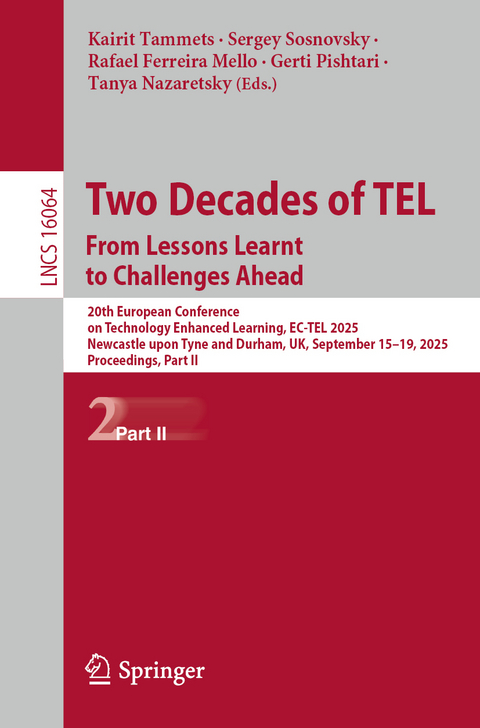
Two Decades of TEL. From Lessons Learnt to Challenges Ahead
Springer International Publishing (Verlag)
978-3-032-03872-2 (ISBN)
The two-volume set LNCS 16063-16064 constitutes the proceedings of 20th European Conference on Technology Enhanced Learning, EC-TEL 2025, which took place in Newcastle upon Tyne and Durham, UK, September 2025.
The total of 43 full papers, including 37 research papers, 4 blue-sky and 2 industry papers, as well as 16 demos and 32 posters papers presented in EC-TEL 2025 proceedings was carefully reviewed and selected from 195 submissions. They focus on all aspects of dynamic interdisciplinary field, bridging pedagogy, educational psychology, and digital technology.
.- Blue-sky.
.- Generating Change: AI as an Opportunity to Address Long-standing OER Challenges.
.- A Web Application and Authoring Tool for Supporting the Generation of Ai-Based Avatars for Communication Scenarios.
.- Teaching with AI: The role of Teachers in the Hybrid Intelligent System.
.- Educator Professional Development Through LA and AIED Participatory Design: A Missing Link.
.- Industry.
.- A Citizen Science Approach to Co-Designing Hybrid Learning Scenarios in the Context of Vocational Secondary Education.
.- Turning Competency Data into Actionable Insights for Teachers.
.- Poster.
.- Generating AI Images for the OER Conversion Tool convOERter".
.- Exploring Human-AI Collaboration in Flipped Learning Design: A Comparative Study of Generative AI and Pedagogical Patterns.
.- Towards Capturing Teacher Agency Manifestations within Orchestration Activities: A Conceptual-Analytical Framework.
.- Designing the Course Load Analytics Platform.
.- How Expertise Levels Shape Preferences and Reflection Needs: Towards AI Reflection Systems for Teacher Empowerment.
.- Error Classification in Stoichiometry Tutoring Systems with Different Levels of Scaffolding: Comparing Rule-Based Classification and Machine Learning.
.- Teacher Agency in Implementing Automated Writing Evaluation Systems in a Science Classroom: A Focus Group Study.
.- Can Large Language Models Identify Locations Better Than Linked Open Data for U-Learning?.
.- Assessing Confusion's Impact in Entrepreneurial Learning with Electrodermal Activity.
.- Students' use of digital technologies to support emotion regulation when learning online.
.- Scaffolding Learning Scenarios with a Socratic Chatbot: Insights from Educators.
.- Classifying Students Meta-Cognitive Comments.
.- Developing a survey on motivations, attitudes, and challenges of non-native participants in English-taught MOOCs.
.- CodeFarm: An application for the development of computational thinking through video games in early educational stages.
.- Devil's Advocates Wear AI: exploring the assistive role of AI in assessment, in a meaningful way.
.- Assessing the effect of performance prediction on students perceptions of courses.
.- Designing a study to evaluate the Impact of WebXR with GenAI on Student Engagement in Distance Education.
.- Transparent Risk Predictions and Explanatory Feedback: Boosting Engagement and Course Achievement in Online Professional Learning.
.- Supporting Learning Design for Sustainable Development Using Large Language Models.
.- Exploring the Complex Analytics Interplay of LMS Design, Usage, Academic Outcomes, and Perceived Workload: A Case Study.
.- KinderGPT: Promoting Children s AI Literacy Through Conversational AI Usability Evaluation and Practical Insights.
.- Temperature is All You Need: Approximating Human Mathematics Hint Efficacy with LLMs.
.- Reimagining TEL - redesigning technology for the promotion of students sense of belonging.
.- Towards developing a guideline for optimizing interface design of Intelligent Tutoring Software.
.- Partnering with AI: A Pedagogical Feedback System for LLM Integration into Programming Education.
.- Investigating the Effects of Motivational Pedagogical Agents on Student Learning and Choice Making in an Adaptive Learning System.
.- A Systematic Review of Integrating Knowledge Graphs with Large Language Models: Applications, Models, Evaluation Methods, and Opportunities.
.- Human-Agent Interaction and Collaboration in Education: A Review and Future Research Prospects.
.- Leveraging LLMs to Assess Tutor Moves in Real-Life Dialogues: A Feasibility Study.
.- Assisting Teachers in the Design of Fee
| Erscheinungsdatum | 03.09.2025 |
|---|---|
| Reihe/Serie | Lecture Notes in Computer Science |
| Zusatzinfo | XXVI, 397 p. 102 illus., 94 illus. in color. |
| Verlagsort | Cham |
| Sprache | englisch |
| Maße | 155 x 235 mm |
| Themenwelt | Schulbuch / Wörterbuch ► Unterrichtsvorbereitung ► Unterrichts-Handreichungen |
| Mathematik / Informatik ► Informatik | |
| Schlagworte | Artificial Intelligence • augmented and virtual reality • Collaborative Learning • computer-assisted instruction • Computer systems • digital libraries and archives • Distance Learning • educational data mining • E-Learning • Game-based Learning • generative AI • higher education and k12 • Human-Computer interaction • immersive learning • information systems • Learning Analytics • Learning environment • Online Learning • Technology-Enhanced Learning • workplace learning |
| ISBN-10 | 3-032-03872-3 / 3032038723 |
| ISBN-13 | 978-3-032-03872-2 / 9783032038722 |
| Zustand | Neuware |
| Informationen gemäß Produktsicherheitsverordnung (GPSR) | |
| Haben Sie eine Frage zum Produkt? |
aus dem Bereich