


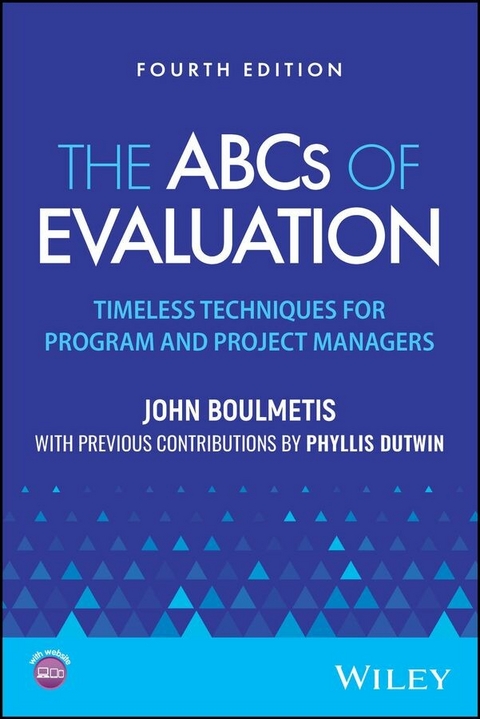
The ABCs of Evaluation (eBook)
349 Seiten
Wiley (Verlag)
978-1-394-29603-3 (ISBN)
The most up-to-date version of the gold standard reference in conducting evaluations
The newly revised fourth edition of The ABCs of Evaluation is an easy-to-read explanation of the concepts and methods of the evaluation process. The author explains what the process offers to people who go through it, how to conduct it properly, and how to draw on its conclusions to improve your workplace. The book also walks you through every step of the evaluation process, answering not just the theoretical question of 'Why should we evaluate?' but demonstrating the nuts and bolts of an effective and illuminating evaluation.
Author John Boulmetis presents evidence-based and useful strategies for conducting evaluations, transforming them from something seen by your people as something to 'get around' or 'get through'-or as something being done 'to' them as opposed to 'for' them-into an invaluable data gathering and processing tool for organizations of all types and sizes.
Inside the book:
- A comprehensive guide to evaluation for program and project managers who are new to the discipline
- Time-tested and proven evaluation principles and techniques you can apply immediately within your own organization
- How to collect data, set standards, implement an evaluation plan, select an evaluation model, and more
Perfect for managers, supervisors, team facilitators, and data analysts, The ABCs of Evaluation is a step-by-step playbook for conducting useful and effective evaluations in any industry and within organizations of any size.
John Boulmetis, PhD, is a Professor Emeritus at the University of Rhode Island School of Education. Dr. Boulmetis received his master's degree in education from the University of Rhode Island and his doctoral degree in adult and vocational education from The Ohio State University. Since his retirement, he has consulted as an independent third-party evaluator on federal grants and contracts.
Phyllis Dutwin, MA, was president of Dutwin Associates, a training and development firm, and former vice president of Reading and Educational Services of New Jersey. She received her master's degree in adult education, training, and development from the University of Rhode Island.
The most up-to-date version of the gold standard reference in conducting evaluations The newly revised fourth edition of The ABCs of Evaluation is an easy-to-read explanation of the concepts and methods of the evaluation process. The author explains what the process offers to people who go through it, how to conduct it properly, and how to draw on its conclusions to improve your workplace. The book also walks you through every step of the evaluation process, answering not just the theoretical question of Why should we evaluate? but demonstrating the nuts and bolts of an effective and illuminating evaluation. Author John Boulmetis presents evidence-based and useful strategies for conducting evaluations, transforming them from something seen by your people as something to get around or get through or as something being done to them as opposed to for them into an invaluable data gathering and processing tool for organizations of all types and sizes. Inside the book: A comprehensive guide to evaluation for program and project managers who are new to the discipline Time-tested and proven evaluation principles and techniques you can apply immediately within your own organization How to collect data, set standards, implement an evaluation plan, select an evaluation model, and more Perfect for managers, supervisors, team facilitators, and data analysts, The ABCs of Evaluation is a step-by-step playbook for conducting useful and effective evaluations in any industry and within organizations of any size.
PREFACE
There are a number of words or phrases that when heard strike fear into our hearts and minds: Public Speaking, Spiders, Clowns, IRS Tax Audits, Cancer, and the phrase “We Need to Talk.” Probably high on the list is the word “Evaluation,” especially if it is to focus on you or your group. It’s hard to say whether more people fear being the object of an evaluation or being responsible for conducting an evaluation.
However, the fact of the matter is that an evaluation is a task that every program and project manager will face at one time or another. You may manage the funding process for an organization, direct a self‐study that requires evaluation, be responsible for the evaluation of a person/group who reports to you, or write a grant proposal that includes an evaluation design. Occasions vary, but they are inevitable.
Still, endorsing evaluation is a lot like endorsing regular visits to the dentist. People are quick to endorse both activities, but when it comes to doing either one, most people are very uncomfortable. The ABCs of Evaluation will reduce your discomfort by doing two things: First, the book will demystify the process of designing and conducting an evaluation by helping you understand the components of an evaluation design. Second, and more important, the book’s aim is to convince you that you play an integral part in any evaluation process, and therefore will be a direct beneficiary of the results.
You might ask, who is the “You” that this book is designed to assist in the process of evaluation? You might be a manager, supervisor, team facilitator, analyst, or an independent third‐party evaluation consultant in the private sector. Then again, you might be in the public or private sector as an administrator, coordinator, facilitator, consultant, or a program/project evaluator. Or you might be a faculty member or student in any of a host of disciplines (education, management, human services, psychology, public affairs, labor relations, or health). For any of these situations, the book will provide you with a basic understanding of the steps to follow to design, conduct, and supervise a program evaluation.
This book has been designed to serve as an introduction to evaluation for program and project managers who have little experience in this task. It presents time‐tested evaluation principles and techniques, but it does not purport to reflect the totality of the professional field of evaluation, which encompasses a far greater range of techniques and technologies than are suited to the needs and interests of this book’s readership.
Demonstrating Success
As a professional, you know that your programs need to show evidence of success. For example, regardless of how important a communication skills training seminar might be to the overall team‐building effort of a company, if you cannot show how it affected the employees’ teamwork skills or how improved teamwork added to company performance, the program might not be funded again. This realization of some form of proof may have originated with you or the organization may require evaluations and demand accountability. If you have always assumed that evaluations are just too difficult for you to do, that you don’t want to tackle difficult data collection or unfathomable data analysis, think again. The ABCs of Evaluation will dispel these misconceptions and show you what to do and how to do it.
Both the person who is designing and performing an evaluation and the person who is participating in and receiving the findings of an evaluation need to prepare themselves to understand the basic processes involved. The evaluator, by understanding the thoughts, concerns, and questions of the evaluated, can better anticipate and prepare to address them up front. The evaluated, by anticipating the processes, the probing, and the data requests of an evaluator, can position themselves to make better use of the evaluation process and results.
Too often people feel that evaluation is something that is done to them rather than for them. Indeed, evaluation may be seen as something to get through and get around (Gray, 1998).
The ABCs of Evaluation is an easy‐to‐read explanation of the concepts and methods of the evaluation process. The chapters are designed to teach readers what the process offers, what it consists of, and how it is designed and implemented and completed. In addition, the book will guide managers step‐by‐step throughout the process of conducting an evaluation, from the early question, “Why evaluate?” to the later one, “What did the evaluation tell me?” Consequently, the book will be useful to those who design and conduct the evaluation, as well as to those who supervise others in these tasks.
You may be experiencing downsizing, reorganization, or the introduction of high‐performance teams or high‐performance teamwork. These new circumstances may require you to possess evaluation skills. Although you now find yourself in a position that requires the skills, you may not have them, or you may not have been trained to use them.
Overview
At the beginning of each chapter, a scenario sets the stage. Then the chapter presents new evaluation concepts followed by concluding exercises designed to challenge your understanding.
Chapter 1 defines evaluation, keeping in mind that it is considered both an art and a science. The chapter proposes that readers learn principles and theories as a first step and then apply them in actual situations.
In Chapter 1, you will learn that evaluation, both quantitative and qualitative (to be explained in full subsequently), means measuring and collecting data against some standard. The evaluation may be of people, an activity, an entire program, or all of the above.
After an introduction to the formal reasons to evaluate (more on this in Chapter 2), the chapter explores the ideas of setting standards, using project cycles, and determining levels in evaluation.
Finally, there is an introduction to an Evaluation Design Format that the reader will learn to use throughout the book.
Chapter 2 encourages you to think about the following: where there is a program, there must be evaluation. The “Why?” of evaluation emanates from different sources or audiences—from a need you have, or from a requirement that administration or management has for planning, policymaking, funding, or ongoing research. Whatever its purposes and objectives, evaluation is an integral part of most programs and should be planned from the outset. The evaluation design format introduced in Chapter 1 comes into use here to address your need to define your audience and to eventually report to that audience.
Chapter 3 explores the importance of management buy‐in to decision‐making and explores how staff, subject‐matter experts, and other stakeholders are involved in the preplanning, planning, and implementation of the evaluation. The chapter also addresses this question: How can I evaluate a program I did not help create?
Evaluation decisions flow through the various stages in the evaluation. Consequently, in this chapter you will learn about whom to involve in the evaluation, and how and why they should be involved. You will learn how to monitor evaluation data and engage in both process (formative) evaluation and product (summative) evaluation (also to be explained in full subsequently).
Chapter 4 addresses a number of questions regarding an Evaluator’s Program Description: Why do you need it? How does it relate to the program’s objectives and activities? The chapter will include discussion of the importance of gleaning information from program staff, for example, goals and objectives, the activities planned to achieve the goals and objectives, and the measures that will be used to evaluate the results. The discussion may also involve more than one level of goals and objectives, such as those of the organization, the staff members, and the clients.
The purpose of Chapter 5 is to describe different models of evaluation and to illustrate the circumstances under which each might be used. Certain design components are shared by all models: evaluation questions, activities to observe, data sources, whom you collect data from or about, how and when you collect the data, how you analyze the data, and who is responsible for each piece of the evaluation.
In Chapter 6, you will learn to identify the data sources that will help you, as an evaluator, to determine whether the program has met its objectives. Two important questions are answered: How do data sources relate to the evaluator’s program description? Are paper‐and‐pencil instruments the only form of measurement? This chapter also introduces logic models as an additional means of understanding project concept and project flow. If a logic model exists, it is advisable that an evaluator discusses it with the project staff so that there is total understanding of the intent, process, and intended outcomes. If one does not exist, it might be helpful for the evaluator to construct one with the project staff so that there is understanding and agreement among all stakeholders of the project staffs’ intent, process, and intended outcomes.
Chapter 6 discusses many forms of data collection, among them using existing data, such as previously collected public records, and collecting new data using surveys,...
| Erscheint lt. Verlag | 9.7.2025 |
|---|---|
| Sprache | englisch |
| Themenwelt | Schulbuch / Wörterbuch |
| Sozialwissenschaften ► Pädagogik | |
| Schlagworte | Conducting evaluations • evaluating employees • evaluating grants • evaluating programs • evaluation book • Evaluation concepts • evaluation data collection • evaluation process • Evaluation strategy • Evaluation Techniques • evaluation tips • Phyllis Dutwin • self-evaluations |
| ISBN-10 | 1-394-29603-7 / 1394296037 |
| ISBN-13 | 978-1-394-29603-3 / 9781394296033 |
| Informationen gemäß Produktsicherheitsverordnung (GPSR) | |
| Haben Sie eine Frage zum Produkt? |
 EPUB (Adobe DRM)
Kopierschutz: Adobe-DRM
Adobe-DRM ist ein Kopierschutz, der das eBook vor Mißbrauch schützen soll. Dabei wird das eBook bereits beim Download auf Ihre persönliche Adobe-ID autorisiert. Lesen können Sie das eBook dann nur auf den Geräten, welche ebenfalls auf Ihre Adobe-ID registriert sind.
Details zum Adobe-DRM
Dateiformat: EPUB (Electronic Publication)
EPUB ist ein offener Standard für eBooks und eignet sich besonders zur Darstellung von Belletristik und Sachbüchern. Der Fließtext wird dynamisch an die Display- und Schriftgröße angepasst. Auch für mobile Lesegeräte ist EPUB daher gut geeignet.
Systemvoraussetzungen:
PC/Mac: Mit einem PC oder Mac können Sie dieses eBook lesen. Sie benötigen eine
eReader: Dieses eBook kann mit (fast) allen eBook-Readern gelesen werden. Mit dem amazon-Kindle ist es aber nicht kompatibel.
Smartphone/Tablet: Egal ob Apple oder Android, dieses eBook können Sie lesen. Sie benötigen eine
Geräteliste und zusätzliche Hinweise
Buying eBooks from abroad
For tax law reasons we can sell eBooks just within Germany and Switzerland. Regrettably we cannot fulfill eBook-orders from other countries.
aus dem Bereich


