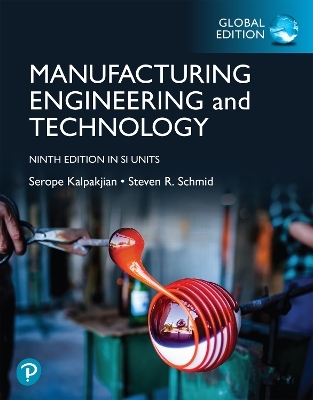
Manufacturing Engineering and Technology, Global Edition
Pearson Education Limited (Verlag)
978-1-292-48804-2 (ISBN)
The 9th Edition is fully updated, with many new topics and illustrations; expands Questions, Qualitative Projects and Quantitative Projects, and Design Problems; examines manufacturing in the context of climate change and the post-COVID world; and much more.
About our authors Serope Kalpakjian is professor emeritus of Mechanical and Materials Engineering at the Illinois Institute of Technology. He is the author of Mechanical Processing of Materials and co-author of Lubricants and Lubrication in Metalworking Operations (with E.S. Nachtman); the first editions of those textbooks have received the M. Eugene Merchant Manufacturing Textbook Award. He has conducted research in various areas of manufacturing, is the author of numerous technical papers and articles in handbooks and encyclopedias, and has edited a number of conference proceedings. He also has been editor and co-editor of several technical journals and has served on various editorial boards, including the Encyclopedia Americana. Among various awards, Professor Kalpakjian has received the Forging Industry Educational and Research Foundation Best Paper Award, the Excellence in Teaching Award from IIT, the ASME Centennial Medallion, the International Education Award from SME, A Person of the Millennium Award from lIT, the Albert Easton White Outstanding Teacher Award from ASM International, and the 2016 SME Gold Medal Award. For 2001, Outstanding Young Manufacturing Engineer Award of SME was named after him. Professor Kalpakjian is a Life Fellow ASME, Fellow SME, Fellow and Life Member ASM International, Fellow Emeritus International Academy for Production Engineering (CIRP), and is a founding member and past president of NAMRI. He is a graduate of Robert College (High Honor, Istanbul), Harvard University, and the Massachusetts Institute of Technology. Steven R. Schmid is the Belk-Woodward Distinguished Professor of Mechanical Engineering at the University of North Carolina - Charlotte, where he teaches and conducts research in the general areas of manufacturing, machine design and tribology. He previously spent almost 30 years on the faculty at the University of Notre Dame. He received his B.S. degree from Illinois Institute of Technology (with Honors) and Master's and Ph.D. from Northwestern University, all in mechanical engineering. He has received numerous awards, including the David Dornfeld Manufacturing Innovation Award and John T. Parsons Awards from SME, the Newkirk Award from ASME, the Kaneb Center Teaching Award (3 times), and the Ruth and Joel Spira Award for Excellence in Teaching. He received the SME Gold Medal in 2022 and a lifetime achievement award from the Spanish manufacturing organization MESIC. Professor Schmid served as President of the North American Manufacturing Research Institution (NAMRI, 2015-2016) and was appointed the first Academic Fellow at the Advanced Manufacturing National Program Office, U.S. Department of Commerce, where he helped design the Manufacturing USA program. From 2016 to 2018, he served as the Program Director of the Manufacturing Machines and Equipment program and Head of the Advanced Manufacturing Cluster at the National Science Foundation. Dr. Schmid is the author of over 140 technical papers, and has co-authored Fundamentals of Machine Elements, Fundamentals of Fluid Film Lubrication, Schey's Tribology in Metalworking, Manufacturing Processes for Engineering Materials, and Manufacturing Engineering and Technology. He is a Fellow of the American Society of Mechanical Engineers and the Society of Manufacturing Engineers.
NOTE: Each chapter concludes with Summary, Bibliography, Review Questions, Qualitative Problems, Quantitative Problems, Synthesis, Design, and Projects. I: Fundamentals of Materials: Behavior and Manufacturing Properties
1: The Structure of Metals
1.1: Introduction
1.2: Types of Atomic Bonds
1.3: The Crystal Structure of Metals
1.4: Deformation and Strength of Single Crystals
1.5: Grains and Grain Boundaries
1.6: Plastic Deformation of Polycrystalline Metals
1.7: Recovery, Recrystallization, and Grain Growth
1.8: Cold, Warm, and Hot Working
2: Mechanical Behavior, Testing, and Manufacturing Properties of Materials
2.1: Introduction
2.2: Tension
2.3: Compression
2.4: Torsion
2.5: Bending (Flexure)
2.6: Hardness
2.7: Fatigue
2.8: Creep
2.9: Impact
2.10: Failure and Fracture of Materials
2.11: Residual Stresses
2.12: Work, Heat, and Temperature
3: Physical Properties of Materials
3.1: Introduction
3.2: Density
3.3: Melting Point
3.4: Specific Heat
3.5: Thermal Conductivity
3.6: Thermal Expansion
3.7: Electrical, Magnetic, and Optical Properties
3.8 : Corrosion Resistance
4: Metal Alloys: Their Structure and Strengthening by Heat Treatment
4.1: Introduction
4.2: Structure of Alloys
4.3: Phase Diagrams
4.4: The Iron–Carbon System
4.5: The Iron–Iron-carbide Phase Diagram and the Development of Microstructures in Steels
4.6: Cast Irons
4.7: Heat Treatment of Ferrous Alloys
4.8: Hardenability of Ferrous Alloys
4.9: Heat Treatment of Nonferrous Alloys and Stainless Steels
4.10: Case Hardening
4.11: Annealing
4.12: Heat Treating Furnaces and Equipment
4.13: Design Considerations for Heat Treating
5: Ferrous Metals and Alloys: Production, General Properties, and Applications
5.1: Introduction
5.2: Production of Iron and Steel
5.3: Casting of Ingots
5.4: Continuous Casting
5.5: Carbon and Alloy Steels
5.6: Stainless Steels
5.7: Tool and Die Steels
6: Nonferrous Metals and Alloys: Production, General Properties, and Applications
6.1: Introduction
6.2: Aluminum and Aluminum Alloys
6.3: Magnesium and Magnesium Alloys
6.4: Copper and Copper Alloys
6.5: Nickel and Nickel Alloys
6.6: Superalloys
6.7: Titanium and Titanium Alloys
6.8: Refractory Metals and Alloys
6.9: Beryllium
6.10: Zirconium
6.11: Lithium
6.12: Low-melting Alloys
6.13: Precious Metals
6.14: Shape-memory Alloys (Smart Materials)
6.15: Amorphous Alloys (Metallic Glasses)
6.16: Metal Foams and Metamaterials
6.17: Rare Earth Metals
7: Polymers: Structure, General Properties, and Applications
7.1: Introduction
7.2: The Structure of Polymers
7.3: Thermoplastics
7.4: Thermosetting Plastics
7.5: Additives in Plastics
7.6: General Properties and Applications of Thermoplastics
7.7: General Properties and Applications of Thermosetting Plastics
7.8: Biodegradable Plastics
7.9: Elastomers (Rubbers)
7.10: Gels
8: Ceramics, Glass, Graphite, Diamond, and Nanomaterials: Structure, General Properties, and Applications
8.1: Introduction
8.2: The Structure of Ceramics
8.3: General Properties and Applications of Ceramics
8.4: Glasses
8.5: Glass Ceramics
8.6: Graphite
8.7: Diamond
8.8: Nanomaterials
9: Composite Materials: Structure, General Properties, and Applications
9.1: Introduction
9.2: The Structure of Reinforced Plastics
9.3: Properties of Reinforced Plastics
9.4: Applications of Reinforced Plastics
9.5: Metal-matrix Composites
9.6: Ceramic-matrix Composites
9.7: Other Composites
II: Metal-casting Processes and Equipment
10: Fundamentals of Metal Casting
10.1: Introduction
10.2: Solidification of Metals
10.3: Fluid Flow
10.4: Fluidity of Molten Metal
10.5: Heat Transfer
10.6: Defects
11: Metal-casting Processes and Equipment
11.1: Introduction
11.2: Expendable-mold, Permanent-pattern Casting Processes
11.3: Expendable-mold, Expendable-pattern Casting Processes
11.4: Permanent-mold Casting Processes
11.5: Casting Techniques for Single-crystal Components
11.6: Rapid Solidification
11.7: Inspection of Castings
11.8: Melting Practice and Furnaces
11.9: Foundries and Foundry Automation
12: Metal Casting: Design, Materials, and Economics
12.1: Introduction
12.2: Design Considerations in Casting
12.3: Casting Alloys
12.4: Economics of Casting
III: Forming and Shaping Processes and Equipment
13: Metal-rolling Processes and Equipment
13.1: Introduction
13.2: The Flat-rolling Process
13.3: Flat-rolling Practice
13.4: Rolling Mills
13.5: Various Rolling Processes and Mills
14: Metal-forging Processes and Equipment
14.1: Introduction
14.2: Open-die Forging
14.3: Impression-die and Closed-die Forging
14.4: Various Forging Operations
14.5: Forgeability of Metals; Forging Defects
14.6: Die Design, Die Materials, and Lubrication
14.7: Die-manufacturing Methods and Die Failures
14.8: Forging Machines
14.9: Economics of Forging
15: Metal Extrusion and Drawing Processes and Equipment
15.1: Introduction
15.2: The Extrusion Process
15.3: Hot Extrusion
15.4: Cold Extrusion
15.5: Extrusion Defects
15.6: Design Considerations
15.7: Extrusion Equipment
15.8: The Drawing Process
15.9: Drawing Practice
15.10: Drawing Defects and Residual Stresses
15.11: Drawing Equipment
16 : Sheet-Metal Forming Processes and Equipment
16.1: Introduction
16.2: Shearing
16.3: Sheet-metal Characteristics and Formability
16.4: Formability Tests for Sheet Metals
16.5: Bending Sheets, Plates, and Tubes
16.6: Miscellaneous Bending and Related Forming Operations
16.7: Deep Drawing
16.8: Rubber Forming and Hydroforming
16.9: Spinning
16.10: Superplastic Forming
16.11: Hot Stamping
16.12: Specialized Forming Processes
16.13: Manufacturing of Metal Honeycomb Structures
16.14: Design Considerations in Sheet-metal Forming
16.15: Equipment for Sheet-metal Forming
16.16: Economics of Sheet-forming Operations
17: Powder-Metal Processes and Equipment
17.1: Introduction
17.2: Production of Metal Powders
17.3: Compaction of Metal Powders
17.4: Sintering
17.5: Secondary and Finishing Operations
17.6: Design Considerations
17.7: Economics of Powder Metallurgy
18: Ceramics, Glasses, and Superconductors: Processing and Equipment
18.1: Introduction
18.2: Shaping Ceramics
18.3: Forming and Shaping of Glass
18.4: Techniques for Strengthening and Annealing Glass
18.5: Design Considerations for Ceramics and Glasses
18.6: Processing of Superconductors
19: Plastics and Composite Materials: Forming and Shaping
19.1: Introduction
19.2: Extrusion
19.3: Injection Molding
19.4: Blow Molding
19.5: Rotational Molding
19.6: Thermoforming
19.7: Compression Molding
19.8: Transfer Molding
19.9: Casting
19.10: Foam Molding
19.11: Cold Forming and Solid-phase Forming
19.12: Processing Elastomers
19.13: Processing Polymer-Matrix Composites
19.14: Processing Metal-Matrix and Ceramic-Matrix Composites
19.15: Design Considerations
19.16: Economics of Processing Plastics and Composite Materials
20: Additive Manufacturing
20.1: Introduction
20.2: Additive Manufacturing Methodology
20.3: Material Extrusion
20.4: Vat Polymerization
20.5: Material Jetting
20.6: Binder Jetting
20.7: Powder Bed Fusion
20.8: Sheet Lamination
20.9: Directed Energy Deposition
20.10: Miscellaneous Processes
20.11: Direct Manufacturing and Rapid Tooling
20.12: Design for Additive Manufacturing
20.13: Additive Manufacturing Economics
IV: Machining Processes and Machine Tools
21: Fundamentals of Machining
21.1: Introduction
21.2: Mechanics of Cutting
21.3: Cutting Forces and Power
21.4: Temperatures in Cutting
21.5: Tool Life: Wear and Failure
21.6: Surface Finis
21.7: Machinability
22: Cutting-Tool Materials and Cutting Fluids
22.1: Introduction
22.2: High-speed Steels
22.3: Cast-cobalt Alloys
22.4: Carbides
22.5: Coated Tools
22.6: Alumina-based Ceramics
22.7: Cubic Boron Nitride
22.8: Silicon-Nitride-based Ceramics
22.9: Diamond
22.10: Whisker-reinforced Materials and Nanomaterials
22.11: Tool Costs and Reconditioning of Tools
22.12: Cutting Fluids
23: Machining Processes: Turning and Hole Making
23.1: Introduction
23.2: The Turning Process
23.3: Lathes and Lathe Operations
23.4: Boring and Boring Machines
23.5: Drilling, Drills, and Drilling Machines
23.6: Reaming and Reamers
23.7: Tapping and Taps
24: Machining Processes: Milling, Broaching, Sawing, Filing, and Gear Manufacturing
24.1: Introduction
24.2: Milling and Milling Machines
24.3: Planing and Shaping
24.4: Broaching and Broaching Machines
24.5: Sawing
24.6: Filing
24.7: Gear Manufacturing by Machining
25: Machining Centers, Machine-tool Structures, and Machining
25.1: Introduction
25.2: Machining Centers
25.3: Machine-tool Structures
25.4: Vibration and Chatter in Machining Operations
25.5: High-speed Machining
25.6: Hard Machining
25.7: Ultraprecision Machining
25.8: Machining Economics
26: Abrasive Machining and Finishing Operations
26.1: Introduction
26.2: Abrasives and Bonded Abrasives
26.3: The Grinding Process
26.4: Grinding Operations and Machines
26.5: Design Considerations for Grinding
26.6: Ultrasonic Machining
26.7: Finishing Operations
26.8: Deburring Operations
26.9: Economics of Abrasive Machining and Finishing Operations
27: Advanced Machining Processes
27.1: Introduction
27.2: Chemical Machining
27.3: Electrochemical Machining
27.4: Electrochemical Grinding
27.5: Electrical-Discharge Machining
27.6: Laser-beam Machining
27.7: Electron-beam Machining
27.8: Water-jet Machining
27.9: Abrasive-jet Machining
27.10: Hybrid Machining Systems
V: Micromanufacturing and Fabrication of Microelectronic Devices
28: Fabrication of Microelectronic Devices
28.1: Introduction
28.2: Clean Rooms
28.3: Semiconductors and Silicon
28.4: Crystal Growing and Wafer Preparation
28.5: Film Deposition
28.6: Oxidation
28.7: Lithography
28.8: Etching
28.9: Diffusion and Ion Implantation
28.10: Metallization and Testing
28.11: Wire Bonding and Packaging
28.12: Yield and Reliability
28.13: Printed Circuit Boards
28.14: Roll-to-Roll Printing of Flexible Electronics
28.15: Flexible Hybrid Electronics
29: Fabrication of Microelectromechanical Devices and Systems and Nanoscale Manufacturing
29.1: Introduction
29.2: Micromachining of MEMS Devices
29.3: Electroforming-based Processes
29.4: Solid Free-form Fabrication of Devices
29.5: Mesoscale Manufacturing
29.6: Nanoscale Manufacturing
VI: Joining Processes and Equipment
30: Fusion Welding Processes
30.1: Introduction
30.2: Oxyfuel–Gas Welding
30.3: Arc-welding Processes: Nonconsumable Electrode
30.4: Arc-welding Processes: Consumable Electrode
30.5: Electrodes for Arc Welding
30.6: Electron-beam Welding
30.7: Laser-beam Welding
30.8: Cutting
30.9: The Weld Joint, Quality and Testing
30.10: Joint Design and Process Selection
31: Solid-state Welding Processes
31.1: Introduction
31.2: Cold Welding and Roll Bonding
31.3: Ultrasonic Welding
31.4: Friction Welding
31.5: Resistance Welding
31.6: Explosion Welding
31.7: Diffusion Bonding
31.8: Economics of Welding Operations
32: Brazing, Soldering, Adhesive-bonding, and Mechanical Fastening Processes
32.1: Introduction
32.2: Brazing
32.3: Soldering
32.4: Adhesive Bonding
32.5: Mechanical Fastening
32.6: Joining Plastics, Ceramics, and Glasses
32.7: Economics of Joining Operations
VII: Surface Technology
33: Surface Roughness and Measurement; Friction, Wear, and Lubrication
33.1: Introduction
33.2: Surface Structure and Integrity
33.3: Surface Texture and Roughness
33.4: Friction
33.5: Wear
33.6: Lubrication
33.7: Metalworking Fluids and Their Selection
34: Surface Treatments, Coatings, and Cleaning
34.1: Introduction
34.2: Mechanical Surface Treatments
34.3: Mechanical Plating and Cladding
34.4: Case Hardening and Hard Facing
34.5: Thermal Spraying
34.6: Vapor Deposition
34.7: Ion Implantation and Diffusion Coating
34.8: Laser Treatments
34.9: Electroplating, Electroless Plating, and Electroforming
34.10: Conversion Coatings
34.11: Hot Dipping
34.12: Porcelain Enameling; Ceramic and Organic Coatings
34.13: Diamond Coating and Diamondlike Carbon
34.14: Surface Texturing
34.15: Painting
34.16: Cleaning of Surfaces
VIII: Engineering Metrology, Instrumentation, and Quality Assurance
35: Engineering Metrology and Instrumentation
35.1: Introduction
35.2: Measurement Standards
35.3: Geometric Features of Parts: Analog and Digital Measurements
35.4: Traditional Measuring Methods and Instruments
35.5: Modern Measuring Instruments and Machines
35.6: Automated Measurement
35.7: General Characteristics and Selection of Measuring Instruments
35.8: Geometric Dimensioning and Tolerancing
36: Quality Assurance, Testing, and Inspection
36.1: Introduction
36.2: Product Quality
36.3: Quality Assurance
36.4: Total Quality Management
36.5: Taguchi Methods
36.6: The ISO and QS Standards
36.7: Statistical Methods of Quality Control
36.8: Statistical Process Control
36.9: Reliability of Products and Processes
36.10: Nondestructive Testing
36.11: Destructive Testing
36.12: Automated Inspection
IX: Manufacturing in a Competitive Environment
37: Automation of Manufacturing Processes and Operations
37.1: Introduction
37.2: Automation
37.3: Numerical Control
37.4: Adaptive Control
37.5: Material Handling and Movement
37.6: Industrial Robots
37.7: Sensor Technology
37.8: Flexible Fixturing
37.9: Assembly Systems
37.10: Design Considerations for Fixturing, Assembly, Disassembly, and Servicing
37.11: Economic Considerations
38: Computer-aided Manufacturing
38.1: Introduction
38.2: Manufacturing Systems
38.3: Computer-integrated Manufacturing
38.4: Computer-aided Design and Engineering
38.5: Computer-aided Manufacturing
38.6: Computer-aided Process Planning
38.7: Computer Simulation of Manufacturing Processes and Systems
38.8: Group Technology
39: Computer-integrated Manufacturing Systems
39.1: Introduction
39.2: Cellular Manufacturing
39.3: Flexible Manufacturing Systems
39.4: Mass Customization
39.5: Holonic Manufacturing
39.6: Just-in-time Production
39.7: Lean Manufacturing
39.8: Communications Networks in Manufacturing
39.9: Artificial Intelligence and Machine Learning
39.10: Economic Considerations
40: Product Design and Manufacturing in a Competitive Environment
40.1: Introduction
40.2: Product Design
40.3: Product Quality
40.4: Decarbonization and Sustainable Manufacturing
40.5: Energy Consumption in Manufacturing
40.6: Material Selection for Products
40.7: Material Substitution
40.8: Manufacturing Process Capabilities
40.9: Process Selection
40.10: Manufacturing Costs and Cost Reduction
Index
| Erscheinungsdatum | 07.10.2025 |
|---|---|
| Verlagsort | Harlow |
| Sprache | englisch |
| Gewicht | 2808 g |
| Themenwelt | Schulbuch / Wörterbuch |
| Technik ► Maschinenbau | |
| ISBN-10 | 1-292-48804-2 / 1292488042 |
| ISBN-13 | 978-1-292-48804-2 / 9781292488042 |
| Zustand | Neuware |
| Informationen gemäß Produktsicherheitsverordnung (GPSR) | |
| Haben Sie eine Frage zum Produkt? |
aus dem Bereich