


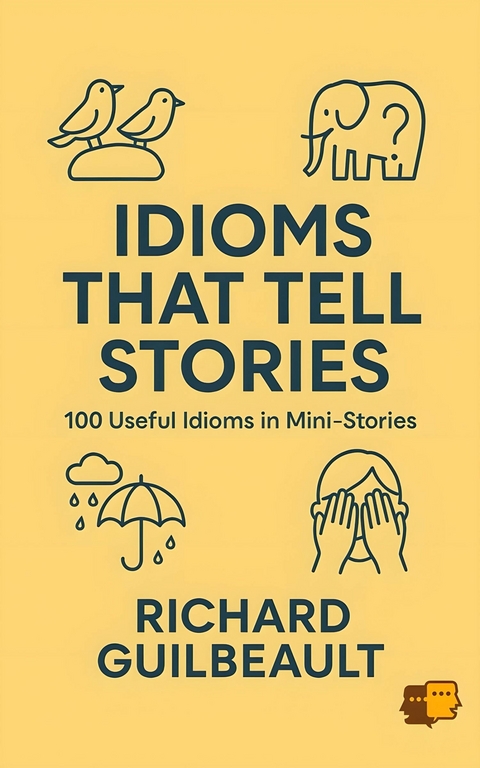
Idioms That Tell Stories (eBook)
330 Seiten
Publishdrive (Verlag)
978-0-00-095620-0 (ISBN)
'Idioms That Tell Stories' offers a fresh, narrative-driven approach to mastering English idioms. Organized into ten thematic chapters-Animals, Body Parts, Food & Drink, Weather & Nature, Colours, Time & Money, Work & Business, People & Relationships, Emotions & Reactions, and Miscellaneous & Abstract-this guide presents 100 essential idioms woven into 150-200-word mini-stories. Each story brings an expression to life, showing how it functions in context and helping learners build intuitive understanding.
Following every chapter, carefully designed exercises reinforce comprehension and active use: true-or-false usage notes, sentence-rewrite drills, custom sentence prompts, and short-story challenges encourage creativity and confidence. A comprehensive answer key supports self-study, while further reading suggestions connect users with deeper resources.
Whether you're an intermediate learner aiming to sound more natural or an instructor seeking engaging classroom material, 'Idioms That Tell Stories' transforms everyday expressions into memorable narratives-and invites you to explore, practice, and share the vivid world behind each phrase.
1. Kill Two Birds with One Stone [kɪl tuː bɜːrdz wɪð wʌn stoʊn]
Literal vs. Figurative Meaning
· Literal: To strike two birds with a single stone
· Figurative: To accomplish two objectives with one action
Explanation
This proverb appears in European collections as far back as the 17th century, its vivid imagery underscoring ruthless efficiency. Today we use it almost exclusively in a positive sense, to praise clever multitasking rather than actual harm. Keep in mind, however, that the phrase still evokes force, so gauge your audience before you use it.
Short Story
Mia glanced at her watch, then at the unread email and blinking calendar reminder. She needed to reply to her client and book the flight. She took a breath and thought, “Might as well kill two birds with one stone.” She typed her response, clicked “Send,” then switched tabs to reserve her seat. Both tasks done before coffee cooled. She leaned back, the morning’s small victory warming her more than the mug ever could.
2. Let the Cat Out of the Bag [lɛt ðə kæt aʊt ʌv ðə bæɡ]
Literal vs. Figurative Meaning
· Literal: To allow a cat to escape from a bag
· Figurative: To reveal a secret or spoil a surprise
Explanation
The origin likely traces back to medieval markets, where dishonest sellers substituted a cat for a piglet in a sack—once the cat escaped, the scam was exposed. Today, “let the cat out of the bag” carries no hint of fraud; instead it simply means to accidentally or deliberately share information meant to be kept quiet. Use it when a slip of the tongue turns private news into public knowledge.
Short Story
Sarah hovered by the conference room door, fingers crossed. She had planned a surprise celebration for Mark’s promotion. At five o’clock she’d send the calendar invite labeled “Team Sync.” Instead, she typed “Surprise Party” and hit send.
“Well,” she muttered, “I just let the cat out of the bag.”
Moments later her colleagues appeared, grinning. Mark walked in to a chorus of cheers. His eyes watered. Sarah smiled, secret no longer hers alone.
3. Wild Goose Chase [waɪld guːs tʃeɪs]
Literal vs. Figurative Meaning
· Literal: Running after a wild goose
· Figurative: Pursuing something that is unlikely to be found or achieved
Explanation
The phrase dates back to the early 1600s, originally describing a type of horse race in which riders followed a lead horse that released a goose at intervals along the course. The unpredictable flight of the goose made the chase appear both thrilling and pointless. Today, calling something a “wild goose chase” gently mocks the wasted effort of chasing an impossible goal.
Short Story
Leo spent the afternoon following up dozens of “urgent” leads. He dialled numbers that no longer existed. He emailed addresses that bounced back. Pages of notes offered no answers. Frustration crept in. He finally closed his laptop and muttered, “I’ve been on a wild goose chase.” He poured himself a cup of tea and let the steam clear his head.
4. Elephant in the Room [ˈɛlɪfənt ɪn ðə rum]
Literal vs. Figurative Meaning
· Literal: A large elephant standing inside a room
· Figurative: An obvious problem or issue that everyone ignores or avoids discussing
Explanation
Although no one knows the exact origin, the phrase gained popularity in mid-20th-century English. It highlights a truth so big and unavoidable that pretending it isn’t there feels absurd. Use it when a group circumvents an important topic, often out of discomfort or politeness.
Short Story
The team sat in silence around the sleek boardroom table. The quarterly figures lay open in front of them—numbers bleeding red across every row. Sarah cleared her throat, heart thumping. “We need to address the elephant in the room,” she said. Heads nodded, shoulders eased. At last, they spoke of layoffs, restructuring and next steps. Relief filled the air like spring rain.
5. Take the Bull by the Horns [teɪk ðə bʊl baɪ ðə hɔːrnz]
Literal vs. Figurative Meaning
· Literal: To grab a bull by its horns
· Figurative: To confront a difficult problem directly and decisively
Explanation
This idiom draws on the image of a matador or a farmer seizing a bull’s horns to control it. It first appeared in English in the early 1600s and has always celebrated bold action. Today, we use it whenever someone faces an uncomfortable or risky situation head-on rather than avoiding it.
Short Story
Olivia stared at the blinking cursor on her screen. The client’s deadline loomed and her team was hesitant to push back. With a steady breath she thought, “Time to take the bull by the horns.” She drafted a frank email: a clear request for more resources and a realistic timeline. She clicked send. Within hours her manager called a meeting, granting the extra support. The challenge hadn’t vanished, but she had claimed control.
6. A Wolf in Sheep’s Clothing [ə wʊlf ɪn ʃiːps ˈkloʊðɪŋ]
Literal vs. Figurative Meaning
· Literal: A wolf dressed in a sheep’s skin
· Figurative: Someone who hides malicious intent under a friendly or innocent appearance
Explanation
This cautionary idiom traces back to Aesop’s fables: the wolf that dons a sheep’s pelt to blend in with the flock before striking. It warns us to look beyond surface kindness and question motives. In modern usage, it applies whenever a person or organization seems benevolent but harbours deceit, reminding us that appearances can be deceptive.
Short Story
Lena shook hands with the new account manager, her smile warm enough to thaw winter frost. He praised every idea she offered, then quietly shifted budgets behind her back. By the end of the quarter she understood: he was a wolf in sheep’s clothing. She folded the contract in her drawer and drafted a cautionary memo. Trust deserved proof, not just polished words.
7. Raining Cats and Dogs [ˈreɪnɪŋ kæts ənd dɔːgz]
Literal vs. Figurative Meaning
· Literal: Cats and dogs falling from the sky
· Figurative: A heavy downpour of rain
Explanation
Though its exact origin is unclear, the phrase appears in 17th-century English literature and may allude to storm drains washing dead animals into the streets or to the Greek expression “cata doxa,” meaning “contrary to experience.” Today we use it to vividly describe rain so intense it feels impossible.
Short Story
Emma unlocked her front door and paused.
Water pounded the pavement, drumming on the roof.
“Looks like it’s raining cats and dogs,” she said, pulling her hood tight.
She dashed across the lobby, droplets splashing at her ankles.
Inside the café, she shook off her umbrella and sighed with relief.
A hot latte steamed in her hands—small comfort against the storm.
8. Horse of a Different Colour [hɔːrs əv ə ˈdɪf.ər.ənt ˈkʌl.ɚ]
Literal vs. Figurative Meaning
· Literal: A horse painted or appearing in a colour unlike the others
· Figurative: Something that is essentially different from what was expected
Explanation
This phrase dates back to Shakespeare’s Measure for Measure (1604), where Pompey quips, “’Tis a kind of good deed to say well; and yet words are no deeds. I’ll give you a horse of that colour.” Over time, it evolved into our modern sense: an unexpected variant or surprise element. Use it when you want to highlight that one item, idea, or situation diverges sharply from the rest.
Short Story
Rachel sifted through sample fabrics for the new sofa. Every swatch was neutral—beige, gray, taupe—until she spotted a deep teal. She lifted it and smiled. “That’s a horse of a different colour,” she said. Her partner peered over. “Bold choice.” Rachel tucked the swatch under her arm. Sometimes the outlier feels just right.
9. The Lion’s Share [ðə ˈlaɪ.ənz ʃɛər]
Literal vs. Figurative Meaning
· Literal: The portion that a lion would claim for itself
· Figurative: The largest or best portion of something
Explanation
This idiom originates from Aesop’s fables—often the story where the lion, as king of beasts, claims the best part of a feast. Over...
| Erscheint lt. Verlag | 27.6.2025 |
|---|---|
| Sprache | englisch |
| Themenwelt | Schulbuch / Wörterbuch ► Wörterbuch / Fremdsprachen |
| ISBN-10 | 0-00-095620-1 / 0000956201 |
| ISBN-13 | 978-0-00-095620-0 / 9780000956200 |
| Informationen gemäß Produktsicherheitsverordnung (GPSR) | |
| Haben Sie eine Frage zum Produkt? |
 EPUB (Adobe DRM)
Größe: 28,7 MB
Kopierschutz: Adobe-DRM
Adobe-DRM ist ein Kopierschutz, der das eBook vor Mißbrauch schützen soll. Dabei wird das eBook bereits beim Download auf Ihre persönliche Adobe-ID autorisiert. Lesen können Sie das eBook dann nur auf den Geräten, welche ebenfalls auf Ihre Adobe-ID registriert sind.
Details zum Adobe-DRM
Dateiformat: EPUB (Electronic Publication)
EPUB ist ein offener Standard für eBooks und eignet sich besonders zur Darstellung von Belletristik und Sachbüchern. Der Fließtext wird dynamisch an die Display- und Schriftgröße angepasst. Auch für mobile Lesegeräte ist EPUB daher gut geeignet.
Systemvoraussetzungen:
PC/Mac: Mit einem PC oder Mac können Sie dieses eBook lesen. Sie benötigen eine
eReader: Dieses eBook kann mit (fast) allen eBook-Readern gelesen werden. Mit dem amazon-Kindle ist es aber nicht kompatibel.
Smartphone/Tablet: Egal ob Apple oder Android, dieses eBook können Sie lesen. Sie benötigen eine
Geräteliste und zusätzliche Hinweise
Buying eBooks from abroad
For tax law reasons we can sell eBooks just within Germany and Switzerland. Regrettably we cannot fulfill eBook-orders from other countries.
aus dem Bereich


