


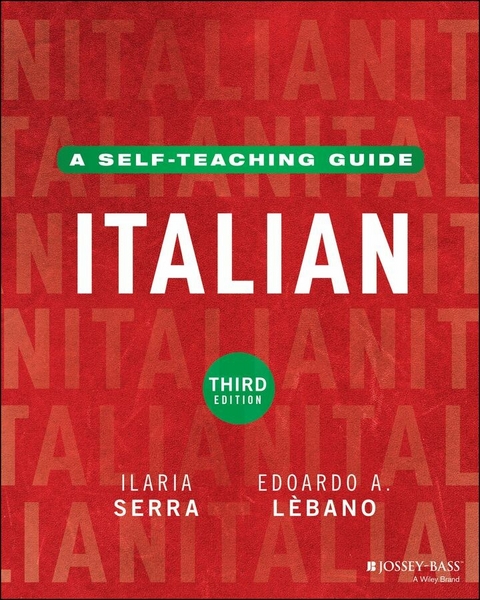
Italian (eBook)
656 Seiten
Jossey-Bass (Verlag)
978-1-394-28075-9 (ISBN)
Learn Italian at your own speed with tons of hands-on practice
In the newly revised third edition of Italian: A Self-Teaching Guide, professor and language educator Dr. Ilaria Serra walks you through how to learn Italian the quick and easy way. This book is ideal for anyone looking to master Italian at their own pace, whether you're approaching the language for the first time or just brushing up on the basics.
Italian: A Self-Teaching Guide contains fifteen simple lessons that show you how to engage in everyday conversations, from ordering food at a restaurant to making travel arrangements with a hotel concierge or an Airbnb host. The author helps you develop the skills you need to have actual Italian conversations with actual people in the real world.
You'll also find:
- Straightforward instructions and sample mini-dialogues on how to arrange a ride share and conduct other travel business
- Help with speaking to a mechanic or a doctor in Italian so you can visit Italian-speaking countries with added confidence
- Extensive vocabulary and culture notes, along with a fun assortment of exercises, self-tests, and practice activities
- Easy and complete grammar explanations
- Self-check solutions
An exciting and essential resource for everyone who wants to tackle Italian at their own speed, Italian: A Self-Teaching Guide remains the gold standard in books that teach you how to speak, read, write, and understand the language. It's perfect for students, jobseekers, world travelers, and the simply curious everywhere.
ILARIA SERRA, PhD, is professor of Italian and Comparative Studies at Florida Atlantic University (FAU) and director of the university's Venice Study Abroad Program. A native of Venice, Italy, Ilaria researches Italian cinema, Italian literature, and the history of Italian immigration to the United States. She received FAU's Scholar of the Year Award in 2012 and 2020.
The late EDOARDO A. LÈBANO was professor of Italian and director of the Center for Italian Studies at Indiana University in Bloomington.
1
Basic Expressions
| Buon giorno, signore. | Good morning, sir. |
| Buona sera, signora. | Good evening, ma'am. |
| Buona notte, signorina. | Good night, miss. |
| Salve | Hello (general greeting) |
| Ciao | Hello/Bye (informal) |
| Come sta? | How are you? (formal) |
| Sto bene, grazie. E Lei? | I'm fine, thank you. And you? |
| Non c'è male, grazie. | Not too bad, thank you. |
| Come si chiama Lei? | What is your name? (formal) |
| Mi chiamo Giovanni Rossi. | My name is Giovanni Rossi. |
| Dove ạbita, signor Rossi? | Where do you live, Mr. Rossi? |
| Ạbito a Milano. | I live in Milan. |
| Di dov'è Lei, signora Jones? | Where are you from, Mrs. Jones? |
| Sono di Miami. | I am from Miami. |
| ArrivederLa, signor Martini. | Goodbye, Mr. Martini. |
| Arrivederci. | Goodbye. |
| A domani. | See you tomorrow. |
| A presto. | See you soon. |
| Ciao. Come ti chiami? | What's your name? (informal) |
| Ciao, Maria, e tu? | Hi, Maria, and you? |
| Sono Edoardo. Come va? | I am Edoardo. How's it going? |
| Benino, tu come stai? | Pretty well, how are you? (informal) |
| Così così. | So‐so. |
| Di dove sei, Maria? | Where are you from, Maria? |
| Sono di Venezia. | I am from Venice. |
| Dove abiti, Maria? | Where do you live, Maria? |
| Abito a Roma. | I live in Rome. |
| Ti presento Giovanni. | I introduce to you Giovanni. |
| Piacere. | Pleasure to meet you. |
- The titles signore, signora, and signorina are to be used when addressing a person you do not know. Remember that signore becomes signor before a man's last name.
- ArrivederLa is a formal salutation used with only one person at a time (less common today). Arrivederci can be used with a person you have already met or with a group of people.
- Ciao is an informal salutation used when meeting or parting—the equivalent of hi or bye.
Salve is used when meeting and can be used formally or informally and in every moment of the day.
EXERCISE
ANSWERS p. 226
- It's 10:00 a.m. You meet a gentleman you have never seen before. How do you greet him? ___________________
- How do you say How are you (informal)? ___________________
- In late afternoon, do you use buona sera or buona notte? ___________________
- How do you greet an old friend? ___________________
- What is your reply to the question Come sta Lei? ___________________
- Your name is Robert Smith. Introduce yourself in Italian. ___________________
- Ask someone the question Where are you from(informal)? ___________________
- In saying goodbye to a group of people, do you use arrivederLa or arrivederci? ___________________
- How do you say Not too bad, thank you? ___________________
- Ask Maria where she lives. ___________________
PAROLE DA RICORDARE (Words to Remember)
| aereo | airplane |
| anno | year |
| ạutobus | bus |
| bambina (f.) | child, little girl |
| bambino (m.) | child, little boy |
| bar | bar |
| borsa | purse |
| caffè | coffee, café |
| casa | house, home |
| cellulare | cell phone |
| città | city, town |
| classe | class |
| dottore | doctor, physician |
| film | film, movie |
| giorno | day |
| hotel | hotel |
| informazione | information |
| lezione | lesson |
| libro | book |
| madre | mother |
| matita | pencil |
| nome | noun, name |
| notte | night |
| padre | father |
| penna | pen |
| piatto | plate, dish of food |
| piazza | square |
| professore (m.) | professor |
| professoressa (f.) | professor |
| quaderno | notebook |
| ragazza | girl |
| ragazzo | boy |
| ristorante | restaurant |
| sera | evening |
| settimana | week |
| signora | lady, married woman; ma'am, Mrs. |
| signore | man, gentleman; sir, Mr. |
| signorina | young lady, unmarried woman; Miss |
| sport | sport |
| stanza | room |
| stazione | station |
| studente (m.) | student |
| studentessa (f.) | student |
| treno | train |
| università | university |
| vacanza | vacation, holiday |
| via | street, road |
| vino | wine |
| virtù | virtue |
| zaino | backpack |
| zụcchero | sugar |
GRAMMAR I Gender and Number of Italian Nouns
Italian nouns are either masculine or feminine. The gender is generally determined by the final letter of the word.
- Most singular nouns end in o or a. Nouns ending in o are usually masculine; those ending in a are usually feminine. The plural of these nouns is formed by changing o to i and a to e.
- Some nouns ending in e are masculine, and some are feminine. The appropriate gender is learned through usage. The plural is formed by changing e to i.
some masculine nouns ending in e: dottore, nome, padre, professore, ristorante, signore, studente some feminine nouns ending in e: informazione, classe, lezione, madre, notte, stazione - Nouns ending with an accented vowel do not change in the plural. Usually nouns ending in è, ì, and ò are masculine, and those ending in à (città) and ù (virtù) are feminine.
- Nouns ending in a consonant do not change in the plural. Most are of foreign origin and, unless otherwise indicated, are masculine.
Determine the gender of each of the following nouns; then form the plural and give the English meaning.
ANSWERS pp. 226–227
Example: bambino m.; pl. bambini; child, children
- anno ___________________
- matita ___________________
- nome ___________________
- città ___________________
- vacanza...
| Erscheint lt. Verlag | 27.6.2025 |
|---|---|
| Sprache | englisch |
| Themenwelt | Schulbuch / Wörterbuch ► Wörterbuch / Fremdsprachen |
| Technik | |
| Schlagworte | how can I learn Italian? • Italian language exercises • Italian language practice • Italian practice • learn italian • learn italian book • learn to read Italian • learn to speak Italian • learn tow rite Italian • self-paced Italian • self-taught Italian |
| ISBN-10 | 1-394-28075-0 / 1394280750 |
| ISBN-13 | 978-1-394-28075-9 / 9781394280759 |
| Informationen gemäß Produktsicherheitsverordnung (GPSR) | |
| Haben Sie eine Frage zum Produkt? |
 EPUB (Adobe DRM)
Kopierschutz: Adobe-DRM
Adobe-DRM ist ein Kopierschutz, der das eBook vor Mißbrauch schützen soll. Dabei wird das eBook bereits beim Download auf Ihre persönliche Adobe-ID autorisiert. Lesen können Sie das eBook dann nur auf den Geräten, welche ebenfalls auf Ihre Adobe-ID registriert sind.
Details zum Adobe-DRM
Dateiformat: EPUB (Electronic Publication)
EPUB ist ein offener Standard für eBooks und eignet sich besonders zur Darstellung von Belletristik und Sachbüchern. Der Fließtext wird dynamisch an die Display- und Schriftgröße angepasst. Auch für mobile Lesegeräte ist EPUB daher gut geeignet.
Systemvoraussetzungen:
PC/Mac: Mit einem PC oder Mac können Sie dieses eBook lesen. Sie benötigen eine
eReader: Dieses eBook kann mit (fast) allen eBook-Readern gelesen werden. Mit dem amazon-Kindle ist es aber nicht kompatibel.
Smartphone/Tablet: Egal ob Apple oder Android, dieses eBook können Sie lesen. Sie benötigen eine
Geräteliste und zusätzliche Hinweise
Buying eBooks from abroad
For tax law reasons we can sell eBooks just within Germany and Switzerland. Regrettably we cannot fulfill eBook-orders from other countries.
aus dem Bereich


