


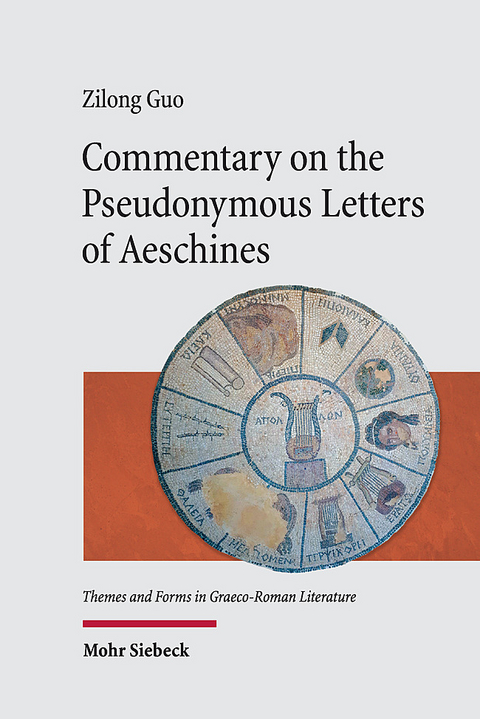
Commentary on the Pseudonymous Letters of Aeschines
Seiten
- Titel wird nachgedruckt
- Versandkostenfrei
- Auch auf Rechnung
- Artikel merken
Im vorliegenden Band untersucht Zilong Guo die Aeschines zugeschriebenen Briefe und konturiert ihre Mischung aus literarischen Traditionen. Anhand von Analysen und Kommentaren ermittelt er deren Funktion in der griechischen Literatur, von rhetorischen Übungen bis hin zu epistolischer Fiktion, und erschließt so ihre historische und literarische Bedeutung.
Through a comprehensive introduction and detailed commentary, Zilong Guo reappraises the letters attributed to the Attic orator Aeschines. These letters merit a place in Greek literature for their synthesis of preexisting literary forms. Letters 2, 3, 7, 11, and 12 imitate the letters of Demosthenes in a manner akin to rhetorical exercises. Letters 1, 5, 6, 8, 9, and 10 exhibit features reminiscent of the epistolary fiction that flourished in the first centuries AD. Letter 4 is a prose paraphrase of Pindar's victory odes. Like other literary forgeries, these letters are both problematic and fascinating. Likely products of rhetorical culture, they nevertheless hold a unique place as early - and remarkably successful - examples of how literary and political trends were interwoven to (re)shape the Classical tradition.
Through a comprehensive introduction and detailed commentary, Zilong Guo reappraises the letters attributed to the Attic orator Aeschines. These letters merit a place in Greek literature for their synthesis of preexisting literary forms. Letters 2, 3, 7, 11, and 12 imitate the letters of Demosthenes in a manner akin to rhetorical exercises. Letters 1, 5, 6, 8, 9, and 10 exhibit features reminiscent of the epistolary fiction that flourished in the first centuries AD. Letter 4 is a prose paraphrase of Pindar's victory odes. Like other literary forgeries, these letters are both problematic and fascinating. Likely products of rhetorical culture, they nevertheless hold a unique place as early - and remarkably successful - examples of how literary and political trends were interwoven to (re)shape the Classical tradition.
Born 1988; PhD in Classical Studies from the University of Edinburgh; Professor of Classics at the Institute for the History of Ancient Civilizations, Northeast Normal University, Changchun, China.
| Erscheinungsdatum | 30.09.2025 |
|---|---|
| Reihe/Serie | Themes and Forms in Graeco-Roman Literature |
| Verlagsort | Tübingen |
| Sprache | englisch |
| Maße | 155 x 232 mm |
| Gewicht | 406 g |
| Themenwelt | Schulbuch / Wörterbuch ► Wörterbuch / Fremdsprachen |
| Geisteswissenschaften ► Religion / Theologie ► Christentum | |
| Geisteswissenschaften ► Sprach- / Literaturwissenschaft ► Sprachwissenschaft | |
| Schlagworte | Ancient history • attic orators • Classical Philology • Greek Literature • literary forgers |
| ISBN-10 | 3-16-164688-6 / 3161646886 |
| ISBN-13 | 978-3-16-164688-1 / 9783161646881 |
| Zustand | Neuware |
| Informationen gemäß Produktsicherheitsverordnung (GPSR) | |
| Haben Sie eine Frage zum Produkt? |
Mehr entdecken
aus dem Bereich


aus dem Bereich
wenn Kirche Spaß macht, entsteht ein Ort der Begeisterung
Buch | Softcover (2025)
Kösel (Verlag)
CHF 28,90
und was sie über die Kirche verraten
Buch | Hardcover (2024)
C.H.Beck (Verlag)
CHF 39,90


