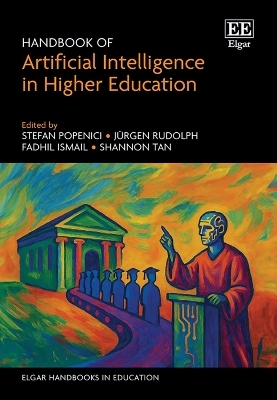
Handbook of Artificial Intelligence in Higher Education
Edward Elgar Publishing Ltd (Verlag)
978-1-0353-3875-7 (ISBN)
- Noch nicht erschienen
- Versandkostenfrei
- Auch auf Rechnung
- Artikel merken
Bringing together critical perspectives from around the world, this state-of-the-art Handbook illustrates the practical dilemmas and ethical stakes of generative AI in lecture halls, research projects, and university governance. Contributors explore emerging trends, risks, and innovative applications of the technology in universities, proposing cutting-edge solutions to the challenges posed by AI to higher education institutions. Drawing on evidence-based scholarship, global case studies, and nuanced critique, this Handbook invites higher education stakeholders to confront AI’s hidden labour and environmental costs, question its social and pedagogical biases, and leverage its opportunities.
This Handbook is an essential resource for scholars and students in all areas of higher education research and policy, particularly those focused on the expanding role of AI. Administrators, institutional leaders, and policymakers will profit from its invaluable insights into policy and governance. It is also of interest to curriculum developers and teachers, due to its actionable recommendations on the optimal use of this new technology.
Edited by Stefan Popenici, AI Researcher, Jürgen Rudolph, Murdoch University, Fadhil Ismail, Senior Lecturer, Kaplan Higher Education Academy and Shannon Tan, Lecturer, Kaplan Higher Education Academy, Singapore
Contents
Introduction: Rethinking higher education in the Age of AI 1
Stefan Popenici, Jürgen Rudolph, Fadhil Ismail and Shannon Tan
PART I AI AND HIGHER EDUCATION: THE BIG PICTURE
1 Imagining the AI-powered university of today and tomorrow 17
Peter Waring
2 Charting an AI course: A framework for higher education strategy development 30
Rose Luckin and Ant Bagshaw
3 A human–AI co-generative framework for higher education 54
Bron Eager, Mitch Parsell and Toby Newstead
4 Conceptualising artificial intelligence as an apprentice 67
Joseph Crawford, Michael Cowling and Kelly-Ann Allen
5 Generative AI tools in academic research: applications and implications for qualitative and quantitative research methodologies 76
Mike Perkins andJasper Roe
6 The use of artificial intelligence in higher education 92
Ebrahim Mohammadkarimi
7 AI technologies and university admission systems 107
Jim Faherty
8 AI in open and distance learning 120
Mehmet Firat Firat
PART II TOWARDS A CRITICAL AI LITERACY
9 Analysing modern slavery statements using large language models 134
Ser-Huang Poon, Eghbal Rahimikia, Philip Jobi Vallavanthra and Siliang Wei
10 The hidden labour in AI: Big Tech’s dirty secret and the need for critical AI literacy in higher education 152
Jürgen Rudolphvi Handbook of artificial intelligence in higher education
11 AI in our common future: AI for sustainability education beyond the Anthropocene 167
Eunice Tan
12 AI and bias: Parallels and paradoxes 182
Fadhil Ismail
13 The rise of AI: threat to graduate attributes 201
Kelum A. A. Gamage and Shyama C. P. Dehideniya
14 The impact of AI on inclusive learning communities 218
Rachel Forsyth, Claire Hamshire, Kevwe Olomu and Elizabeth King
15 AI and disability in higher education 230
Sharon Kerr and Stefan Popenici
16 Leveraging AI for neurodiversity inclusion in tertiary education 243
Rachel van Gorp and Glenys Ker
17 AI in higher education as a catalyst for positive societal transformation and inclusivity 259
Maylyn Tan and Laura Visser Kaldenbach
18 AI at the crossroads: Between the free play of forces, regulation, and control? Dispositives of Artificial Intelligence governance and discursive organizing in higher education 276
Susanne Maria Weber and Marc-André Heidelmann
PART III TEACHING, LEARNING ASSESSMENT
19 “Is that all there is?” Work-integrated learning educators meet GenAI: upskilling journeys to “‘the deep end”’ 300
Martin Andrew and Beate Mueller
20 AI-powered pedagogy: Transforming education in the Digital Age 315
Diane Kalendra, Sumesh Nair, Mingwei Sun, Tareq Rasul, Wagner Junior Ladeira and Fernando de Oliveira Santini
21 Chalkboards to chatbots: A paradigm shift in teaching and learning 330
Augustine Osamor Ifelebuegu
22 Rethinking learning in the era of artificial intelligence 344
Khalid A. Khan
23 AI pedagogy: Navigating doctoral education with AI-integrated teaching and learning 361
Weina Li Chen and Samaa Haniya
24 Collusion, plagiarism, or contract cheating? How generative AI fits into existing academic integrity policies 372
Miriam Sullivan
25 The modernisation of assessment in HE: AI as a disruptive catalyst for change 387
Athanasios Hassoulas
26 Ethical and technological considerations for teaching with and about AI programs in higher education 403
Laura Dumin
27 Level up: Adaptive AI in serious gaming for training and assessment 416
Kevin Yi-Lwern Yap, William Siew and Bina Rai
PART IV WORK AND EMPLOYABILITY
28 The rise of generative AI: Implications for work and learning 442
Samson Tan
29 AI and employability: Transitioning from Google to GenAI 460
Michael Choy
30 Artificial intelligence in day-to-day professional practice: implications for higher education 474
Margaret Bearman, Sarah Howard and Sarah Caouette Sarah Caouette
31 Empowering adult learners using Generative AI: Unveiling the six essential pillars 487
Michael Agyemang Adarkwah
PART V DISCIPLINE- AND COUNTRY-SPECIFIC STUDIES
32 Implementing AI technologies in various business subjects 502
Nurhafihz Noor, Lance DuBos, Sook Rei Tan and Kim-Lim Tan
33 AI-assisted language education within Chinese higher education: a systematic review of the literature 2000–2024 515
Junmin Xiao and Fiona Xiaofei Tang
34 Exploring student perspectives on AI in higher education: A multidisciplinary analysis 534
Sin Manw Sophia Lam, Wai Yin Koey Chung, Wing Tung Michelle Cheng and Gary Cheng
35 AI applications in initial teacher education: A systematic mapping review 548
Melissa Bond, Emily Oxley and Lydia Lymperis
36 Responses of Japanese university and college teachers to the rise of generative AI: Analysis of 2023 and 2024 syllabi 574
Takeru Mashino
37 AI’s transformative impact on teacher education: Enhancing in-service and pre-service training 595
Lucas Kohnke
38 Artificial intelligence and higher education in Türkiye 608
Begum Burak
39 Spotlight on emerging AI trends in international universities in the UAE 623
Faiza Qureshi and Eugene Pribytkov
| Erscheinungsdatum | 18.12.2025 |
|---|---|
| Reihe/Serie | Elgar Handbooks in Education |
| Verlagsort | Cheltenham |
| Sprache | englisch |
| Maße | 169 x 244 mm |
| Themenwelt | Schulbuch / Wörterbuch ► Unterrichtsvorbereitung ► Unterrichts-Handreichungen |
| Informatik ► Theorie / Studium ► Künstliche Intelligenz / Robotik | |
| Sozialwissenschaften ► Pädagogik ► Erwachsenenbildung | |
| ISBN-10 | 1-0353-3875-0 / 1035338750 |
| ISBN-13 | 978-1-0353-3875-7 / 9781035338757 |
| Zustand | Neuware |
| Informationen gemäß Produktsicherheitsverordnung (GPSR) | |
| Haben Sie eine Frage zum Produkt? |
aus dem Bereich