


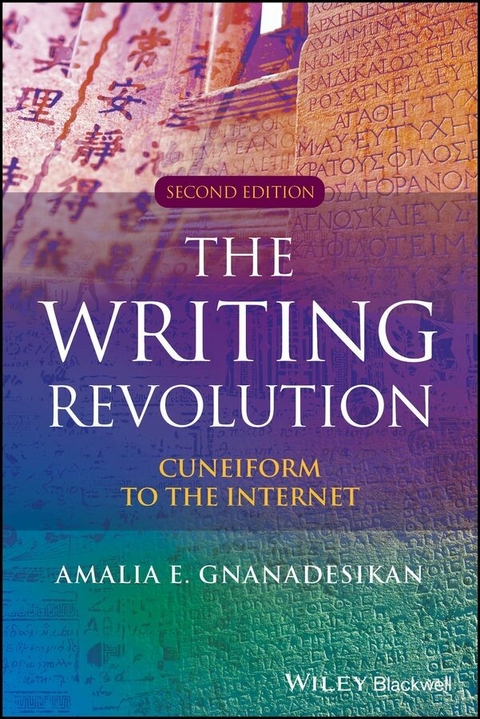
The Writing Revolution (eBook)
565 Seiten
Wiley-Blackwell (Verlag)
978-1-394-21821-9 (ISBN)
Now in its second edition, The Writing Revolution takes readers on a journey through the origins, historical development, adaptations, linguistic properties, cultural context, and social impact of the world's major written traditions. Demonstrating how the creation of writing transcended the limitations of human memory and made the modern world possible, linguist Amalia E. Gnanadesikan offers an engaging, easy-to-read historical narrative of written language that covers everything from the earliest proto-cuneiform tablet to the latest AI-generated text.
Concise chapters describe how different writing systems originated, how they evolved over time, and how they represent the thoughts and sounds expressed in spoken language. Throughout the book, Gnanadesikan interweaves ideas from cultural studies, archaeology, linguistics, literature, anthropology, and information science-complemented by illustrative examples of Egyptian hieroglyphs, Japanese syllabaries, Chinese characters, New World writing systems, the Roman alphabet, and many others.
Featuring new and expanded coverage of the Digital Age, including Unicode, the internet, emojis, and generative AI, The Writing Revolution: Cuneiform to the Internet is essential reading for students of writing systems, linguistics, information science, and intellectual history, as well as general readers with an interest in the remarkable history of written language.
AMALIA E. GNANADESIKAN served as the Technical Director for Language Analysis at the University of Maryland Center for Advanced Study of Language. Now retired, she has taught writing, linguistics, and writing systems at the University of Maryland, West Chester University, and Rutgers University. Her linguistics publications include works in writing systems, phonology, and language description. She is the author of Dhivehi: The Language of the Maldives.
An exploration of the original Information Technology the writing systems of history The Writing Revolution: Cuneiform to the Internet explores the origins, historical development, adaptations, linguistic properties, cultural context, and social impact of one of humankind's greatest inventions: writing systems. Now in its second edition, this popular book traces the history of writing from the earliest proto-cuneiform tablet to the latest AI-generated text. Author Amalia E. Gnanadesikan offers an engaging, highly readable narrative account of how different writing systems originated, how they evolved over time, and how they have represented languages around the world. Concise, easy-to-digest chapters cover each of the world's major written traditions across time and space, including Egyptian hieroglyphs, Chinese characters, Bronze-Age Linear B, New World writing systems, the Roman alphabet, and many others. Updated throughout, The Writing Revolution features new and expanded coverage of the Digital Age, including Unicode, the World Wide Web, emojis, generative AI, and more. Investigating how the creation of writing made the modern world possible, The Writing Revolution: Covers the world's major writing systems as well as a selection of lesser-known scripts Discusses papyrus, paper, the printing press, digital writing, and other associated technologies Features engaging examples throughout, including Egyptian funerary texts, Maya calendars, Arabic calligraphy, Morse code, and modern text messaging Interweaves ideas from cultural studies, archaeology, linguistics, literature, anthropology, and information science The Writing Revolution is a must-read for students of writing systems, linguistics, information science, and intellectual history, as well as general readers with an interest in the history of written language.
1
The First IT Revolution
This sentence is a time machine. I composed it a long time before you opened this book and read it. Yet here are my words after all this time, pristinely preserved, as good as new. The marvelous technology that allows the past to speak directly to the future in this way is by now so pervasive that we take it for granted: it is writing.
Imagine a world without writing. Obviously there would be no books: no novels, no encyclopedias, no cookbooks, no textbooks, no telephone books, no scriptures, no diaries, no travel guides. There would be no ball‐points, no typewriters, no word processors, no Internet, no magazines, no movie credits, no shopping lists, no newspapers, no tax returns. But such lists of objects almost miss the point. The world we live in has been indelibly marked by the written word, shaped by the technology of writing over thousands of years. Ancient kings proclaimed their authority and promulgated their laws in writing. Scribes administered great empires by writing, their knowledge of recording and retrieving information essential to governing complex societies. Religious traditions were passed on through the generations and spread to others, in writing. Scientific and technological progress was achieved and disseminated through writing. Accounts in trade and commerce could be kept because of writing. Nearly every step of civilization has been mediated through writing. A world without writing would bear scant resemblance to the one we now live in.
Writing is a virtual necessity to the societies anthropologists call civilizations. A civilization is distinguished from other societies by the complexity of its social organization, by its construction of cities and large public buildings, and by the economic specialization of its members, many of whom are not directly involved in food procurement or production. A civilization, with its taxation and tribute systems, its trade, and its public works, requires a sophisticated system of record keeping. And so the early civilizations of Mesopotamia, Egypt, China, Mesoamerica, and (probably) India all developed a system of writing. Only the Andean civilization of the Incas and their predecessors instead invented an intricate system of keeping records on knotted, color‐coded strings. These quipus are still poorly understood but probably did not express their users’ language the way writing does.
Early writing had three essential functions. It was used in state administration and display, in trade and commerce, and in religion. The ancient Sumerians invented writing for administration and trade. The ancient Chinese used it to record what questions they had asked of Heaven. The ancient Maya used it to establish the divine authority of kings, and the ancient Egyptians used it to gain eternal life. In the case of trade and administration, the advantage of keeping written records is clear. The natural affinity of writing with religion is less transparent, but may well stem from the relative permanence – immortality, almost – of the written word. From ancient Egypt to the modern world, writing has been used to mark burials (bestowing a form of immortality on the deceased), as well as to dedicate offerings and record the words of God. Literature, which we now tend to consider the essence of written language, was a much later development – and in the case of some literate cultures, never developed at all.
Writing was invented from scratch at least three times: in Mesopotamia, in China, and in Mesoamerica. In Egypt and in the Indus Valley, writing may also have been invented independently, or the basic idea may have been borrowed from Mesopotamia. When the first words were written down in what is now southern Iraq in the late fourth millennium BC, history was made in more senses than one, for it is writing that separates history from prehistory – the time that can be studied through written records from the time that can be studied only through archaeology. Thanks to the time‐machine technology of writing, a selection of the thoughts and words of earlier peoples have come down to us.
Writing is one of the most important human inventions of all time. It is rivaled by agriculture, the wheel, and the controlled use of fire, but by little else. The goal of this book is to shed light on how this remarkable technology actually works, where it came from, what it has done for us, and why it looks so different in different parts of the world.
Writing and Language
Writing was invented to solve a particular problem: information only existed if someone could remember it. Once it was gone from memory, it was gone for good. As human societies became more complex, those attempting to control them found that their memories were overtaxed. What they needed was an external storage device. What they came up with is writing.
Let’s say I owe you five dollars. If I say “I will repay you next April,” the words are gone the instant I utter them. They exist only in my memory and in the memory of anyone who has heard me. And who is to say I will continue to remember them? You may well want more lasting evidence of my promise. Nowadays I could record my words electronically, but the inventors of writing lived more than five millennia before the invention of the phonograph, the tape recorder, or the digital voice recorder. Nor was capturing human speech their intention; they needed a way to record information. The memories of nonliterate people are good, but they are far from infallible, and the human memory was not made for book‐keeping.
So is there any way to keep my promise alive? How can we be sure exactly what has been said, or thought, or done? I could tell someone else, who would tell someone else, who would tell someone else … and, as in the party game “telephone,” where each person whispers a message to the next person in a circle, the message would be very different by the end. But let’s say I write down the words on a piece of paper and pass the paper around the circle. The words are just the same at the end as at the beginning. There is no amusing party game left, but there is instead reliable transmission of information.
This is the essence of writing. Writing represents language, but it outlasts the spoken word. The oldest examples of writing have lasted over five thousand years. Others will last only until I press my computer’s delete key. But all have the potential to outlast the words I speak, or the words I put together in my head. A spoken (or mentally composed) message unfolds in time, one word replacing the previous one as it is uttered. Writing arranges the message in space, each word following the previous one in a line. Writing is therefore a process of translating time into space.
Being spatial, writing is visible. But being visible is not crucial to its definition. Braille, discussed further in Chapter 15, is a kind of writing designed to be felt with the fingers. It represents letters as a series of raised bumps that can be read by touch. In both reading by touch and reading by sight, time has been translated into space. There are also forms of language, such as American Sign Language (ASL), that are not writing but are inherently visible and spatial. Sign languages are akin to spoken languages in their essential properties: they too unfold in time. Like spoken words, signed words are gone the moment they are produced. By contrast, writing is a transformation of language into something permanent, a technology applied to the natural languages we learn instinctively as children.
Writing takes words and turns them into objects, visible or tangible. Written down, words remain on the page like butterflies stuck onto boards with pins. They can be examined, analyzed, and dissected. They can be pointed to and discussed. Spoken or signed words, by contrast, are inherently ephemeral. As a result, written language often seems more real to us than spoken language. In a highly literate culture it is easy to confuse writing with language itself, since much communication is mediated by writing, and the standards of written language influence our sense of “proper” language. But writing is not the basic, primary form of language, nor is it necessary to language.
Humans everywhere use language. It is a natural and normal human behavior. Although babies are not born speaking a language, all children who are raised around other people, who can perceive the language spoken around them (they are not, say, deaf in an environment where no sign language is used), and who are within normal range in certain mental and physical facilities will inevitably learn at least one language. They pick up their mother tongue naturally over the first few years of life. Indeed they cannot really be taught it and will resist instruction if parents try too hard to correct their baby talk. Reading and writing do not come so naturally and must be taught. By the time children learn to read and write, the vast majority of their language learning (other than further vocabulary growth and sometimes second‐language study) has already taken place.
As far as we can tell, language has been with us since the human race began. By contrast, writing is not a fundamental aspect of human life despite the profound impact it has had on human history. All human societies have had language, but many have had no writing. The Ethnologue database counts 7,164 languages spoken (or signed) in the world today. An uncountable number of others were once spoken but are now dead. The...
| Erscheint lt. Verlag | 10.6.2025 |
|---|---|
| Reihe/Serie | The Language Library |
| Sprache | englisch |
| Themenwelt | Schulbuch / Wörterbuch ► Wörterbuch / Fremdsprachen |
| Geisteswissenschaften ► Sprach- / Literaturwissenschaft | |
| Schlagworte | alphabet history • glyphs history • history of writing intro • history of writing textbook • language scripts history • Writing Systems • writing systems history • writing systems linguistics textbook • writing systems origins • written language history |
| ISBN-10 | 1-394-21821-4 / 1394218214 |
| ISBN-13 | 978-1-394-21821-9 / 9781394218219 |
| Informationen gemäß Produktsicherheitsverordnung (GPSR) | |
| Haben Sie eine Frage zum Produkt? |
 EPUB (Adobe DRM)
Kopierschutz: Adobe-DRM
Adobe-DRM ist ein Kopierschutz, der das eBook vor Mißbrauch schützen soll. Dabei wird das eBook bereits beim Download auf Ihre persönliche Adobe-ID autorisiert. Lesen können Sie das eBook dann nur auf den Geräten, welche ebenfalls auf Ihre Adobe-ID registriert sind.
Details zum Adobe-DRM
Dateiformat: EPUB (Electronic Publication)
EPUB ist ein offener Standard für eBooks und eignet sich besonders zur Darstellung von Belletristik und Sachbüchern. Der Fließtext wird dynamisch an die Display- und Schriftgröße angepasst. Auch für mobile Lesegeräte ist EPUB daher gut geeignet.
Systemvoraussetzungen:
PC/Mac: Mit einem PC oder Mac können Sie dieses eBook lesen. Sie benötigen eine
eReader: Dieses eBook kann mit (fast) allen eBook-Readern gelesen werden. Mit dem amazon-Kindle ist es aber nicht kompatibel.
Smartphone/Tablet: Egal ob Apple oder Android, dieses eBook können Sie lesen. Sie benötigen eine
Geräteliste und zusätzliche Hinweise
Buying eBooks from abroad
For tax law reasons we can sell eBooks just within Germany and Switzerland. Regrettably we cannot fulfill eBook-orders from other countries.
aus dem Bereich


