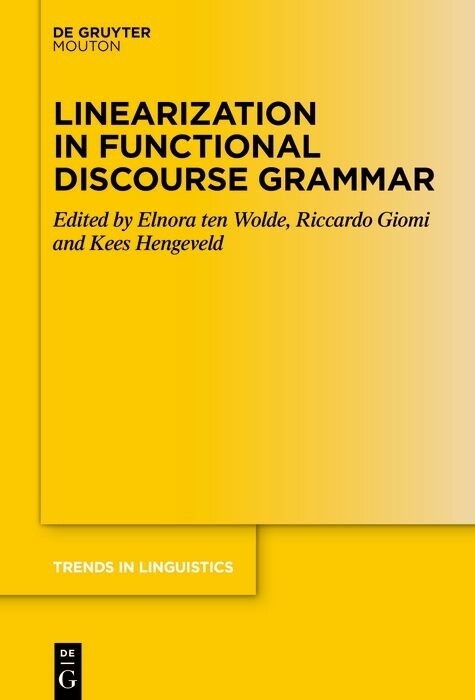
Linearization in Functional Discourse Grammar (eBook)
305 Seiten
De Gruyter (Verlag)
978-3-11-151795-7 (ISBN)
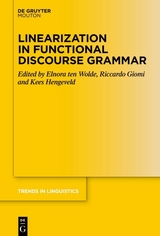
This volume develops Functional Discourse Grammar's innovative and unique approach to constituent ordering, both by refining some of its theoretical tenets, and by applying it to data from a variety of languages (including Brazilian Portuguese, Dutch, English, European and South American Spanish, Italian, Tagalog, Tahitian, Tamil and Turkish). This work will not only interest typologists working on theoretically-oriented approaches to constituent order and linguistics working in these individual languages, but also, given Functional Discourse Grammar's intermediate position between formalist and functionalist models of language, linguists working in both types of approaches.
1 Introduction: Linearization in Functional Discourse Grammar
Acknowledgements: We are grateful to Thomas Schwaiger for his helpful comments on an earlier version of this chapter. The volume editors are furthermore grateful to Daniel Van Olmen for his detailed review of the volume as a whole; to Barbara Karlson and Birgit Sievert of the De Gruyter staff for a smooth publication process; and to the University of Graz PostDoc office, the University of Graz, and the University of Vienna for generous funding of the International Functional Discourse Grammar Workshop, held in the summer of 2023, that led to this volume.
Abstract
This introductory chapter serves to provide a background to the chapters that follow, which develop the Functional Discourse Grammar (FDG) approach to linearization. A unique characteristic of FDG is that the placement rules that govern morphosyntax obey the instructions of the Interpersonal (pragmatic) and Representational (semantic) Levels in a top-down, functionally oriented fashion. The chapter accordingly provides an outline of the theory, followed by a consideration of FDG’s position in the current hierarchy vs linearity debate in linguistics, psycholinguistics and artificial intelligence. FDG contributes to this debate by demonstrating that linearization is driven by functional needs. This leads to an overview of the operation of the placement rules at the clause, phrase and word layers which demonstrates and exemplifies the distinctive features of the FDG approach to linearization: (a) a typology based on absolute and relative positions rather than S, V and O; (b) the recognition of the need for often substantial look-ahead in the ordering of constituents; (c) the iconicity present in the extent to which hierarchical relations at the Interpersonal and Representational Levels are reflected in linear order; (d) the use of a single set of ordering principles at all layers of morphosyntactic organization. The final section presents the various contributions to this volume, situating them within the broader context laid out in the preceding sections.
1 Introduction
The current volume aims to further develop and apply the system of morphosyntactic representation in Functional Discourse Grammar (FDG) with regard to its treatment of linearization. FDG is exceptional among functional models in that it has a separate morphosyntactic component, which contains its own system of placement rules, the design of which is inspired by the overall organization of the model: linearization is dealt with in a top-down and dynamic fashion that is consistent with the functional orientation of the model (Hengeveld and Mackenzie 2008: Chapter 4; Hengeveld 2013; Keizer 2015: Chapter 5).
In this introduction to the volume we first present an outline of FDG in Section 2, to provide the reader not familiar with FDG with the necessary theoretical background. In Section 3 we offer a broader perspective on linearization. While recursive hierarchical embedding has dominated the scene of syntactic theorization for several decades, recent research in theoretical syntax (e.g. Pollard and Sag 1994; Broccias 2019; Jackendoff and Audring 2020), linguistic typology (Dryer 2009), psycho- and neurolinguistics, and computational linguistics (e.g. Unger 2010; Frank and Bod 2011; Frank, Bod, and Christiansen 2012) has been putting more and more emphasis on non-hierarchical linearization. FDG’s position in the context of this debate, presented in Section 4, is a balanced one, based as it is on the assumption that the hierarchical relations so prominent in its account of pragmatic and semantic organization may, but need not always be reduplicated in the build-up of actual morphosyntactic structures. The overall system of placement rules is explained, and it is shown how it applies in exactly the same way at the clause, phrase, and word levels. Section 5 then presents the contributions to this volume and situates them within the broader context sketched in Sections 3 and 4.
2 Functional Discourse Grammar
2.1 General features
FDG is a structural-functional, typologically-based theory of language structure. The term structural-functional indicates that, while recognizing that a language is first and foremost a tool for communication and as such is constantly adapted to and shaped by the communicative needs of the community of its speakers, the theory also recognizes the cognitive reality of grammar as a structured system of rules and constraints. In this regard, FDG differs from so-called “radical functional” approaches such as Hopper’s (1987, 1988, 2015) Emergent Grammar and resembles other theories such as Role and Reference Grammar (Van Valin and LaPolla 1997; Van Valin 2005) and Systemic Functional Grammar (Halliday 1985; Halliday and Matthiessen 2004). The term typologically-based, on the other hand, reflects FDG’s fundamental concern with typological adequacy, that is, the requirement that a functional model be capable of providing a grammar for any type of natural language, while also accounting for the differences and similarities between individual languages (Dik 1997: 14).
Typological adequacy is one of the three standards of adequacy set up by Dik (1997: 13–14) as guidelines for the functionalist endeavor, that is, criteria against which to assess the success of a functional model of grammar. The other two standards are those of psychological and pragmatic adequacy. The former is the assumption that a functional model of grammar “must relate as closely as possible to psychological models of linguistic competence and linguistic behaviour” (Dik 1997: 13); the latter is the degree to which the model accounts for the fact that linguistic expressions are “instruments which are used by a Speaker in order to evoke some intended interpretation in the Addressee within a context defined by preceding expressions, and within a setting defined by the essential parameters of the speech situation” (Dik 1997: 13). In the next section we will show how these two concepts inspire the overall architecture of FDG, translating, on the one hand, into its strictly top-down approach to the structure of the grammar and, on the other, into the fact that the Grammatical Component is conceived of as one of four modules of a wider theory of verbal interaction, in constant interplay with a Conceptual, a Contextual and an Articulation Component.
Another definitional property of FDG, which it shares with Systemic Functional Grammar and, especially, Role and Reference Grammar, is its hierarchically organized layered structure. The principle of hierarchical organization is taken very seriously in FDG, so much so that hierarchical relations are assumed to exist both between the four levels of grammatical analysis recognized in the model (such that the information passed on from the higher levels determines the content of the lower ones) and within each of these levels, which are all displayed as a layered structure where linguistic units of the type relevant to each particular level are recursively embedded within one another.
2.2 The structure of the grammar
The four levels of grammatical analysis distinguished in FDG deal with pragmatics (Interpersonal Level), semantics (Representational Level), syntax and morphology (Morphosyntactic Level), and phonology (Phonological Level). As shown in Figure 1, their hierarchical organization is such that pragmatics governs semantics, both govern morphosyntax and all three of the preceding govern phonology.
Figure 1: The general architecture of FDG (Hengeveld, Keizer, and Giomi, in prep.).
Another distinctive aspect of FDG that is represented in the figure is that the Grammatical Component, consisting of the four levels just described, is encapsulated within a broader network of components which jointly make up a full-fledged theory of verbal interaction. The role of the Conceptual Component is to develop a prelinguistic communicative intention which the grammatical operations of Interpersonal and Representational Formulation translate into pragmatic and semantic representations; these feed into the two operations of Encoding, which generate the Morphosyntactic and the Phonological Levels; finally, the Phonological Level is the input for the Articulation Component, which converts the phonological representation into a phonetic, orthographic or visual-spatial one (in spoken, written and signed communication, respectively), which are then converted into a sensorily perceivable output. The Conceptual, Grammatical and Articulation Components work in tandem with the Contextual Component, whose role is to provide the other three components with the information necessary to...
| Erscheint lt. Verlag | 16.6.2025 |
|---|---|
| Reihe/Serie | Trends in Linguistics. Studies and Monographs [TiLSM] |
| Zusatzinfo | 10 b/w ill., 6 b/w tbl. |
| Sprache | englisch |
| Themenwelt | Schulbuch / Wörterbuch ► Wörterbuch / Fremdsprachen |
| Geisteswissenschaften ► Sprach- / Literaturwissenschaft ► Sprachwissenschaft | |
| Schlagworte | Constituent Structure • Functional Discourse Grammar • Functional Theories • Funktionale Diskursgrammatik • Funktionale Grammatik • Linearisierung • Linearization • Sprachtypologie • Typology |
| ISBN-10 | 3-11-151795-0 / 3111517950 |
| ISBN-13 | 978-3-11-151795-7 / 9783111517957 |
| Informationen gemäß Produktsicherheitsverordnung (GPSR) | |
| Haben Sie eine Frage zum Produkt? |
 EPUB (Wasserzeichen)
Größe: 1,7 MB
DRM: Digitales Wasserzeichen
Dieses eBook enthält ein digitales Wasserzeichen und ist damit für Sie personalisiert. Bei einer missbräuchlichen Weitergabe des eBooks an Dritte ist eine Rückverfolgung an die Quelle möglich.
Dateiformat: EPUB (Electronic Publication)
EPUB ist ein offener Standard für eBooks und eignet sich besonders zur Darstellung von Belletristik und Sachbüchern. Der Fließtext wird dynamisch an die Display- und Schriftgröße angepasst. Auch für mobile Lesegeräte ist EPUB daher gut geeignet.
Systemvoraussetzungen:
PC/Mac: Mit einem PC oder Mac können Sie dieses eBook lesen. Sie benötigen dafür die kostenlose Software Adobe Digital Editions.
eReader: Dieses eBook kann mit (fast) allen eBook-Readern gelesen werden. Mit dem amazon-Kindle ist es aber nicht kompatibel.
Smartphone/Tablet: Egal ob Apple oder Android, dieses eBook können Sie lesen. Sie benötigen dafür eine kostenlose App.
Geräteliste und zusätzliche Hinweise
Buying eBooks from abroad
For tax law reasons we can sell eBooks just within Germany and Switzerland. Regrettably we cannot fulfill eBook-orders from other countries.
aus dem Bereich