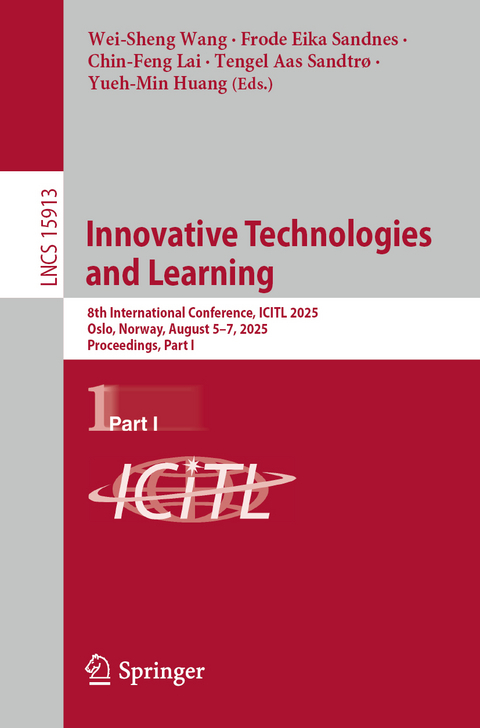
Innovative Technologies and Learning
Springer International Publishing (Verlag)
978-3-031-98184-5 (ISBN)
The two-volume set, LNCS 15913 and 15914, constitutes the refereed conference proceedings of the 8th International Conference on Innovative Technologies and Learning, ICITL 2025, held in Oslo, Norway, during August 5 7, 2025.
The 82 papers included in these proceedings were carefully reviewed and selected from 214 submissions. The papers are organized in the following topical sections:
Part I: Artificial Intelligence in Education; Computational Thinking in Education; Design and Framework of Learning Systems; VR/AR/MR/XR in Education.
Part II: Pedagogies to Innovative Technologies and Learning; STEM/STEAM Education; Application and Design of Generative Artificial Intelligence in Education.
.- Artificial Intelligence in Education.
.- AI Tools for English Proficiency Test Preparation: A Research Review.
.- Enhancing Social Adaptation in Young Learners Through a 2-Year Multimedia Program on Social-Emotional Learning.
.- To Learn or Not to Learn Artificial Intelligence: An Anticipated Regret-Extended Expectancy-Value Theory.
.- Improving Learning to Cross-Lingual Question Answering via Performance Enhancement with XLM-R+ model.
.- Drawing for You: Exploring the Impact of Integrating Educational Technology into Picture Book Creation on Students Understanding of Special Education.
.- AI-Enhanced Augmented Reality for L2 Medical English Learning and Remote Surgical Collaboration.
.- AI-driven Constructivist Framework, in Child Welfare and Social Work Education.
.- Teaching AI Textual Interpretation: A Catalyst for Enhanced Literary Skills.
.- Lesson Plan Designing in the Digital Age: A Multimodal Approach with ChatGPT.
.- GenAI Chatbot Tutors as Agents of Inclusive Education: A Review Guided by Ethics of Care and Critical Pedagogy.
.- Postgraduate students perspective of Generative Artificial Intelligence for learning.
.- The Impact of AI-Generated and Non-AI-Generated Images on Learning Outcomes and Attitudes: A Case Study of Visual Narrative in Elementary School English Curriculum.
.- From Technology Acceptance to Teaching Practice: Exploring Pre-Service Teachers' User Typologies and Training Needs in ChatGPT Adoption.
.- Adaptive Auto-Prompting in Inquiry-Based Learning: Enhancing Curiosity and Learning Engagement to Improve Higher-Order Thinking.
.- ChatGPT-assisted Escape Room:Preservice teacher preparation for Generative Artificial Intelligence Enhanced Instructional Design.
.- STEMChat: Investigating Student Perceptions of ChatGPT-Based Mobile Instant Messaging in Collaborative STEM Learning.
.- Enhancing the Development of Higher Order Thinking in Beginners Through Creative Guided GPT.
.- Exploring the impact of using GenAI applications on MIS students' learning in system analysis.
.- AI-Supported Summative Reflection to Foster Motivation and Teamwork in STEM: An Application of the 6E+R Framework
.- The Impact of Generated AI-Supported Learning on Elementary Students Writing Skills.
.- Computational Thinking in Education.
.- A Study on the Effectiveness of Integrating Innovative Learning Strategies into Computational Thinking in Programming Learning for Non-CS Major Students.
.- Design and Framework of Learning Systems.
.- Which Students Collaborate? Unsupervised Identification of Team Structures from Individual Reports Documenting Groupwork.
.- Exploring the Factors Affecting Student s Online Assessing Peers Ability Continuance Intention as the Mediator.
.- Web Scraping and its use for teaching in course Information Systems in Tourism.
.- Extending eMath4All Platform to Broaden Applicability, Enrich Learning Experience and Enhance Teacher Support
.- Evaluating Cognitive Learning Hierarchies of LLM-created Assessment Questions in Engineering Education.
.- A Learning Analytics Framework for Higher Education in South Africa
.- Play My Math: Design and Implementation of a Fraction Generator Tool within a Mathematical Musician Digital Learning Platform.
.- Experiences with a Pragmatic Student Attendance Management Scheme.
.- Bridging the Digital Divide: User Interface Design Principles for Enhancing Elderly Learners' Engagement with Educational Technology
.- VR/AR/MR/XR in Education.
.- Evaluation of the Effectiveness of Integrating Virtual Reality with Goal-Based Scenario Learning Theory in Tree Risk Assessment.
.- Implementation and Validation of the Innovative VR Distance Learnin
| Erscheinungsdatum | 13.06.2025 |
|---|---|
| Reihe/Serie | Lecture Notes in Computer Science |
| Zusatzinfo | XIX, 385 p. 89 illus., 73 illus. in color. |
| Verlagsort | Cham |
| Sprache | englisch |
| Maße | 155 x 235 mm |
| Themenwelt | Schulbuch / Wörterbuch ► Unterrichtsvorbereitung ► Unterrichts-Handreichungen |
| Mathematik / Informatik ► Informatik | |
| Schlagworte | Artificial Intelligence • Collaborative Learning • computational Science and engineering education • computational thinking • computer-assisted instruction • Computer engineering education • Computer supported cooperative work • computing education • Distance Learning • Education • E-Learning • Engineering • Informal Education • information science education • Information Technology Education • Interactive Learning Environments • K-12 education • Learning Management Systems • student assessment |
| ISBN-10 | 3-031-98184-7 / 3031981847 |
| ISBN-13 | 978-3-031-98184-5 / 9783031981845 |
| Zustand | Neuware |
| Informationen gemäß Produktsicherheitsverordnung (GPSR) | |
| Haben Sie eine Frage zum Produkt? |
aus dem Bereich