Hebrew
Columbia University Press (Verlag)
978-0-231-21712-5 (ISBN)
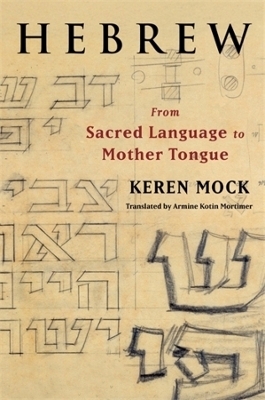
For nearly two thousand years, Hebrew belonged to the realm of the sacred. A written liturgical language used primarily by rabbis and scholars, it was not spoken in everyday contexts. A revival process in the late nineteenth century brought Hebrew back into daily use, adapting sacred texts as the foundations for a new vernacular. A “mother tongue” emerged.
Keren Mock provides a strikingly original multidisciplinary account of this transformation of Hebrew from an ancient sacred tongue to a secular spoken language. Bringing together psychoanalytic, semiotic, and comparative-literature perspectives, she provides deep insight into key moments in this history. Drawing on extensive, revealing interviews, Mock offers critical readings of two major Israeli authors, Aharon Appelfeld and Sami Michael, focusing on their struggles to write in Hebrew as immigrants. She delves into the archives of the lexicographer Eliezer Ben-Yehuda, the creator of an all-embracing dictionary of ancient and modern Hebrew, and considers Baruch Spinoza’s little-known Hebrew grammar in light of his philosophical works. In reflecting on the making and meaning of a mother tongue, Mock addresses questions of memory and forgetting, mourning and restitution, and the sacred and the secular. Through the exceptional history of Hebrew, this book uncovers the workings of language in the social and psychological realms.
Hebrew features forewords by Pierre-Marc de Biasi, an artist and scholar of literature, and Julia Kristeva, a renowned psychoanalyst, philosopher, and linguist, speaking to the significance of the book.
Keren Mock is a research associate at the Institut des textes et manuscrits modernes, a research unit of the Centre national de la recherche scientifique and the École normale supérieure de Paris; adjunct faculty at Sciences Po Paris; and a clinical psychologist. Armine Kotin Mortimer has translated many works of literary fiction and nonfiction from French, including Julia Kristeva’s Dostoyevsky in the Face of Death (Columbia, 2023).
Foreword: Keren Mock, a New Voice in Critical Thinking, by Pierre-Marc de Biasi
Foreword: The Signifying Nature of Language, by Julia Kristeva
Introduction
Part I. The Age of the Pioneers Appelfeld and Michael: Edification of a New Mother Tongue
1. Hebrew as a Mother Tongue Among Languages
2. Hiatus and Reconstructive Narration in the Work of Aharon Appelfeld
3. Sami Michael’s “Literary Fall” Through Translation
Part II. The Ben-Yehuda Worksite: Literary Excavations and Lexicographical Matter
4. The “Resurrection” of Hebrew?
5. Spectra and Corpus of a New Mother Tongue: Eliezer Ben-Yehuda’s Vision
6. Words as Language “Bricks”
Part III. Spinoza’s New Concept: The Philosophical Foundations of Secular Hebrew
7. To Be Jewish and Multilingual in Amsterdam in the 1660s
8. From Scriptures to Writing
9. Regularity as the Foundation of Immanence
10. The Nature of Words: The Omnipotence of the Noun
11. Hebrew as a Mother Tongue
Acknowledgments
Notes
Index
| Erscheinungsdatum | 08.11.2025 |
|---|---|
| Reihe/Serie | European Perspectives: A Series in Social Thought and Cultural Criticism |
| Übersetzer | Armine Kotin Mortimer |
| Zusatzinfo | 13 b/w illustrations |
| Verlagsort | New York |
| Sprache | englisch |
| Maße | 156 x 235 mm |
| Themenwelt | Schulbuch / Wörterbuch ► Wörterbuch / Fremdsprachen |
| Geschichte ► Teilgebiete der Geschichte ► Kulturgeschichte | |
| Geisteswissenschaften ► Sprach- / Literaturwissenschaft ► Sprachwissenschaft | |
| ISBN-10 | 0-231-21712-9 / 0231217129 |
| ISBN-13 | 978-0-231-21712-5 / 9780231217125 |
| Zustand | Neuware |
| Informationen gemäß Produktsicherheitsverordnung (GPSR) | |
| Haben Sie eine Frage zum Produkt? |
aus dem Bereich