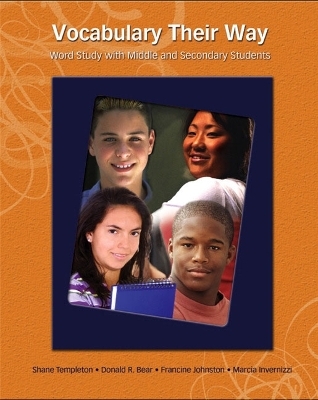
Vocabulary Their Way
Pearson
978-0-13-155535-8 (ISBN)
- Titel erscheint in neuer Auflage
- Artikel merken

Shane Templeton is Foundation Professor of Curriculum and Instruction at the University of Nevada, Reno, where he is Program Coordinator for Literacy Studies. A former elementary and secondary teacher, his research focuses on the development of orthographic knowledge. He has written several books on the teaching and learning of reading and language arts and is a member of the Usage Panel of the American Heritage Dictionary. He is author of the "Spelling Logics" column in Voices from the Middle, the middle school journal of the National Council of Teachers of English. Francine Johnston is a former first grade teacher and reading specialist who learned about word study during her graduate work at the University of Virginia. She is now an associate professor in the School of Education at the University of North Carolina at Greensboro, where she teaches courses in reading, language arts, and children's literature. Francine frequently works with regional school systems as a consultant and researcher. Her research interests include current spelling practices and materials as well as the relationship between spelling and reading achievement. Donald R. Bear is director of the E. L. Cord Foundation Center for Learning and Literacy where he and preservice, Master’s and doctoral students teach and assess children who struggle to learn to read and write. Donald is a professor in the Department of Educational Specialties in the College of Education at the University of Nevada, Reno. Donald has been a classroom teacher and he researches and writes about literacy development and instruction. He is an author of numerous articles, book chapters, and books, including Words Their Way, Words Their Way with English Learners, and Vocabulary Their Way. Marcia Invernizzi is a professor of reading education at the Curry School of Education at the University of Virginia. Marcia is also the director of the McGuffey Reading Center, where she teaches the clinical practica in reading diagnosis and remedial reading. Formerly an English and reading teacher, she works with Book Buddies, Virginia's Early Intervention Reading Initiative (EIRI), and Phonological Awareness Literacy Screening (PALS).
Vocabulary Their Way: Word Study, Grades 4-12
Table of Contents
Part I: Foundations of Learning and Teaching Vocabulary
Chapter 1 — The Nature of Vocabulary Development and Instruction
What the research says
Early intermediate
Middle intermediate
Late Intermediate
Synchrony of development
Chapter 2 — The Meaning and Structure of Words
How Words Work: Meanings and Feelings
How Words Are Written: Spelling Makes Sense!
Chapter 3 — Where Words Come from and Where They’re Going
History
Dynamics of construction of new vocabulary
Part II: Instruction and Assessment
Chapter 4 —Essential Vocabulary Strategies and Activities
Guidelines for Teaching Core Academic and Content-Specific Academic Vocabulary
Tools for Teaching
Word Sorts and Concept Sorts
The Dictionary
Technology
Guidelines for Selecting Which Words to Teach Directly
Guidelines for Selecting Core Academic Vocabulary
Guidelines for Selecting Content-Specific Academic Vocabulary
Generative Strategies
Word Formation with Base Words and Affixes
Strategy for Decoding Longer Words
Principles of Teaching Morphology: Base Words and Affixes
Word Sort Activities to Support Word Formation with Base Words and Affixes
Word Formation with Greek/Latin Foots and Affixes
Principles of Teaching Morphology: Greek/Latin Roots and Affixes
Word Sort Activities to Support Word Formation with Greek/Latin Roots and Affixes
Word-Specific Strategies
Concept Sorts
Vocab-O-Grams
Vocabulary Cards
List, Group, and Label
Exploring Antonyms and Synonyms
Analogies
Vocabulary Notebooks
Graphic Organizers
Games
Online Resources about Words
Looking Ahead
Chapter 5-Teaching Core Academic Vocabulary in English/Language Arts
Concrete sorting
Using word study for character analysis
Sorting Adjectives
Concrete ways to understand authors word choice
Word study to teach poetry
Iambic pentameter
Syllable stress
Contrasts of poetry–word choice (alliteration/contrast is major literary technique which lends itself right into word choice)
Chapter 6— Teaching Content-Specific Academic Vocabulary
English
Guidelines for Content Area Vocabulary InstructionHistory
Mathematics
Science
Technical/Vocational
Chapter 7— Vocabulary Instruction with English Language Learners
The Context for Instruction
Wide Reading
Purposeful Writing
Reading to your EL Students
Ongoing Word Study Activities
Determining English Learners’ Level of English Proficiency
Word-Specific Challenges for English Learners
Generative Instruction
Compound Words
Driving Words from Common Base Words
Cognates
Chapter 8 - Assessment and Organization
Assessing
Grouping for instruction
Use checklist–qualitative
Early intermediate
Middle intermediate
Late Intermediate
Synchrony of development
Part III: Appendix
Additional Word Sorts
Sample Lessons
Spelling-to-Sound Correspondences
Most productive spelling rules
Syllable Patterns and Rules
Games
Assessments
Content Area Standards and Vocabulary
| Erscheint lt. Verlag | 7.8.2009 |
|---|---|
| Sprache | englisch |
| Maße | 216 x 276 mm |
| Gewicht | 553 g |
| Themenwelt | Schulbuch / Wörterbuch |
| Sozialwissenschaften ► Pädagogik | |
| ISBN-10 | 0-13-155535-9 / 0131555359 |
| ISBN-13 | 978-0-13-155535-8 / 9780131555358 |
| Zustand | Neuware |
| Informationen gemäß Produktsicherheitsverordnung (GPSR) | |
| Haben Sie eine Frage zum Produkt? |
aus dem Bereich