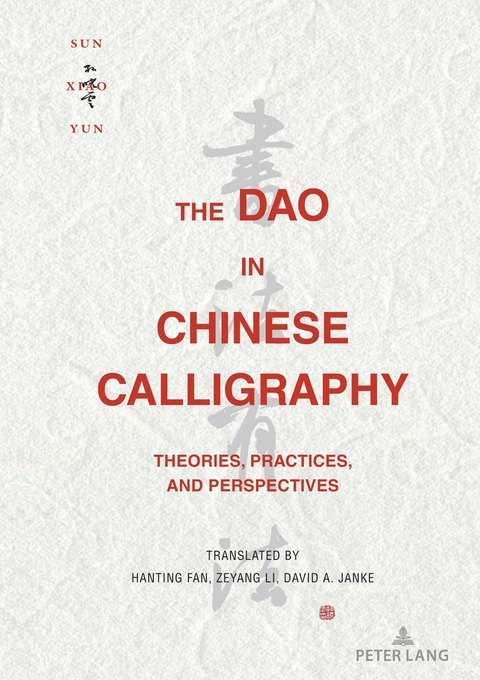
The Dao in Chinese Calligraphy
Peter Lang Group Ag, International Academic Publishers (Verlag)
978-3-0343-5036-5 (ISBN)
By reframing the discourse around calligraphy, the author invites readers to appreciate the depth of the traditional approach.
Sun Xiaoyun, a distinguished calligrapher, started her classical training at the tender age of three. She serves as President of the China Calligraphers Association and Honorary Director of the Jiangsu Art Museum.
Preface to Peter Lang Edition – Preface to Original Edition – Calligraphy: Truly Deserving of ‘China’ – Three Incidents That Perplexed Me – ‘Getting to the Root’ – What Does ‘Convenience’ Mean? – The Blind Men and an Elephant – Doubting the ‘Eight Principles of the Character Yong’ – Mastering Brush Grip – ‘Five Fingers’ or ‘Five Characters’ – Visualizing ‘Adjusting the Stirrups’ – Calligraphy: Mastering Brushwork Techniques – Man is the Measure of All Things’ – The Emergence of Brushwork Techniques 1. ‘Gathering the Brush-tip 裹锋’ and Continuous Writing – The Emergence of Brushwork Techniques 2. Writing Without Support – Reasoning Boldly – Diameter of the Brush Shaft – Brush Bristle: Length and Hardness – The Origin of Paper and the Concept of ‘Move, Lift, Hold, and Dye’ – Insights from ‘The Execution of Chen Shimei’ – Brushwork Techniques Root in Writing Posture – The Swan Song of ‘the Ancient Method’ – Unconscious Loss – Merits and Demerits of Using a Table – Exploring the ‘Eight-Point Script’ – Shaping Form and Momentum through Xiang and Bei – What a Giant Elephant! – The Culmination of Calligraphy: Zhangcao – The Physiological Limits of Lihua and Meihua – Wanfa: Weaving Three Strands into One – Shangfa: Engraving the Calligraphy of Wang Xizhi in the Heart – Bianfa: Perseverance of Brushwork Techniques amid Evolution of Characters – Wufa: Accepting the Unavoidable Reality – Is Calligraphy a Visual Art? – Decoding Ancient Analogies – The Regeneration of Rotational Momentum in Brushwork – Understanding ‘Contraction’ and ‘Expansion’ – Semi-cursive Script: the Last to Take the Stage – Personalizing Aesthetics in the Art of Calligraphy – Deciphering the Misconstrued ‘Intention Comes Before Writing – The Impact of Brush Rotating on Right-to-Left Vertical Writing – Debunking the Myth of ‘Solid Fingers and Open Palms’ – Describing the Unseen Sun to the Blind – The Inadvertent Mislabeling: A Reflection on ‘Calling a Stag a Horse’ – Unraveling the Study of Tie: An Examination of Its Collapse – Reassessing the Study of Bei – The Pitfalls of ‘Drawing Characters’ – A Concise Historic Overview of Japanese Calligraphy – Distinguishing the Boundaries Between Calligraphy and Painting – The Frustrating Debate on ‘the Essence of Calligraphy’ – Decoding the Universal Principles of Calligraphy – A Revelatory Moment During Commute – The Confusion about Traditional Chinese Painting – Unveiling the Association Between gufa and Brushwork Techniques – Exploring the Shared Origins of Calligraphy and Traditional Chinese Painting – The Indispensable Role of Brushwork Techniques in the Traditional Chinese Painting – The Singular Trajectory to Mount Hua’s Summit – Literati Painting – The Distant Mountain in the Mist – ‘When a Painting Resembles its Subject, it is Reminiscent of a Child’s Work’ – The Imitation Game – Truth and Helplessness – The Tale of Jizi – Postscript to the Revised Edition – Works by Sun Xiaoyun – Bibliography – Translators’ Acknowledgment – Index.
| Erscheinungsdatum | 14.05.2025 |
|---|---|
| Verlagsort | New York |
| Sprache | englisch |
| Maße | 148 x 210 mm |
| Gewicht | 494 g |
| Themenwelt | Kunst / Musik / Theater ► Design / Innenarchitektur / Mode |
| Sachbuch/Ratgeber ► Freizeit / Hobby ► Kreatives Gestalten | |
| Schulbuch / Wörterbuch ► Wörterbuch / Fremdsprachen | |
| Geisteswissenschaften ► Sprach- / Literaturwissenschaft ► Sprachwissenschaft | |
| Informatik ► Grafik / Design ► Desktop Publishing / Typographie | |
| Sozialwissenschaften | |
| Schlagworte | Calligraphy • Calligraphy and painting techniques compared • Chinese • Chinese calligraphy • Chinese Culture • Perspectives • Practices • Theories • Xiaoyun |
| ISBN-10 | 3-0343-5036-8 / 3034350368 |
| ISBN-13 | 978-3-0343-5036-5 / 9783034350365 |
| Zustand | Neuware |
| Informationen gemäß Produktsicherheitsverordnung (GPSR) | |
| Haben Sie eine Frage zum Produkt? |
aus dem Bereich