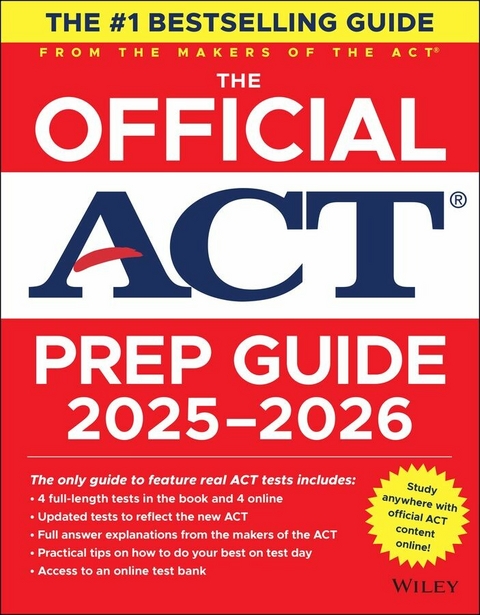
The Official ACT Prep Guide 2025 - 2026 (eBook)
963 Seiten
Wiley (Verlag)
978-1-394-33589-3 (ISBN)
THE OFFICIAL ACT® PREP GUIDE 2025-2026
The comprehensive guide to the 2025-2026 ACT test-including 4 genuine, full-length practice tests.
The Official ACT® Prep Guide 2025-2026 book includes four authentic ACT tests-all of which contain the optional writing test-so you get maximum practice before your test date.
This guide provides clear explanations for every answer straight from the makers of the ACT to help you improve your understanding of each subject. You'll also get:
- Practical tips and strategies for boosting your score on the English, math, reading, science, and (optional) writing tests
- Four new practice tests that reflect the Enhanced ACT experience
- Expert advice on how to mentally and physically prepare for your test
This edition has been updated with four new practice tests, writing samples, and prompts, so you can be sure your materials will set you up for success on your ACT test.
Through the Official Guide, you'll learn what to expect on test day, understand the types of questions you will encounter when taking the ACT, and adopt test-taking strategies that are right for you.
THE OFFICIAL ACT PREP GUIDE 2025 2026 The comprehensive guide to the 2025 2026 ACT test including 4 genuine, full-length practice tests. The Official ACT Prep Guide 2025 2026 book includes four authentic ACT tests all of which contain the optional writing test so you get maximum practice before your test date. This guide provides clear explanations for every answer straight from the makers of the ACT to help you improve your understanding of each subject. You ll also get: Practical tips and strategies for boosting your score on the English, math, reading, science, and (optional) writing tests Four new practice tests that reflect the Enhanced ACT experience Expert advice on how to mentally and physically prepare for your test This edition has been updated with four new practice tests, writing samples, and prompts, so you can be sure your materials will set you up for success on your ACT test. Through the Official Guide, you ll learn what to expect on test day, understand the types of questions you will encounter when taking the ACT, and adopt test-taking strategies that are right for you.
Chapter 1:
About the ACT
The ACT® measures your achievement in core academic areas important for your college and career success: English, math, reading, science, and (optionally) writing. It isn’t an IQ test—it doesn’t measure your basic intelligence. It’s an achievement test that’s been carefully designed—using surveys of classroom teachers, reviews of curriculum guides for schools all over the country, and advice from curriculum specialists and college faculty members—to be one of several effective tools for evaluating your college and career readiness.
The individual tests that make up the ACT consist of questions that measure your knowledge and skills. You’re not required to memorize facts or vocabulary to do well on the ACT. Of course, all the terms, formulas, and other information you learned in your classes will be useful to you when you take the ACT. However, last-minute cramming (such as memorizing 5,000 vocabulary words or the entire periodic table of elements) won’t directly improve your performance on the ACT.
Description of the Full ACT Test
The full ACT consists of four multiple-choice tests—English, mathematics, reading, and science—and an optional writing test. Topics covered on these five tests correspond very closely to topics covered in typical high school classes. Table 1.1 gives you a snapshot of all five tests.
| Table 1.1: ACT Tests |
|---|
| Test | Questions | Time | Content Covered |
|---|
| English | 50 questions | 35 minutes | Measures standard written English knowledge and skills along with English language conventions |
| Mathematics | 45 questions | 50 minutes | Measures mathematical skills students have typically acquired in courses taken up to the beginning of grade 12 |
| Reading | 36 questions | 40 minutes | Measures reading comprehension |
| Science | 40 questions | 40 minutes | Measures the interpretation, analysis, evaluation, reasoning, and problem-solving skills required in the natural sciences |
| Writing (optional) | 1 prompt | 40 minutes | Measures writing skills emphasized in high school English classes and in entry-level college composition courses |
Questions on the tests are intended to help assess college and career readiness. The following sections provide an overview of what you should know to perform well on each test. For additional details, check out the ACT College and Career Readiness Standards presented in chapter 12.
English Test
50 questions (40 scored), 35 minutes
The English test consists of six or seven essays or passages, each of which is accompanied by a sequence of multiple-choice test questions. The length of the passages will vary; longer passages of approximately 340 words will be accompanied by ten items, while shorter passages of approximately 185 words will be accompanied by five items. Different passage types are employed to provide a variety of rhetorical situations. Passages are chosen not only for their appropriateness in assessing writing skills but also to reflect students’ interests and experiences.
You will receive four scores for the ACT English test: a total test score based on all 40 scored questions and three reporting category scores based on the following:
-
Production of Writing
-
Knowledge of Language
-
Conventions of Standard English
Production of Writing
Production of Writing questions test knowledge and skills in two areas of English composition:
-
Topic development in terms of purpose and focus
-
Organization, unity, and cohesion
Topic Development in Terms of Purpose and Focus
Examples of knowledge and skills tested include the following:
-
Determine the relevance of material to the topic or the focus of the passage or paragraph.
-
Identify the purpose of a word or phrase (for example, to identify a person, to define a term, or to help describe an object).
-
Determine whether a passage has met a specific goal.
-
Use a word, phrase, or sentence to accomplish a specific purpose, such as to convey a feeling or attitude or to illustrate a given statement.
Organization, Unity, and Cohesion
Examples of knowledge and skills tested include the following:
-
Determine the need for transition words or phrases to define relationships in terms of time or logic.
-
Determine the most logical place for a sentence in a paragraph or in the passage as a whole.
-
Provide a suitable conclusion for a paragraph or passage.
-
Provide a suitable introduction for a paragraph or passage.
-
Rearrange sentences in a paragraph to establish a logical flow.
-
Determine the most logical place to divide a paragraph to achieve a stated goal.
Knowledge of Language
Knowledge of Language questions test your ability to clearly and succinctly express yourself in written English. Knowledge and skills tested include the following:
-
Revise unclear, clumsy, and confusing writing.
-
Delete redundant and wordy material.
-
Revise an expression to make it conform to the style and tone used throughout the passage.
-
Determine logical connections between clauses.
-
Choose the most appropriate word or phrase in terms of the sentence content.
Conventions of Standard English
Conventions of Standard English questions test knowledge and skills such as the following:
-
Determine the need for punctuation or conjunctions to join clauses or to correct awkward-sounding fragments, fused sentences, and faulty subordination and coordination of clauses.
-
Recognize and correct inappropriate shifts in verb tense.
-
Recognize and correct disturbances in sentence structure, such as faulty placement of adjectives, participial phrase fragments, missing or incorrect relative pronouns, dangling or misplaced modifiers, faulty parallelism, and run-on sentences.
-
Maintain consistent and logical verb tense and voice and pronoun person within a paragraph or passage.
Note: Spelling and the rote recall of grammar rules are not tested.
Mathematics Test
45 questions (41 scored), 50 minutes
The mathematics test presents multiple-choice questions that require you to use reasoning skills to solve practical math problems. The material covered on the test emphasizes the major content areas that are prerequisites to successful performance in entry-level courses in college mathematics. Some questions may belong to a set of several questions (for example, several questions about the same graph or chart).
Conceptual knowledge and computational skills are assumed as background for the problems, but recall of complex formulas and extensive computation is not required.
Nine scores are reported for the ACT mathematics test: a total test score based on all 41 scored questions and eight reporting category scores based on specific mathematical knowledge and skills. The reporting categories are:
-
Preparing for Higher Mathematics, which includes separate scores for Number and Quantity, Algebra, Functions, Geometry, and Statistics and Probability
-
Integrating Essential Skills
-
Modeling
Preparing for Higher Mathematics
This category captures the more recent mathematics that students are learning, starting when they begin using algebra as a general way of expressing and solving equations. This category is divided into the following five subcategories:
-
Number and Quantity
-
Algebra
-
Functions
-
Geometry
-
Statistics and Probability
Number and Quantity
Math questions in this category test your knowledge of numbers and fundamental math concepts and operations, including the following:
-
Perform calculations on whole numbers and decimals.
-
Recognize equivalent fractions and fractions in lowest terms.
-
Locate rational numbers (whole numbers, fractions, decimals, and mixed numbers) on the number line.
-
Recognize single-digit factors of a number.
-
Identify a digit’s place value.
-
Demonstrate knowledge of elementary number concepts, including rounding, ordering of decimals, pattern identification, primes, and greatest common factor.
-
Write powers of 10 using exponents.
-
Comprehend the concept of length on the number line, and find the distance between two points.
-
Understand absolute value in terms of distance.
-
Find the distance between two points with the same x-coordinate or y-coordinate in the coordinate plane.
-
Add, subtract, and multiply matrices...
| Erscheint lt. Verlag | 24.4.2025 |
|---|---|
| Sprache | englisch |
| Themenwelt | Schulbuch / Wörterbuch |
| Sozialwissenschaften ► Pädagogik ► Erwachsenenbildung | |
| Schlagworte | act answers • act online practice • ACT practice • act practice answers • act practice exam • ACT Practice questions • act practice tests • act questions • act strategies • act study • ACT study guide • act test bank • act tips |
| ISBN-10 | 1-394-33589-X / 139433589X |
| ISBN-13 | 978-1-394-33589-3 / 9781394335893 |
| Informationen gemäß Produktsicherheitsverordnung (GPSR) | |
| Haben Sie eine Frage zum Produkt? |
 EPUB (Adobe DRM)
Kopierschutz: Adobe-DRM
Adobe-DRM ist ein Kopierschutz, der das eBook vor Mißbrauch schützen soll. Dabei wird das eBook bereits beim Download auf Ihre persönliche Adobe-ID autorisiert. Lesen können Sie das eBook dann nur auf den Geräten, welche ebenfalls auf Ihre Adobe-ID registriert sind.
Details zum Adobe-DRM
Dateiformat: EPUB (Electronic Publication)
EPUB ist ein offener Standard für eBooks und eignet sich besonders zur Darstellung von Belletristik und Sachbüchern. Der Fließtext wird dynamisch an die Display- und Schriftgröße angepasst. Auch für mobile Lesegeräte ist EPUB daher gut geeignet.
Systemvoraussetzungen:
PC/Mac: Mit einem PC oder Mac können Sie dieses eBook lesen. Sie benötigen eine
eReader: Dieses eBook kann mit (fast) allen eBook-Readern gelesen werden. Mit dem amazon-Kindle ist es aber nicht kompatibel.
Smartphone/Tablet: Egal ob Apple oder Android, dieses eBook können Sie lesen. Sie benötigen eine
Geräteliste und zusätzliche Hinweise
Buying eBooks from abroad
For tax law reasons we can sell eBooks just within Germany and Switzerland. Regrettably we cannot fulfill eBook-orders from other countries.
aus dem Bereich