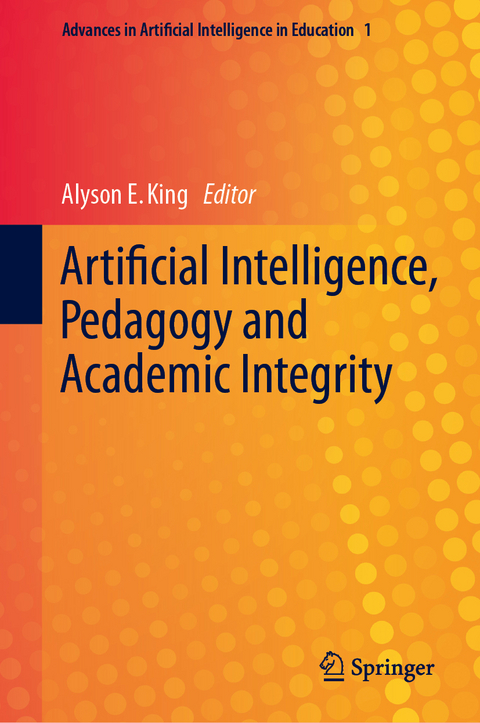
Artificial Intelligence, Pedagogy and Academic Integrity
Springer International Publishing (Verlag)
978-3-031-92533-7 (ISBN)
This book addresses the implications of artificial intelligence for teaching, learning and academic integrity in higher education. It explores policies about the use of Generative Artificial Intelligence (GenAI), describes how to teach writing in the era of GenAI, and how instructors can design courses and assessments that prevent plagiarism while building the necessary skills for critical thinking and writing. Together, the chapters include research results, case studies, teaching methodologies, course design ideas, analysis of power and gatekeeping, and best practices related to GAI from a diverse range of researchers from English and French Canada, the United States, England, Ukraine and Croatia. The authors approach the advent and rapid spread of GenAI in higher education by examining its use from different perspectives with a particular focus on its impact on academic integrity. Taking a communication studies approach, consideration is given to the role GenAI might play disrupting power structures in universities to improve access for students who are non-traditional or English Language Learners. The book also explores how reimagining teaching methodologies can help to mitigate academic integrity violations due to misuse of GenAI and to teach students to use GenAI with integrity as a research and brainstorming tool. Students need to learn how to assess the reliability of GenAI s output as the develop the skills for research and writing. Methods of teaching writing and research skills using GenAI are explored in an effort to ensure that critical thinking skills are developed successfully. Most instructors who use writing-intensive assessments believe that essential critical thinking skills are developed via the writing process; often, ideas become concrete as one writes about them. Teaching with GenAI can provide opportunities for instructors to guide their students into a deeper analysis and critique of their research.
Dr. Alyson E. King is a researcher in the field of Higher Education, with a focus on the experiences of undergraduate students. She is an Professor at Ontario Tech University in Canada. As the Principal Investigator on a SSHRC Partnership Development grant called Diversities of resilience: understanding the strategies for success used by underrepresented students in Canadian universities , she explored the success strategies of historically underrepresented university students and the barriers to education that they face. She has been a co-investigator on several related projects, including a SSHRC Insight Grant about Supported Education programs for adults living with mental illness. Dr. King is a co-investigator on the International Partnership on University Plagiarism Prevention funded by a SSHRC Partnership Grant.
Introduction.- Part I: The Technology of Generative Artificial Intelligence.- 1. How Large Language Models Work Or: How I Learned to Stop Worrying and Love ChatGPT Patrick Juola.- 2. The Future of Text-Matching Software: From Detecting Artificial Intelligence to Preventing Plagiarism Catherine E. Déri.- 3. Releasing Something Dangerous into the Wild : A Media Ecological Perspective on the GenAI - Academic Integrity Nexus Felix Odartey-Wellington and Sarah MacRae.- Part II: Pedagogy, GenAI, and Academic Integrity.- 4. University instructors reactions and adjustments to artificial intelligence, one year after the release of ChatGPT Martine Peters and Catherine E. Déri.- 5. Teaching writing in the time of ChatGPT: Rethinking what counts as learning Alyson King and Pariss Garramone.- 6. Surveillance and Guidance: an Academic Integrity Crossway for Humans Using Generative AI Gabriel Dumouchel and Martine Peters.-
| Erscheinungsdatum | 04.07.2025 |
|---|---|
| Reihe/Serie | Advances in Artificial Intelligence in Education |
| Zusatzinfo | XIII, 168 p. 24 illus., 20 illus. in color. |
| Verlagsort | Cham |
| Sprache | englisch |
| Maße | 155 x 235 mm |
| Themenwelt | Schulbuch / Wörterbuch ► Unterrichtsvorbereitung ► Unterrichts-Handreichungen |
| Sozialwissenschaften ► Pädagogik ► Schulpädagogik / Grundschule | |
| Schlagworte | Academic integrity-compliant regulations on the use of GAI • Academic integrity nexus from a media ecological standpoint • Andragogy and artificial intelligence • Conversational agents into digital collaborative writing tools • Evolution of text-matching software • GAI-related misconducts in post-secondary education • How to integrate GAI into courses • Pedagogy and artificial intelligence • Text-matching software and ChatGPT • The use of AI in higher education in Croatia • Violations of academic integrity in higher education • Writing with integrity with the help of AI (GAI) |
| ISBN-10 | 3-031-92533-5 / 3031925335 |
| ISBN-13 | 978-3-031-92533-7 / 9783031925337 |
| Zustand | Neuware |
| Informationen gemäß Produktsicherheitsverordnung (GPSR) | |
| Haben Sie eine Frage zum Produkt? |
aus dem Bereich