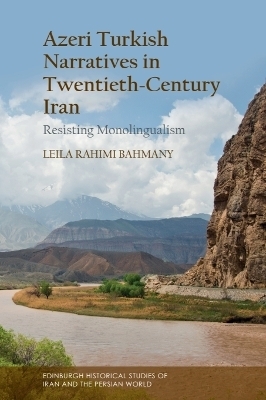
Azeri Turkish Narratives in Twentieth-Century Iran
Edinburgh University Press (Verlag)
978-1-3995-5083-3 (ISBN)
Modern Azeri Turkish prose narratives emerged towards the end of the Second World War, a period marked by the rise of multiple hostile ideological trends – including Aryanism, centralism, nationalism and archaism – all seeking to eradicate the Azeri Turkish language. Azeri Turkish was framed as a linguistic threat to be eliminated as monolingualism, seen as a prerequisite for a unified nation-state, became one of the main state projects of the Pahlavis in their attempt to create a homogenised, Persianised Aryan nation. Yet, despite a century of systematic Persianisation, literature in Azeri Turkish not only endured but continues to thrive in Iran to this day.
This book introduces short stories, novels and memoirs in Azeri Turkish from the 1940s to the end of the twentieth century, situating them within the historical and political events of the time, from the rise of the Azerbaijan People’s Government to the Iranian Revolution and beyond. It analyses the author's engagement with the questions of forced monolingualism, institutionalised assimilation policies and centre–periphery relations, revealing the dissident nature of this minority literature. It shows how the persistent marginalisation of Azeri Turkish literature, along with the constant revisitation of the region’s dark historical periods, has shaped much of this literature as trauma narratives. Finally, it advocates for vitalising Iranian literary studies by embracing linguistic and cultural diversity.
Leila Rahimi Bahmany is a Guest Professor at Ludwig Maximilian University of Munich. She earned her doctorate from the Free University of Berlin, specialising in modern literature of Iran and comparative literature. Her first book, Mirrors of Entrapment and Emancipation: Forugh Farrokhzad and Sylvia Plath (Leiden University Press, 2015) received the Latfifeh Yarshater Award.
Note on Transliteration, Dates and Translation
Acknowledgements
Introduction: The Politics of Writing in Azeri Turkish and Early Influences
Nation and Monolingualism in Iran
The Emergence of Modern 'Small Literature' in Agitated Azerbaijan (1941–46)
The Newspaper Aẕərbaycan (1945–46) and Its Main Contributor: Fətḥi Xoşginabi
The Wooden Language of the Fictionalised Propaganda: Major Contributors to Aẕərbaycan (1945–46)
Tehran, the Centre of Tyranny as Reflected in Aẕərbaycan (1945–46)
Writing Against Oblivion: Folktales and Memoirs (1947–79)
The Revolution, the Pledge of Liberation and the Literature of Exile (1979–95)
When Truths Are Spoken: Oppression beyond Azerbaijan (1993–2000)
Resilience through Language and History: Stories from Ardabil (1998–2000)
Charting Narratives: Towards Future Perspectives
Bibliography
Index
| Erscheinungsdatum | 12.09.2025 |
|---|---|
| Reihe/Serie | Edinburgh Historical Studies of Iran and the Persian World |
| Verlagsort | Edinburgh |
| Sprache | englisch |
| Maße | 156 x 234 mm |
| Themenwelt | Schulbuch / Wörterbuch ► Wörterbuch / Fremdsprachen |
| Geschichte ► Allgemeine Geschichte ► Neuzeit (bis 1918) | |
| Geisteswissenschaften ► Geschichte ► Regional- / Ländergeschichte | |
| Geisteswissenschaften ► Sprach- / Literaturwissenschaft ► Anglistik / Amerikanistik | |
| Geisteswissenschaften ► Sprach- / Literaturwissenschaft ► Literaturwissenschaft | |
| Geisteswissenschaften ► Sprach- / Literaturwissenschaft ► Sprachwissenschaft | |
| ISBN-10 | 1-3995-5083-7 / 1399550837 |
| ISBN-13 | 978-1-3995-5083-3 / 9781399550833 |
| Zustand | Neuware |
| Informationen gemäß Produktsicherheitsverordnung (GPSR) | |
| Haben Sie eine Frage zum Produkt? |
aus dem Bereich