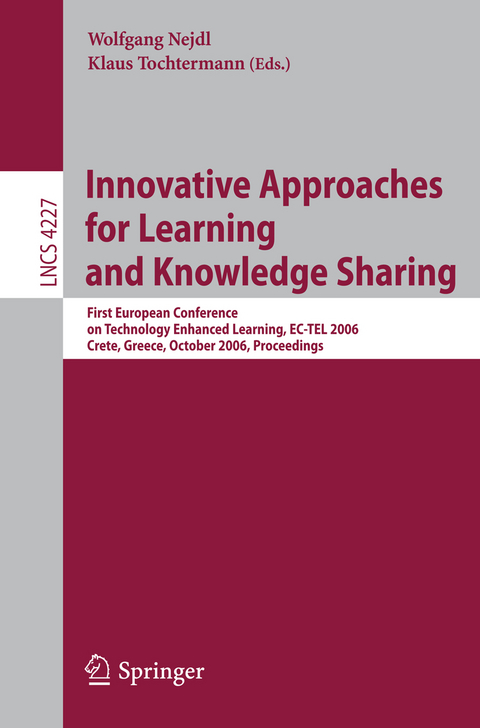
Innovative Approaches for Learning and Knowledge Sharing
Springer Berlin (Verlag)
978-3-540-45777-0 (ISBN)
Klaus Tochtermann lehrt an der TU Graz und leitet das Institut für Vernetzte Medien bei JOANNEUM RESEARCH in Graz.
Keynotes.- From Clicks to Touches: Enabling Face-to-Face Shared Interface.- Innovating eLearning and Mobile Learning Technologies for Europe's Future Educational Challenges, Theory and Case Studies.- Full Papers.- Considering Human Memory Aspects for Adaptation and Its Realization in AHA!.- Creating and Delivering Adaptive Courses with AHA!.- Awareness and Collaboration in the iHelp Courses Content Management System.- Interoperability for Peer-to-Peer Networks: Opening P2P to the Rest of the World.- Promoting Teachers' Collaborative Re-use of Educational Materials.- A Formal Model of Learning Object Metadata.- Automatic and Manual Annotation Using Flexible Schemas for Adaptation on the Semantic Desktop.- eMapps.com: Games and Mobile Technology in Learning.- Bayesian Student Models Based on Item to Item Knowledge Structures.- Towards Community-Driven Development of Educational Materials: The Edukalibre Approach.- Is There a Way to e-Bologna? Cross-National Collaborative Activities in University Courses.- Ontological Support for a Theory-Eclectic Approach to Instructional and Learning Design.- Explicit Referencing in Learning Chats: Needs and Acceptance.- Integrating Learning Object Repositories Using a Mediator Architecture.- Guided and Interactive Factory Tours for Schools.- Adult Learners and ICT: An Intervention Study in the UK.- Community Aware Content Adaptation for Mobile Technology Enhanced Learning.- Pattern-Based Cross Media Social Network Analysis for Technology Enhanced Learning in Europe.- User Effect in Evaluating Personalized Information Retrieval Systems.- Data and Application Integration in Learning Content Management Systems: A Web Services Approach.- Using Virtual Learners' Behaviours to Help the Development of Educational Business Games.- AMechanism to Support Context-Based Adaptation in M-Learning.- Production and Deployment of Educational Videogames as Assessable Learning Objects.- Two Technology-Enhanced Courses Aimed at Developing Interpersonal Attitudes and Soft Skills in Project Management.- Developing Collaborative Virtual Learning Community for the Korean Community Health Practitioners.- Simulation as Efficient Support to Learning Business Dynamics.- MD2 Method: The Didactic Materials Creation from a Model Based Perspective.- DynMap+: A Concept Mapping Approach to Visualize Group Student Models.- Knowledge Management in Schools - From Electronic Schoolbag to Social Software.- Satellite-Enabled Interactive Education: Scenarios and Systems Architectures.- Motivational Effects Within Scientific Experimentation Scenarios.- Getting to Know Your Student in Distance Learning Contexts.- Short Papers.- The L2C Project: Learning to Collaborate Through Advanced SmallWorld Simulations.- Integrating Instructional Material and Teaching Experience into a Teachers' Collaborative Learning Environment.- A Neural Approach for Modeling the Inference of Awareness in Computer-Supported Collaboration.- An Exploratory Study of the Relationship Between Learning Styles and Cognitive Traits.- Automatic Semantic Activity Monitoring of Distance Learners Guided by Pedagogical Scenarios.- Electronic Portfolios as a Means for Initializing Learner Models for Adaptive Tutorials.- New Media for Teaching Applied Cryptography and Network Security.- Initiating Technology-Enhanced Learning at a Public-Sector Institution in a Developing Country.- Requirements and an Architecture for a Multimedia Content Re-purposing Framework.- Developing a Reference Model to Describe the Personal Learning Environment.- Semantic Modelling ofLearning Objects and Instruction.- Context-Aware Workplace Learning Support: Concept, Experiences, and Remaining Challenges.- A Context-Model for Supporting Work-Integrated Learning.- Posters.- Made-to-Measure Learning Materials.- The Problem of LD Execution and the Need for an IMS LD Level B Ontology.- Taking Teaching Context into Account for Semantic Annotation Patterns.- Designing a Constructionistic Framework for T-L
| Erscheint lt. Verlag | 22.9.2006 |
|---|---|
| Reihe/Serie | Information Systems and Applications, incl. Internet/Web, and HCI | Lecture Notes in Computer Science |
| Zusatzinfo | XVIII, 726 p. |
| Verlagsort | Berlin |
| Sprache | englisch |
| Maße | 155 x 235 mm |
| Gewicht | 1080 g |
| Themenwelt | Schulbuch / Wörterbuch ► Unterrichtsvorbereitung ► Unterrichts-Handreichungen |
| Mathematik / Informatik ► Informatik | |
| Schlagworte | Adaptive Systems • adaptive tutorials • Assistive Technology • Blended Learning • computer assisted learning • Computer-Assisted Learning • computer supported collarborative work • Distance Learning • Educational technology • E-Learning • Human-Computer interaction • intelligent tuto • Intelligent Tutoring Systems • Interface Agents • knowledge management • learning • learning content management system • Mobile Learning • Multimedia • Organizational Learning • SCORM • semantic modeling • semantic web • Social Software • Teaching Strategies • User Interfaces • Web-based Training • workplace learning |
| ISBN-10 | 3-540-45777-1 / 3540457771 |
| ISBN-13 | 978-3-540-45777-0 / 9783540457770 |
| Zustand | Neuware |
| Informationen gemäß Produktsicherheitsverordnung (GPSR) | |
| Haben Sie eine Frage zum Produkt? |
aus dem Bereich