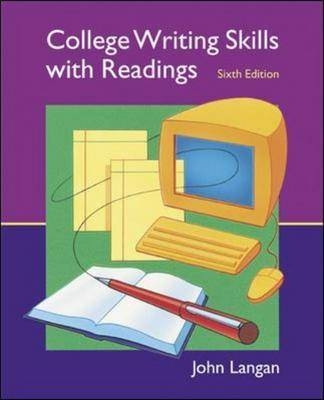
College Writing Skills with Readings
McGraw Hill Higher Education (Verlag)
978-0-07-299627-2 (ISBN)
- Titel ist leider vergriffen;
keine Neuauflage - Artikel merken
Highly regarded and used by countless students, this effective rhetoric/handbook/reader is ideal for writing courses that focus on the essay. The sixth edition features Langan's renowned clear writing style and a wide range of writing assignments and activities that reinforce the four essentials of good writing: unity, support, coherence, and sentence skills. "College Writing Skills with Readings" comes packaged with a free student CD-ROM, a free registration card for access to the Online Learning Center, and a free user's guide to help students gain the maximum benefit from the text and electronic materials. "I long ago lost count of the number of instructors who have told me that the four bases really work. When you explain the four bases to students and make the bases really clear with a lot of activities, students get it." - John Langan.
John Langan has taught reading and writing at Atlantic Community College near Atlantic City, New Jersey, for over twenty years. The author of a popular series of college textbook on both reading and writing, he enjoys the challenge of developinging materials that teach skills in an especially clear and lively way. Before teaching, he earned advanced degrees in writing at Rutgers University and in reading at Glassboro State Collee. He also spent a year writing fiction.
PART ONE: ESSAY WRITING(*Indicates New Reading)CHAPTER 1: An Introduction to WritingPoint and SupportStructure of the Traditional EssayBenefits of Writing the Traditional EssayWriting as a SkillWriting as a Process of DiscoveryWriting as a Way to Communicate with Others Keeping a JournalUsing a ComputerReview ActivitiesUsing This TextCHAPTER 2: The Writing ProcessPrewritingWriting a First DraftRevisionEditingReview ActivitiesCHAPTER 3: The First and Second Steps in Essay WritingStep 1: Begin with a Point, or ThesisStep 2: Support the Thesis with Specific EvidencePractice in Advancing and Supporting a ThesisCHAPTER 4: The Third Step in Essay WritingStep3: Organize and Connect the Specific EvidenceIntroductions, Conclusions, and TitlesPractice in Organizing and Connecting Specific EvidenceCHAPTER 5: The Fourth Step in Essay WritingRevising SentencesEditing SentencesPractice in Revising SentencesCHAPTER 6: Four Bases for Revising EssaysBase 1: Unity Base 2: SupportBase 3: CoherenceBase 4: Sentence SkillsPractice in Using the Four BasesPART TWO: PATTERNS OF ESSAY DEVELOPMENTCHAPTER 7: Introduction To Essay DevelopmentCHAPTER 8: DescriptionReading: Lou's Place, Beth JohnsonCHAPTER 9: NarrationReading: The Yellow Ribbon, Pete HamillCHAPTER 10: ExamplesReading: Dad, Andrew H. MalcolmCHAPTER 11: ProcessReading: How to Do Well On A Job Interview, Glenda DavisCHAPTER 12: Cause and Effect*Reading: Taming the Anger Monster, Anne Davidson CHAPTER 13: Comparison and Contrast*Reading: Born to Be Different?, Camille LewisCHAPTER 14: DefinitionReading: Television Addiction, Marie WinnCHAPTER 15: Division and ClassificationReading: Wait Divisions, Tom BodettCHAPTER 16: ArgumentationReading: Ban The Things. Ban Them All., Molly IvinsPART THREE: SPECIAL SKILLSCHAPTER 17: Taking Essay ExamsCHAPTER 18: Writing a SummaryCHAPTER 19: Writing a ReportCHAPTER 20: Writing a Resume and Job Application LetterCHAPTER 21: Using the Library and the InternetCHAPTER 22: Writing a Research PaperPART FOUR: HANDBOOK OF SENTENCE SKILLSGRAMMARCHAPTER 23: Subjects and VerbsCHAPTER 24: FragmentsCHAPTER 25: Run-onsCHAPTER 26: Regular and Irregular VerbsCHAPTER 27: Subject-Verb AgreementCHAPTER 28: Additional Information about VerbsCHAPTER 29: Pronoun Agreement and ReferenceCHAPTER 30: Pronoun TypesCHAPTER 31: Adjectives and AdverbsCHAPTER 32: Misplaced ModifiersCHAPTER 33: Dangling ModifiersMECHANICSCHAPTER 34: Manuscript FormCHAPTER 35: Capital LettersCHAPTER 36: Numbers and AbbreviationsPUNCTUATIONCHAPTER 37: ApostropheCHAPTER 38: Quotation MarksCHAPTER 39: CommaCHAPTER 40: Other Punctuation MarksWORD USECHAPTER 41: Spelling ImprovementCHAPTER 42: Commonly Confused WordsCHAPTER 43: Effective Word ChoiceCHAPTER 44: Editing TestsCHAPTER 45: ESL PointersPART FIVE: READINGS FOR WRITINGIntroduction to The ReadingsLooking Inward*Three Passions, Bertrand Russell Thank You, Alex HaleyShame, Dick GregoryI Became Her Target, Roger WilkinsSmash Thy Neighbor, John McMurtryA Hanging, George OrwellIn My Day, Russell BakerObserving Others*A Legendary Moment, Haven Kimmel*The Professor Is a Dropout, Beth JohnsonThe Monster, Deems TaylorWhy Are Students Turned Off?, Casey BanasPropaganda Techniques in Today's Advertising, Ann McClintockConfronting ProblemsBombs Bursting in Air, Beth JohnsonHere's To Your Health, Joan Dunayer How to Make It In College, Now That You're Here, Brian O'KeeneyCollege Lectures: Is Anybody Listening?, David DanielsSeven Ways to Keep The Peace at Home, Daniel A. SugarmanIn Praise of the F Word, Mary SherryIs Sex all That Matters?, Joyce GarityREADING COMPREHENSION CHART
| Erscheint lt. Verlag | 9.7.2004 |
|---|---|
| Verlagsort | London |
| Sprache | englisch |
| Maße | 188 x 231 mm |
| Gewicht | 1224 g |
| Themenwelt | Schulbuch / Wörterbuch |
| ISBN-10 | 0-07-299627-7 / 0072996277 |
| ISBN-13 | 978-0-07-299627-2 / 9780072996272 |
| Zustand | Neuware |
| Informationen gemäß Produktsicherheitsverordnung (GPSR) | |
| Haben Sie eine Frage zum Produkt? |
aus dem Bereich