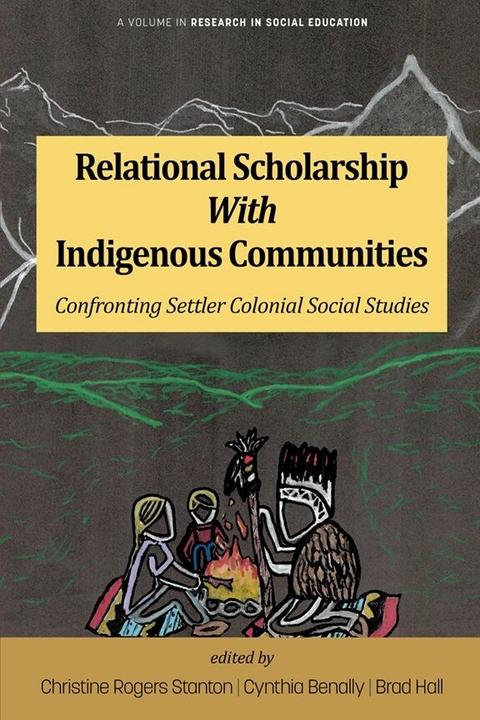
All education and educational scholarship occurs on Indigenous Lands. Despite this reality, U.S. social studies education and scholarship has reinforced settler colonialism through curricula, teacher education, professional development, policy research, and more. To confront settler colonial social studies and transform the field, educators and scholars must engage relational approaches, prioritize community and student expertise, and commit to action that recognizes Indigenous Ways of Knowing.This book brings together Indigenous and non-Indigenous scholars, practitioners, and community partners from across the U.S. to share experiences of, stories about, and hopes for anti-colonial social studies. By sharing these examples, the book also provides methodological guidance for researchers, teacher educators, curriculum developers, and policymakers looking to learn about scholarly processes and partnerships with Indigenous communities. In addition to individual chapters, contributors engaged in conversations and collaboration between chapters and aboutthe book as a whole.Chapter co-authors and thought partners dialogued about the following questions: What is relational research, and how can it help confront settler colonial content, processes, and praxis within social studies education? How has social studies education and research (mis)represented and (mis)applied Indigenous Ways of Knowing? How can a re-envisioning of social studies educational research be more intentionally participatory and relational to improve social studies teaching and learning, especially for and with Indigenous communities and youth?ENDORSEMENT:"e;Through relational scholarship, the co-editors and contributing scholars bring forward an essential call to action that centers Indigenous identities, histories, relations to land, and sovereignty. Embodied in Indigenous research and anti-colonial research methods, the collective work uniquely privileges Indigenous Peoples at the core of transforming the field of social studies for Indigenous futurities. Threaded throughout this book, are critical questions we should all be asking ourselves as we engage in advocacy, agency, and resurgence with and for Indigenous Peoples."e; - Jeremy Garcia (Hopi/Tewa), University of Arizona
| Erscheint lt. Verlag | 1.8.2024 |
|---|---|
| Sprache | englisch |
| Themenwelt | Schulbuch / Wörterbuch ► Lexikon / Chroniken |
| Geisteswissenschaften ► Geschichte | |
| Sozialwissenschaften ► Ethnologie | |
| Sozialwissenschaften ► Pädagogik | |
| Sozialwissenschaften ► Soziologie | |
| ISBN-13 | 979-8-88730-664-3 / 9798887306643 |
| Informationen gemäß Produktsicherheitsverordnung (GPSR) | |
| Haben Sie eine Frage zum Produkt? |
 PDF (Adobe DRM)
Kopierschutz: Adobe-DRM
Adobe-DRM ist ein Kopierschutz, der das eBook vor Mißbrauch schützen soll. Dabei wird das eBook bereits beim Download auf Ihre persönliche Adobe-ID autorisiert. Lesen können Sie das eBook dann nur auf den Geräten, welche ebenfalls auf Ihre Adobe-ID registriert sind.
Details zum Adobe-DRM
Dateiformat: PDF (Portable Document Format)
Mit einem festen Seitenlayout eignet sich die PDF besonders für Fachbücher mit Spalten, Tabellen und Abbildungen. Eine PDF kann auf fast allen Geräten angezeigt werden, ist aber für kleine Displays (Smartphone, eReader) nur eingeschränkt geeignet.
Systemvoraussetzungen:
PC/Mac: Mit einem PC oder Mac können Sie dieses eBook lesen. Sie benötigen eine
eReader: Dieses eBook kann mit (fast) allen eBook-Readern gelesen werden. Mit dem amazon-Kindle ist es aber nicht kompatibel.
Smartphone/Tablet: Egal ob Apple oder Android, dieses eBook können Sie lesen. Sie benötigen eine
Geräteliste und zusätzliche Hinweise
Buying eBooks from abroad
For tax law reasons we can sell eBooks just within Germany and Switzerland. Regrettably we cannot fulfill eBook-orders from other countries.
 EPUB (Adobe DRM)
Kopierschutz: Adobe-DRM
Adobe-DRM ist ein Kopierschutz, der das eBook vor Mißbrauch schützen soll. Dabei wird das eBook bereits beim Download auf Ihre persönliche Adobe-ID autorisiert. Lesen können Sie das eBook dann nur auf den Geräten, welche ebenfalls auf Ihre Adobe-ID registriert sind.
Details zum Adobe-DRM
Dateiformat: EPUB (Electronic Publication)
EPUB ist ein offener Standard für eBooks und eignet sich besonders zur Darstellung von Belletristik und Sachbüchern. Der Fließtext wird dynamisch an die Display- und Schriftgröße angepasst. Auch für mobile Lesegeräte ist EPUB daher gut geeignet.
Systemvoraussetzungen:
PC/Mac: Mit einem PC oder Mac können Sie dieses eBook lesen. Sie benötigen eine
eReader: Dieses eBook kann mit (fast) allen eBook-Readern gelesen werden. Mit dem amazon-Kindle ist es aber nicht kompatibel.
Smartphone/Tablet: Egal ob Apple oder Android, dieses eBook können Sie lesen. Sie benötigen eine
Geräteliste und zusätzliche Hinweise
Buying eBooks from abroad
For tax law reasons we can sell eBooks just within Germany and Switzerland. Regrettably we cannot fulfill eBook-orders from other countries.
aus dem Bereich